


Prostaglandin E3 metabolism and cancer
- PMID: 24657656
- PMCID: PMC4366418
- DOI: 10.1016/j.canlet.2014.03.010
Prostaglandin E3 metabolism and cancer
Abstract
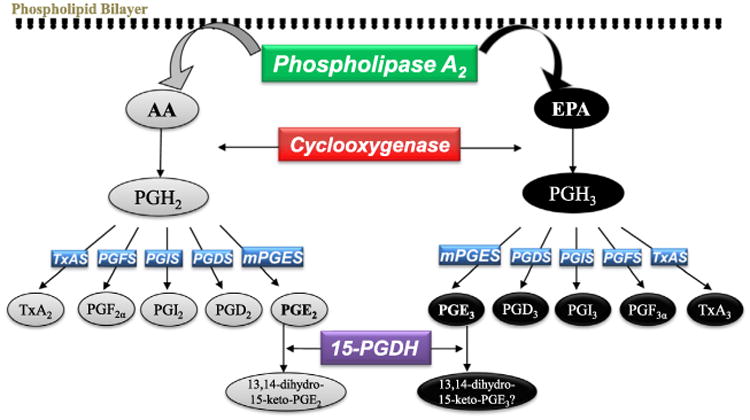
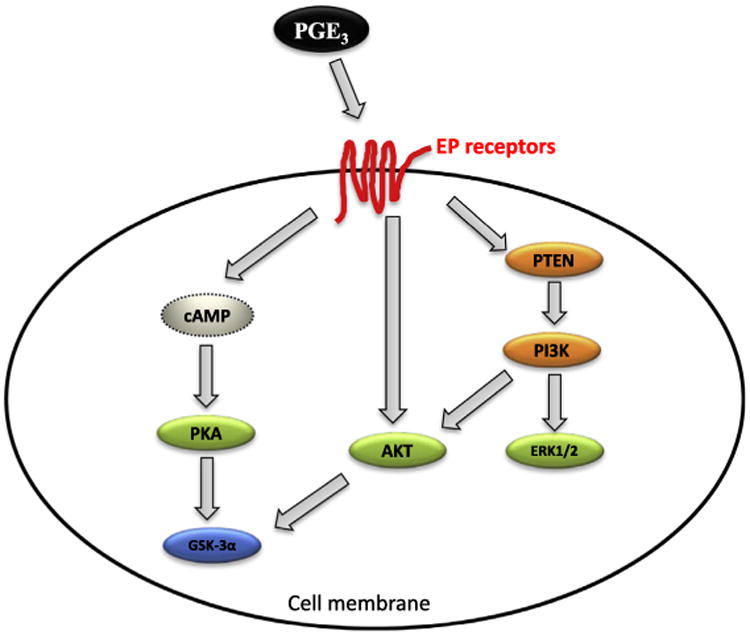
The anticancer activity of n-3 fatty acids, especially those derived from fish, such as eicosapentaenoic acid (EPA) and docosahexaenoic acid) (DHA), has been studied for centuries. While there is a growing body of evidence that EPA and DHA may influence cancer initiation and development through targeting multiple events of tumor development, the underlying mechanisms responsible for these activities are still not fully understood. A number of studies have suggested that the anticancer activities of EPA and DHA are associated with their effects on eicosanoid metabolism by which they inhibit prostaglandin E2 (PGE2) production. In contrast to DHA, EPA can function as a substrate for cyclooxygenases (COXs) to synthesize unique 3-series prostaglandin compounds, especially PGE3. With advance technology in mass spectrometry, there is renewed interest in studying the role of PGE3 in EPA elicited anti-proliferative activity in various cancers, with some promising results. Here, we summarize the regulation of PGE3 synthesis in cancer cells and its role in EPA elicited anticancer activity. The development of PGE3 and its metabolites as potential biomarkers for future clinical evaluation of EPA and fish oil in cancer care is discussed.
Keywords: Cancer cells; Metabolism; PGE(3); Tumor tissues; n-3 Fatty acids.
Copyright © 2014 Elsevier Ireland Ltd. All rights reserved.
Conflict of interest statement
Figures
References
-
- Rothwell PM, Wilson M, Elwin CE, Norrving B, Algra A, Warlow CP, Meade TW. Long-term effect of aspirin on colorectal cancer incidence and mortality: 20-year follow-up of five randomised trials. Lancet. 2010;376:1741–1750. - PubMed
-
- Chan AT, Ogino S, Fuchs CS. Aspirin and the risk of colorectal cancer in relation to the expression of COX-2. New Engl J Med. 2007;356:2131–2142. - PubMed
-
- McCarty MF. Minimizing the cancer-promotional activity of cox-2 as a central strategy in cancer prevention. Med Hypotheses. 2012;78:45–57. - PubMed
Publication types
MeSH terms
Substances
Grants and funding
LinkOut - more resources
Full Text Sources
Other Literature Sources
Molecular Biology Databases
Research Materials
