


Risk factors of pre-eclampsia/eclampsia and its adverse outcomes in low- and middle-income countries: a WHO secondary analysis
- PMID: 24657964
- PMCID: PMC3962376
- DOI: 10.1371/journal.pone.0091198
Risk factors of pre-eclampsia/eclampsia and its adverse outcomes in low- and middle-income countries: a WHO secondary analysis
Abstract
Background: Pre-eclampsia has an immense adverse impact on maternal and perinatal health especially in low- and middle-income settings. We aimed to estimate the associations between pre-eclampsia/eclampsia and its risk factors, and adverse maternal and perinatal outcomes.
Methods: We performed a secondary analysis of the WHO Global Survey on Maternal and Perinatal Health. The survey was a multi-country, facility-based cross-sectional study. A global sample consisting of 24 countries from three regions and 373 health facilities was obtained via a stratified multi-stage cluster sampling design. Maternal and offspring data were extracted from records using standardized questionnaires. Multi-level logistic regression modelling was conducted with random effects at the individual, facility and country levels.
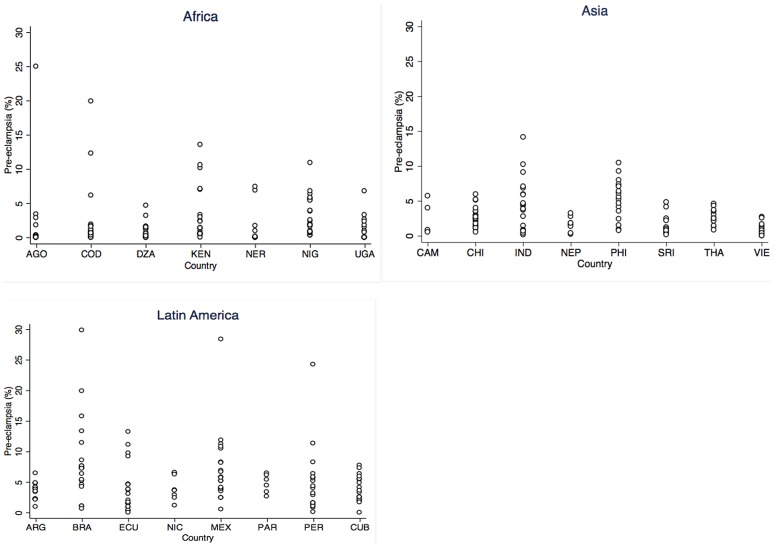
Results: Data for 276,388 mothers and their infants was analysed. The prevalence of pre-eclampsia/eclampsia in the study population was 10,754 (4%). At the individual level, sociodemographic characteristics of maternal age ≥30 years and low educational attainment were significantly associated with higher risk of pre-eclampsia/eclampsia. As for clinical and obstetric variables, high body mass index (BMI), nulliparity (AOR: 2.04; 95%CI 1.92-2.16), absence of antenatal care (AOR: 1.41; 95%CI 1.26-1.57), chronic hypertension (AOR: 7.75; 95%CI 6.77-8.87), gestational diabetes (AOR: 2.00; 95%CI 1.63-2.45), cardiac or renal disease (AOR: 2.38; 95%CI 1.86-3.05), pyelonephritis or urinary tract infection (AOR: 1.13; 95%CI 1.03-1.24) and severe anemia (AOR: 2.98; 95%CI 2.47-3.61) were found to be significant risk factors, while having >8 visits of antenatal care was protective (AOR: 0.90; 95%CI 0.83-0.98). Pre-eclampsia/eclampsia was found to be a significant risk factor for maternal death, perinatal death, preterm birth and low birthweight.
Conclusion: Chronic hypertension, obesity and severe anemia were the highest risk factors of preeclampsia/eclampsia. Implementation of effective interventions prioritizing risk factors, provision of quality health services during pre-pregnancy and during pregnancy for joint efforts in the areas of maternal health are recommended.
Conflict of interest statement
Figures
References
-
- Lozano R, Wang H, Foreman KJ, Rajaratnam JK, Naghavi M, et al. (2011) Progress towards Millennium Development Goals 4 and 5 on maternal and child mortality: an updated systematic analysis. Lancet 378: 1139–1165. - PubMed
-
- Khan KS, Wojdyla D, Say L, Gulmezoglu AM, Van Look PF (2006) WHO analysis of causes of maternal death: a systematic review. Lancet 367: 1066–1074. - PubMed
-
- Ahman E, Zupan J (2007) Neonatal and perinatal mortality: country, regional and global estimates 2004. OMS 9241596147 9241596147.
-
- World Health Organization, UNICEF (2004) Low birthweight: country, regional and global estimates. Geneva.
Publication types
MeSH terms
Grants and funding
LinkOut - more resources
Full Text Sources
Other Literature Sources
Medical
Research Materials
