Review
. 2014 Jun;99(6):984-96.
doi: 10.3324/haematol.2013.100552. Epub 2014 Mar 21.

The clinical relevance and management of monoclonal gammopathy of undetermined significance and related disorders: recommendations from the European Myeloma Network

Affiliations
Review

The clinical relevance and management of monoclonal gammopathy of undetermined significance and related disorders: recommendations from the European Myeloma Network

Niels W C J van de Donk et al. Haematologica. 2014 Jun.

Abstract

Monoclonal gammopathy of undetermined significance is one of the most common pre-malignant disorders. IgG and IgA monoclonal gammopathy of undetermined significance are precursor conditions of multiple myeloma; light-chain monoclonal gammopathy of undetermined significance of light-chain multiple myeloma; and IgM monoclonal gammopathy of undetermined significance of Waldenström's macroglobulinemia and other lymphoproliferative disorders. Clonal burden, as determined by bone marrow plasma cell percentage or M-protein level, as well as biological characteristics, including heavy chain isotype and light chain production, are helpful in predicting risk of progression of monoclonal gammopathy of undetermined significance to symptomatic disease. Furthermore, alterations in the bone marrow microenvironment of monoclonal gammopathy of undetermined significance patients result in an increased risk of venous and arterial thrombosis, infections, osteoporosis, and bone fractures. In addition, the small clone may occasionally be responsible for severe organ damage through the production of a monoclonal protein that has autoantibody activity or deposits in tissues. These disorders are rare and often require therapy directed at eradication of the underlying plasma cell or lymphoplasmacytic clone. In this review, we provide an overview of the clinical relevance of monoclonal gammopathy of undetermined significance. We also give general recommendations of how to diagnose and manage patients with monoclonal gammopathy of undetermined significance.


Figures

Figure 1.
Figure 1.
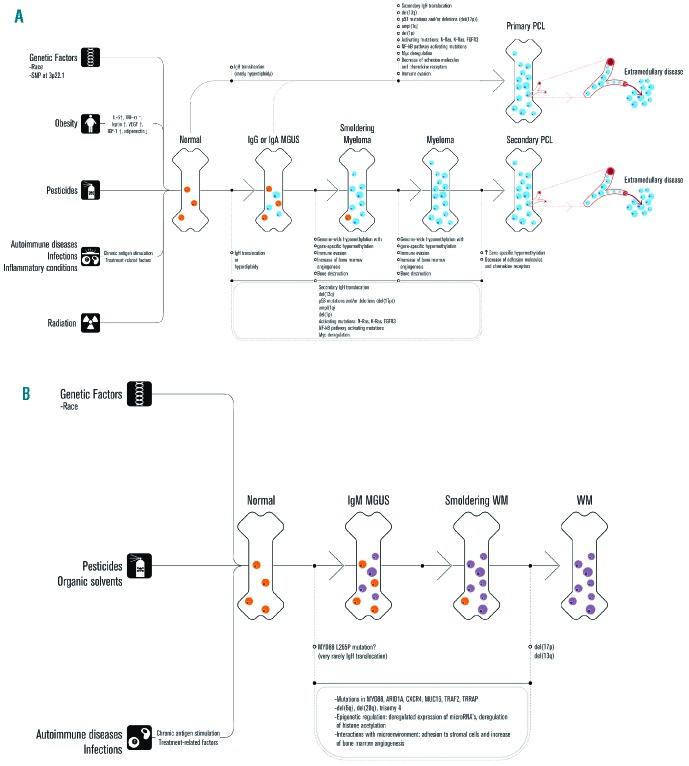
Model for the mechanisms that contribute to the development and progression of MGUS. Obesity, exposure to pesticides, radiation exposure, and personal history of autoimmune diseases, inflammatory conditions and infections are associated with an increased risk of MGUS. In addition, there is a genetic predisposition to MGUS. (A) Primary immunoglobulin heavy chain (IgH) translocations with 5 recurrent chromosomal partners (4p16, 6p21, 11q13, 16q23, 20q11) and hyperdiploidy are early events and associated with the initiation of limited clonal plasma cell proliferation in non-IgM MGUS. Acquisition of secondary chromosomal abnormalities (such as deletions of (parts of) chromosomes or secondary chromosomal translocations) and mutations involving individual genes results in the stepwise progression from MGUS to newly diagnosed symptomatic MM, and finally aggressive forms of MM such as sPCL or extramedullary MM. During this process there is a progressive replacement of normal/polyclonal plasma cells (orange) by clonal plasma cells (blue). Progression of the plasma cell disorder is also accompanied by altered interactions of the tumor cells with various components of their microenvironment such as osteoclasts, endothelial cells, and cells of the immune system. Recent evidence suggests the presence of intraclonal heterogeneity in MGUS, adding a further level of genetic complexity to the initiation and progression of myeloma. (B) Progression from IgM MGUS to symptomatic Waldenström’s macroglobulinemia also involves a series of genetic changes (activating mutations, inactivating mutations, and chromosomal abnormalities) and altered interactions with the microenvironment. This results in a progressive decrease in normal B cells and normal plasma cells (orange) and increase in clonal B cells and clonal plasma cells (purple).
Figure 2.
Figure 2.
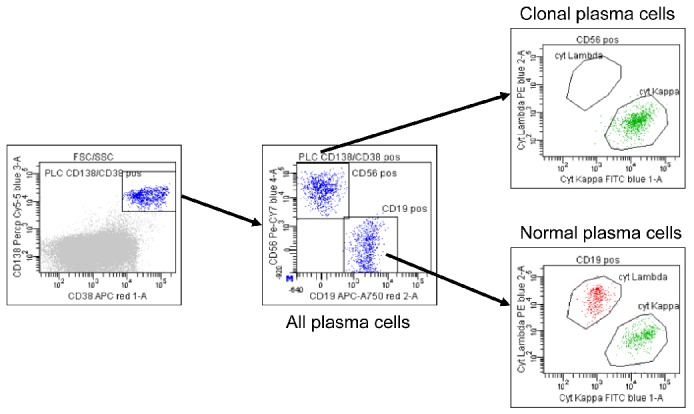
Immunophenotypic characterization of the clonal plasma cells in MGUS. In MGUS normal and malignant plasma cells coexist. The median percentage of clonal plasma cells is approx. 40–73% in MGUS, 97% in SMM, and >99% in MM. Representative dot plots from a MGUS patient show that the total percentage of CD38+ and CD138+ bone marrow plasma cells is 0.74%. Among all bone marrow plasma cells, 48% are polyclonal plasma cells (CD56 and CD19+) and 52% are clonal plasma cells (CD56+, CD19, and cytoplasmic kappa+).
Figure 3.
Figure 3.
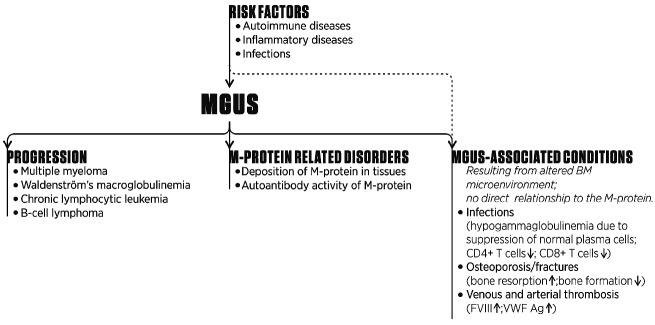
Associations between MGUS and other disorders. MGUS patients have a life-long risk of progression to MM or, to a lesser extent, other lymphoproliferative disorders. In addition, MGUS is also associated with several conditions that may partly result from an altered BM microenvironment due to the underlying plasma cell or lymphoplasmacytic clone. It cannot be fully excluded that part of the increased risk for these conditions from MGUS is due to other underlying conditions that are prevalent in persons who are tested for monoclonal gam-mopathies. Furhermore, several disorders are present or develop in MGUS patients due to deposition of the M-protein in tissues or because of autoantibody activity of the M-protein.

References

    1. Dispenzieri A, Katzmann JA, Kyle RA, Larson DR, Melton LJ, III, Colby CL, et al. Prevalence and risk of progression of light-chain monoclonal gammopathy of undetermined significance: a retrospective population-based cohort study. Lancet 2010; 375(9727):1721–8 - PMC - PubMed
    1. Eisele L, Durig J, Huttmann A, Duhrsen U, Assert R, Bokhof B, et al. Prevalence and progression of monoclonal gammopathy of undetermined significance and light-chain MGUS in Germany. Ann Hematol 2012; 91(2):243–8 - PubMed
    1. Kyle RA, Therneau TM, Rajkumar SV, Larson DR, Plevak MF, Offord JR, et al. Prevalence of monoclonal gammopathy of undetermined significance. N Engl J Med 2006;354(13):1362–9 - PubMed
    1. Kyle RA, Therneau TM, Rajkumar SV, Offord JR, Larson DR, Plevak MF, et al. A long-term study of prognosis in monoclonal gammopathy of undetermined significance. N Engl J Med 2002;346(8):564–9 - PubMed
    1. Owen RG, Treon SP, Al-Katib A, Fonseca R, Greipp PR, McMaster ML, et al. Clinicopathological definition of Waldenstrom’s macroglobulinemia: consensus panel recommendations from the Second International Workshop on Waldenstrom’s Macroglobulinemia. Semin Oncol 2003;30(2):110–5 - PubMed

MeSH terms