


Case Reports
doi: 10.1159/000357107.
Epub 2013 Dec 23.
Coxiella burnetii - Pathogenic Agent of Q (Query) Fever
Affiliations
- PMID: 24659949
- PMCID: PMC3949614
- DOI: 10.1159/000357107
Item in Clipboard
Case Reports
Coxiella burnetii - Pathogenic Agent of Q (Query) Fever
Transfus Med Hemother.
2014 Feb.
No abstract available
Figures
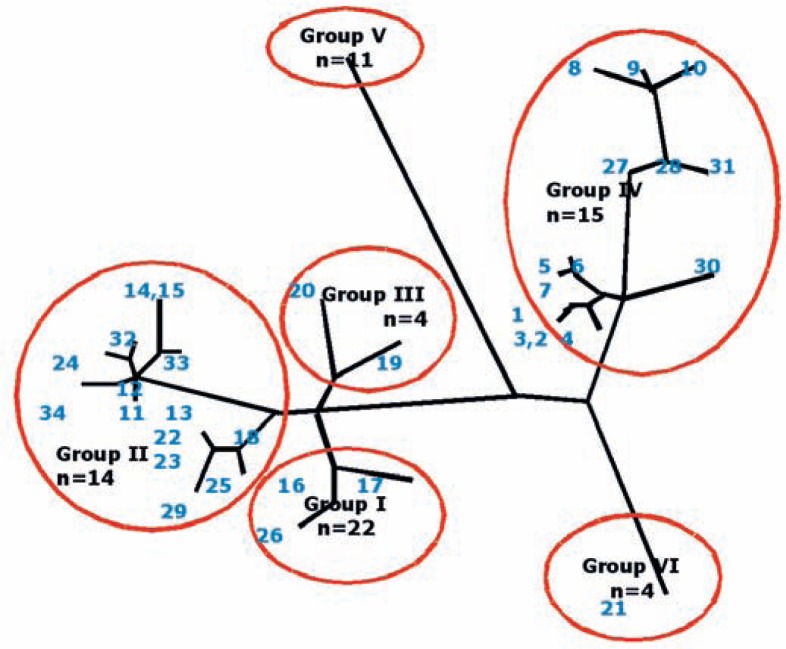
The 6 genogroups of C. burnetii and the MST genotypes assigned to these groups. Genogroup VI contains the so-called Dugway strain. The phylogenetic tree shows the close relationship of individual MST genotypes which have partly developed by convergent evolution. In this analysis, MST 14 and 15 are identical in Group II. Graphic modelled on Hornstra et al., 2011 [22] (L. Guertler).
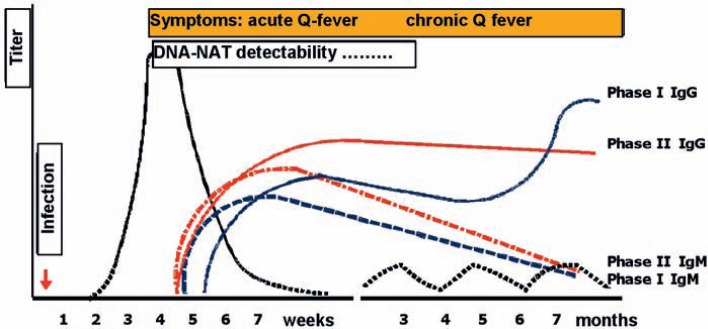
Temporal course of C. burnetii infection and serological response, detectable through Phase I and II antibodies. In the chronic course, DNA can be detected periodically years after acute infection, and antibody titers remain high. Diagram based on Van Wijk et al., 2011 [134] (L. Guertler).
References
-
- Derrick EH. ‘Q’ fever, a new fever entity: clinical features, diagnosis and laboratory investigation. Med J Aust. 1937;2:281–299. - PubMed
-
- Burnet FM, Freeman M. Experimental studies on the virus of ‘Q’ fever. Med J Aust. 1937;2:299–305.
-
- Davis G, Cox HR. A filterpassing infectious agent isolated from ticks: isolation from Dermatocentor andersoni, reaction in animals, and filtration experiments. Public Health Rep. 1938;53:2259–2267.
-
- WHO . Health Aspects of Chemical and Biological Weapons. 2nd ed. Geneva: World Health Organization; 2004.
-
- Madariaga MG, Rezai K, Trenholme GM, Weinstein RA. Q fever: a biological weapon in your backyard. Lancet Infect Dis. 2003;3:709–721. - PubMed
Publication types
LinkOut - more resources
Full Text Sources
Other Literature Sources
