


Dust events, pulmonary diseases and immune system
- PMID: 24660118
- PMCID: PMC3960758
Dust events, pulmonary diseases and immune system
Abstract
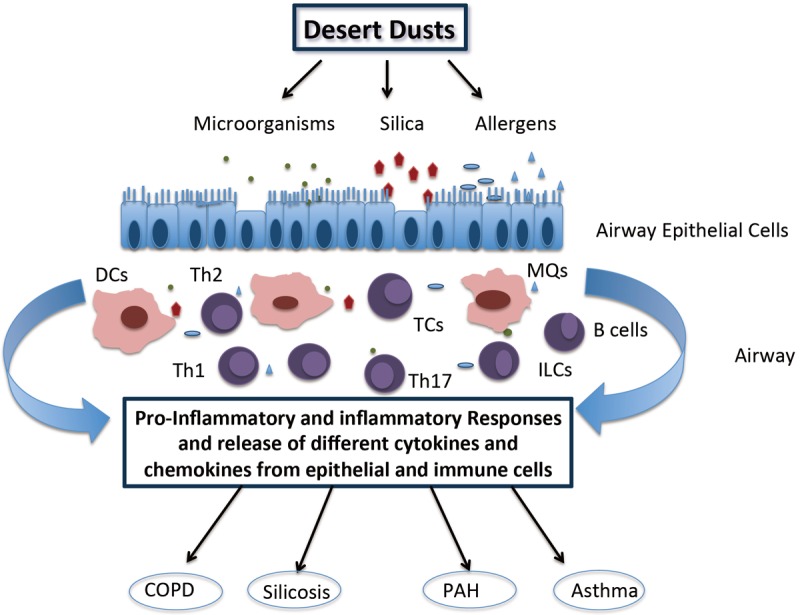
Incidences of sand storms have increased in recent years and there is evidence that these dusts can move across long distances. Sand dusts have different adverse effects on health, but one of the most important of them is pulmonary disease. After inhalation of dust, many dust particles are moved to the airways. Dust particles can be sensed by airways epithelial cells, activate macrophages, dendritic cells and innate immune cells and then initiate responses in various populations of specific immune cells such as T helper cells subsets (Th1, Th2, Th17), T cytotoxic cells and B cells. Initiation of inflammatory immune responses, activation of immune cells and releases of many cytokines, chemokines and other inflammatory molecules, have variable pathologic affects on lung in different respiratory diseases. Unfortunately control of desert dusts is more difficult than control of air pollution. For prevention and treatment of respiratory diseases that are caused by desert dusts, researchers need well-designed epidemiological studies, combined with analysis of the precise composition of sand dusts, and the precise mechanisms of the immune responses. Recognizing the exact cellular and molecular immune mechanisms would be very useful to find new approaches for treatment of desert dust associated pulmonary diseases.
Keywords: Sand dusts; T helper cells; cytokines and chemokines; pulmonary disease.
Figures
References
-
- Husar RB, Tratt DM, Schichtel BA, Falke SR, Li F, Jaffe D, Gasso S, Gill T, Laulainen NS, Lu F, Reheis MC, Chun Y, Westphal D, Holben BN, Gueymard C, McKendry I, Kuring N, Feldman GC, McClain C, Frouin RJ, Merrill J, DuBois D, Vignola F, Murayama T, Nickovic S, Wilson WE, Sassen K, Sugimoto N, Malm WC. Asian dust events of April 1998. J Geophys Res. 2001;106:18317–18330.
-
- Wang Y, Zhuang GS, Tang AH, Zhang WJ, Sun YL, Wang ZF, An ZS. The evolution of chemical components of aerosols at five monitoring sites of China during dust storms. Atmospheric Environment. 2007;41:1091–1106.
-
- Fairlie TD, Jacob DJ, Park RJ. The impact of transpacific transport of mineral dust in the United States. Atmospheric Environment. 2007;41:1251–1266.
-
- Prospero JM, Lamb PJ. African droughts and dust transport to the Caribbean: climate change implications. Science. 2003;302:1024–1027. - PubMed
-
- Prospero JM, Blades E, Naidu R, Mathison G, Thani H, Lavoie MC. Relationship between African dust carried in the Atlantic trade winds and surges in pediatric asthma attendances in the Caribbean. Int J Biometeorol. 2008;52:823–832. - PubMed
Publication types
Grants and funding
LinkOut - more resources
Full Text Sources