


Outcomes are not different for patient-matched versus nonmatched treatment in subjects with chronic recurrent low back pain: a randomized clinical trial
- PMID: 24662210
- PMCID: PMC4171247
- DOI: 10.1016/j.spinee.2014.03.024
Outcomes are not different for patient-matched versus nonmatched treatment in subjects with chronic recurrent low back pain: a randomized clinical trial
Abstract
Background context: Classification schemas for low back pain (LBP), such as the Treatment-Based Classification and the Movement System Impairment, use common clinical features to subgroup patients with LBP and are purported to improve treatment outcomes.
Purpose: To assess if providing matched treatments based on patient-specific clinical features led to superior treatment outcomes compared with an unmatched treatment for subjects with chronic recurrent LBP.
Study design: This study is a randomized controlled trial.
Patient sample: Subjects (n=124) with LBP (≥12 months) with or without recurrences underwent a standardized clinical examination to group them into one of two strata: ineligible or eligible for stabilization exercises based on the Treatment-Based Classification schema. Subjects underwent additional clinical tests to assign them to one of the five possible Movement System Impairment categories.
Outcome measures: Questionnaires were collected electronically at Week 0 (before treatment), Week 7 (after the 6-week 1-hour treatment sessions), and 12 months. Using the Oswestry disability index (0-100) and the Numeric Pain Rating Scale (0-10), the primary analysis was performed using the intention-to-treat principle. Secondary outcomes included fear-avoidance beliefs and psychosocial work-related and general health status.
Methods: After subjects were categorized based on their particular clinical features using both the Treatment-Based Classification and Movement System Impairment schemas, they were randomized into one of two treatments using a 3:1 ratio for matched or unmatched treatments. The treatments were trunk stabilization exercise or Movement System Impairment-directed exercises.
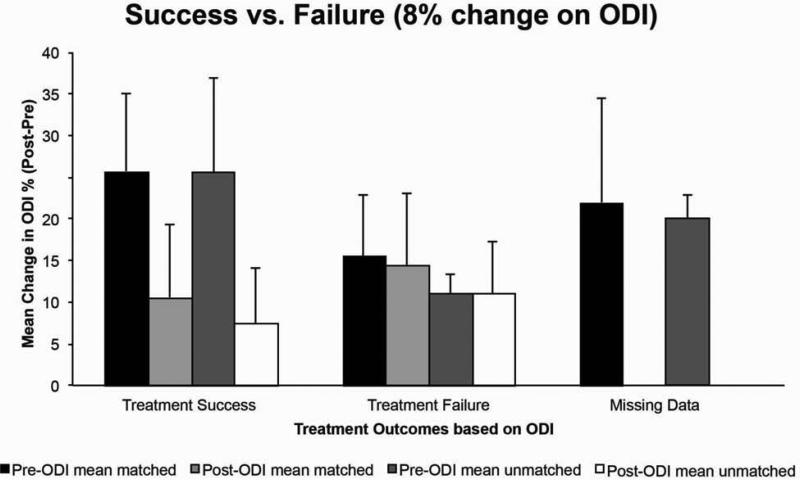
Results: Of the patients allocated to treatment for this study, 76 received a matched treatment and 25 received an unmatched treatment. After treatment, both groups showed a statistically significant improvement in the primary outcome measures and almost all the secondary measures; however, the matched treatment group did not demonstrate superior outcomes at Week 7 or 12 months, except on one of the secondary measures (Graded Chronic Pain Scale [Disability Scale]) (p=.01).
Conclusions: Providing a matched treatment based on either the Treatment-Based Classification or the Movement System Impairment classification schema did not improve treatment outcomes compared with an unmatched treatment for patients with chronic LBP, except on one secondary disability measure.
Trial registration: ClinicalTrials.gov NCT01362049.
Keywords: Chronic low back pain; Classification; Exercise; Physical therapy; Randomized controlled trial; Subgroups.
Copyright © 2014 Elsevier Inc. All rights reserved.
Figures

References
-
- Al-Obaidi SM, Beattie P, Al-Zoabi B, A-W S. The relationship of anticipated pain and fear avoidance beliefs to outcome in patients with chronic low back pain who are not receiving workers' compensation. Spine. 2005;30:1051–1057. - PubMed
-
- Anderrsen G. Epidemiological features of chronic low-back pain. Lancet. 1999;354:581–585. - PubMed
-
- Andersson GBJ, Frymoyer JW. The Adult Spine. Lippincott-Raven Publishers; Philadelphia: 1997. The Epidemiology of Spinal Disorders. p. 93.
-
- Bekkering GE, Hendriks HJM, Koes BW, et al. Dutch physiotherapy guidelines for low back pain. Physiotherapy. 2003;89:82–96.
-
- Borkan JM, Cherkin DC. An agenda for primary care research on low back pain. Spine. 1996;21:2880–2884. - PubMed
Publication types
MeSH terms
Associated data
Grants and funding
LinkOut - more resources
Full Text Sources
Other Literature Sources
Medical
Miscellaneous
