


Chemical composition, antioxidant, anti-inflammatory and anti-proliferative activities of essential oils of plants from Burkina Faso
- PMID: 24662935
- PMCID: PMC3963878
- DOI: 10.1371/journal.pone.0092122
Chemical composition, antioxidant, anti-inflammatory and anti-proliferative activities of essential oils of plants from Burkina Faso
Abstract
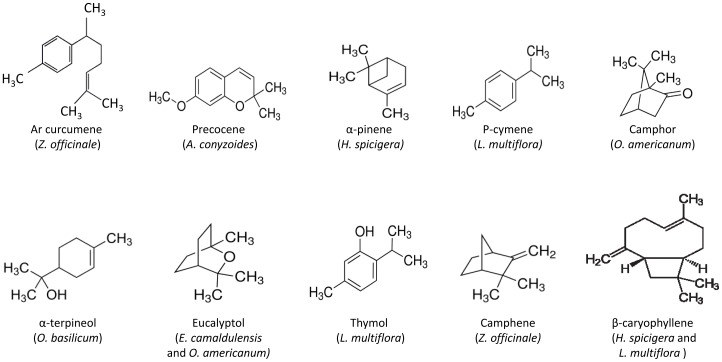
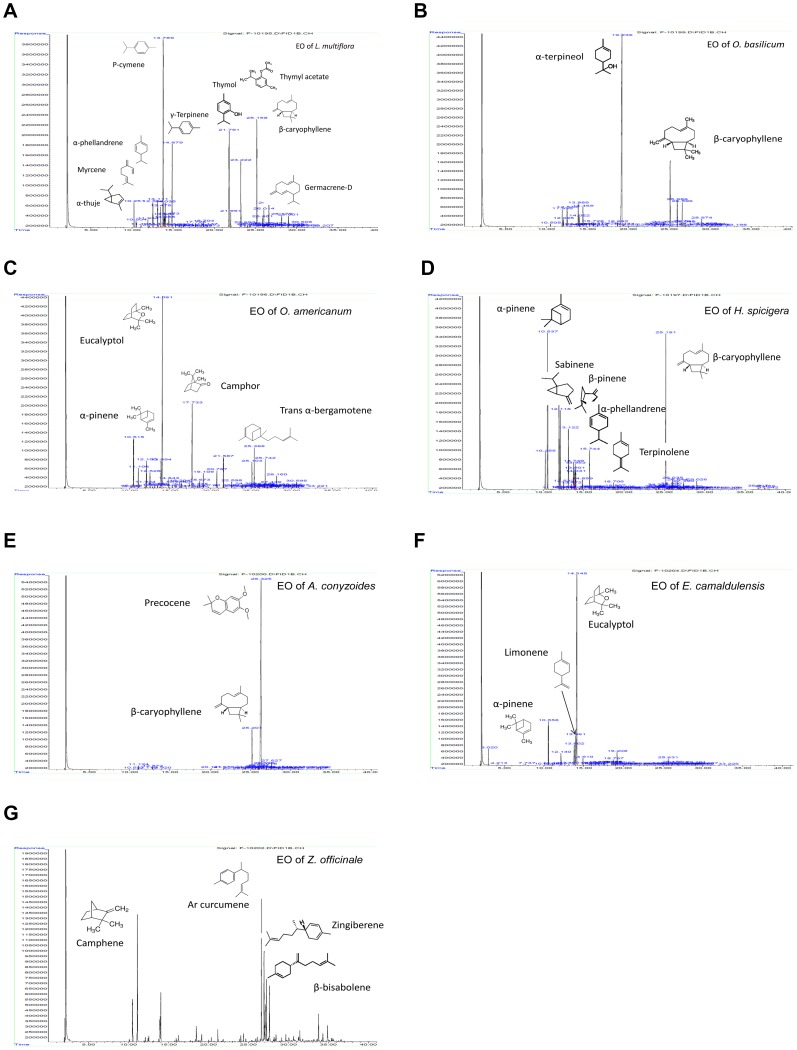
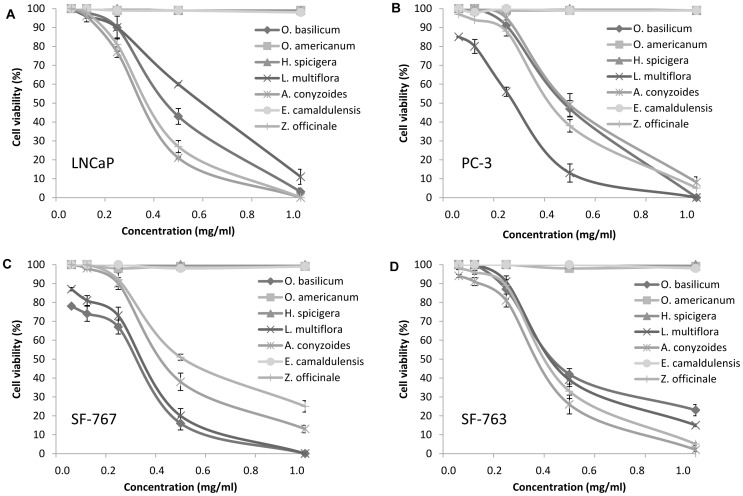
This research highlights the chemical composition, antioxidant, anti-inflammatory and anti-proliferative activities of essential oils from leaves of Ocimum basilicum, Ocimum americanum, Hyptis spicigera, Lippia multiflora, Ageratum conyzoides, Eucalyptus camaldulensis and Zingiber officinale. Essential oils were analyzed by gas chromatography-mass spectrometry and gas chromatography-flame ionization detector. Major constituents were α-terpineol (59.78%) and β-caryophyllene (10.54%) for Ocimum basilicum; 1, 8-cineol (31.22%), camphor (12.730%), α-pinene (6.87%) and trans α-bergamotene (5.32%) for Ocimum americanum; β-caryophyllene (21%), α-pinene (20.11%), sabinene (10.26%), β-pinene (9.22%) and α-phellandrene (7.03%) for Hyptis spicigera; p-cymene (25.27%), β-caryophyllene (12.70%), thymol (11.88), γ-terpinene (9.17%) and thymyle acetate (7.64%) for Lippia multiflora; precocene (82.10%)for Ageratum conyzoides; eucalyptol (59.55%), α-pinene (9.17%) and limonene (8.76%) for Eucalyptus camaldulensis; arcurcumene (16.67%), camphene (12.70%), zingiberene (8.40%), β-bisabolene (7.83%) and β-sesquiphellandrène (5.34%) for Zingiber officinale. Antioxidant activities were examined using 1,1-diphenyl-2-picryl-hydrazyl (DPPH) and 2,2'-azinobis-(3-ethylbenzothiazoline-6-sulfonic acid (ABTS) methods. O. basilicum and L. multiflora exhibited the highest antioxidant activity in DPPH and ABTS tests, respectively. Anti-inflammatory properties were evaluated by measuring the inhibition of lipoxygenase activity and essential oil of Z. officinale was the most active. Anti-proliferative effect was assayed by the measurement of MTT on LNCaP and PC-3 prostate cancer cell lines, and SF-763 and SF-767 glioblastoma cell lines. Essential oils from A. conyzoides and L. multiflora were the most active on LNCaP and PC-3 cell lines, respectively. The SF-767 glioblastoma cell line was the most sensitive to O. basilicum and L. multiflora EOs while essential oil of A. conyzoides showed the highest activity on SF-763 cells. Altogether these results justify the use of these plants in traditional medicine in Burkina Faso and open a new field of investigation in the characterization of the molecules involved in anti-proliferative processes.
Conflict of interest statement
Figures

References
-
- WHO (2013) WHO | Cancer Fact sheet N°297. WHO. Available: http://www.who.int/mediacentre/factsheets/fs297/en/index.html. Accessed 2013 Aug 13.
-
- Goumbri/Lompo O, Domagni O, Sanou A, Konsegre V, Soudre R (2009) Aspects épidémiologiques et histopathologiques des cancers au Burkina Faso. J Afr Cancer 1: 207–211 10.1007/s12558-009-0052-x - DOI
-
- Graham JG, Quinn ML, Fabricant DS, Farnsworth NR (2000) Plants used against cancer - an extension of the work of Jonathan Hartwell. J Ethnopharmacol 73: 347–377. - PubMed
-
- Liu RH (2004) Potential synergy of phytochemicals in cancer prevention: mechanism of action. J Nutr 134: 3479S–3485S. - PubMed
Publication types
MeSH terms
Substances
LinkOut - more resources
Full Text Sources
Other Literature Sources
Medical
