. 2014 Jul;66(7):1712-22.
doi: 10.1002/art.38637.

Citrulline-specific Th1 cells are increased in rheumatoid arthritis and their frequency is influenced by disease duration and therapy

Affiliations

Citrulline-specific Th1 cells are increased in rheumatoid arthritis and their frequency is influenced by disease duration and therapy

Eddie A James et al. Arthritis Rheumatol. 2014 Jul.

Abstract

Objective: Rheumatoid arthritis (RA) is thought to be a T cell-mediated disease, based on its strong association with HLA class II alleles, clinical responsiveness to T cell-directed therapies, and the presence of CD4+ T cells in rheumatoid joints. The presence of anti-citrullinated protein antibodies (ACPAs) in RA serum and the association of these antibodies with HLA-DR4 alleles implicate citrulline-specific autoreactive T cells in the development and progression of RA. The goal of this study was to determine the characteristics and specificity of autoreactive T cell responses in RA.

Methods: We developed a panel of HLA-DRB1*04:01 tetramers, selecting citrullinated peptides from synovial antigens and verifying their immunogenicity in DRB1*04:01-transgenic mice. Seven tetramers were used to examine the ex vivo frequency and surface phenotype of citrulline-specific (Cit-specific) T cells in patients with RA and healthy subjects with DRB1*04:01 haplotypes, using a magnetic enrichment procedure.

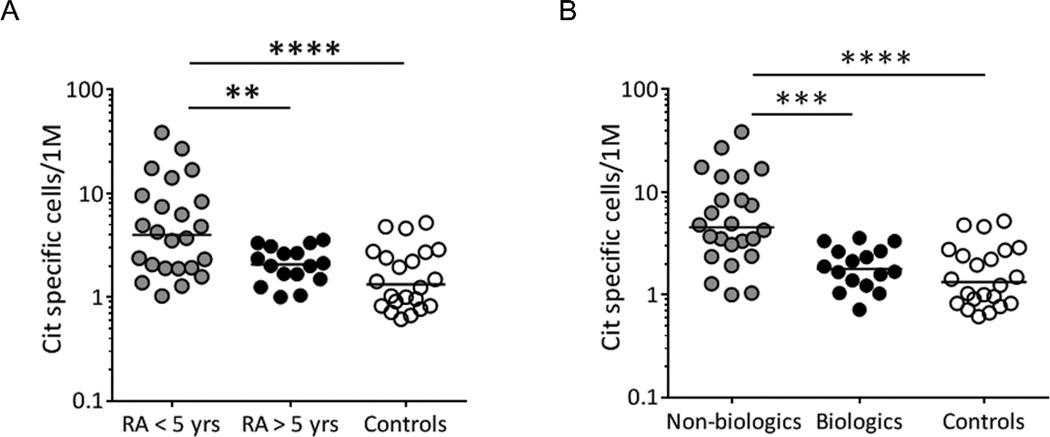
Results: Cit-specific T cells were detectable in peripheral blood samples from both healthy subjects and RA patients. In comparison to healthy subjects, RA patients had significantly higher frequencies of Cit-specific T cells, and a greater proportion of these cells displayed a Th1 memory phenotype. Among RA patients, the frequency of Cit-specific T cells was highest within the first 5 years after diagnosis of RA and was decreased in patients taking biologic agents, irrespective of disease duration.

Conclusion: These findings link the presence of ACPAs in RA with Th1 cells specific for citrullinated epitopes and provide tools for disease-specific immunomonitoring of autoreactive T cells.


Conflict of interest statement

Conflict of Interest

No conflicts of interest

Figures

Fig. 1
Fig. 1
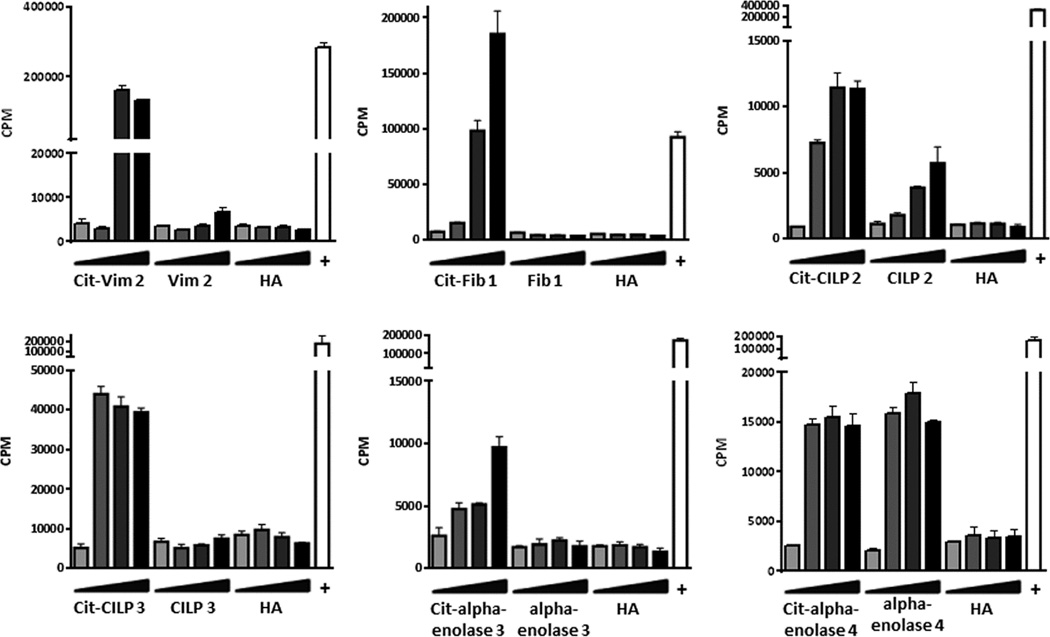
Novel citrullinated peptides are antigenic in DR0401-IE mice. Representative 3H-thymidine incorporation from DR0401-IE mice immunized with Cit-Vim 2 (n=6), Cit-Fib 1 (n=6), Cit-CILP 2 (n=3), Cit-CILP 3 (n=3), Cit-alpha-enolase 3 (n=3), and Cit-alpha-enolase 4 (n=7). In vitro recall responses were measured with challenge from the immunizing citrullinated peptide, its arginine version, and HA using a dose titration of 0, 0.5, 5, and 50 µg/ml of peptide. Anti-CD3/anti-CD28 was used as a positive control in all assays (+).
Fig. 2
Fig. 2
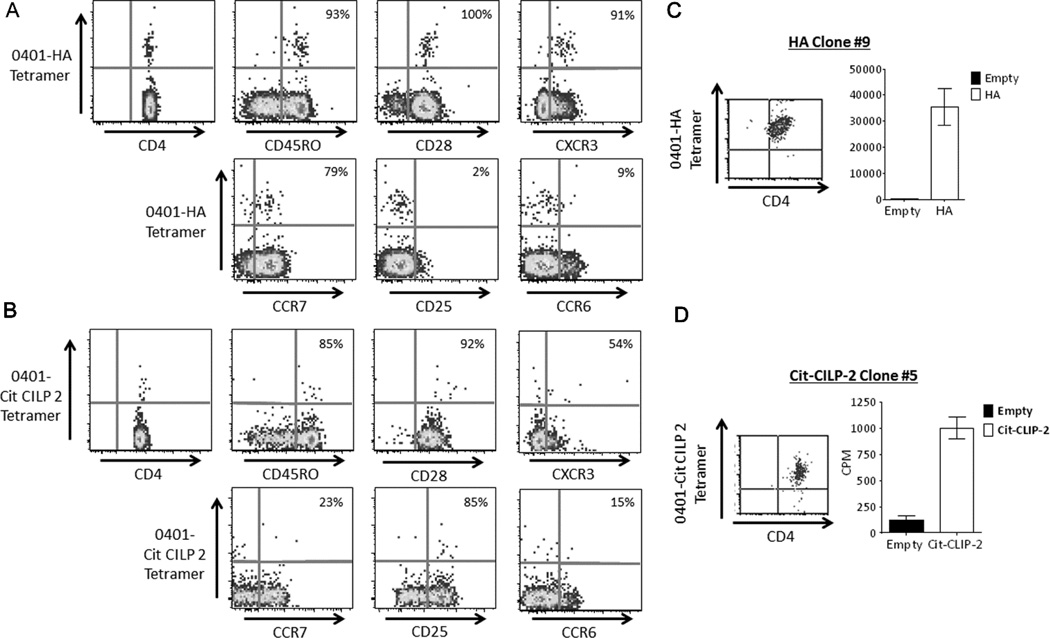
Flu and citrulline-specific CD4 T cells can reliably be detected ex vivo from the peripheral blood of RA patients. A) A representative example of ex vivo tetramer analysis for flu specific T cells from PBMC of an RA subject with a DR0401 haplotype after staining with DR0401-HA306–318 tetramer along with CD4, CXCR3, CD45RO, CD28, CCR7, CD25, and CCR6 antibodies. B) A representative example of ex vivo tetramer analysis for citrulline specific T cells from PBMC of an RA subject with a DR0401 haplotype after staining with DR0401-Cit-CILP 2 tetramer, CD4, CXCR3, CD45RO, CD28, CCR7, CD25, and CCR6 antibodies. C) DR0401- HA306–318 tetramer staining (left panel) and peptide specific proliferation (right panel) as seen by monomer stimulation (black bars=DR0401-empty monomer, white bars=DR0401-HA306–318 monomer) of a direct ex vivo sorted HA-T cell clone isolated from an RA patient. D) DR0401-Cit-CILP 2 tetramer staining (left panel) and peptide specific proliferation (right panel) as seen by monomer stimulation (black bars=DR0401-empty monomer, white bars=DR0401- Cit-CILP 2 monomer) of a direct ex vivo sorted Cit-CILP 2-T cell clone isolated from an RA patient.
Fig. 3
Fig. 3
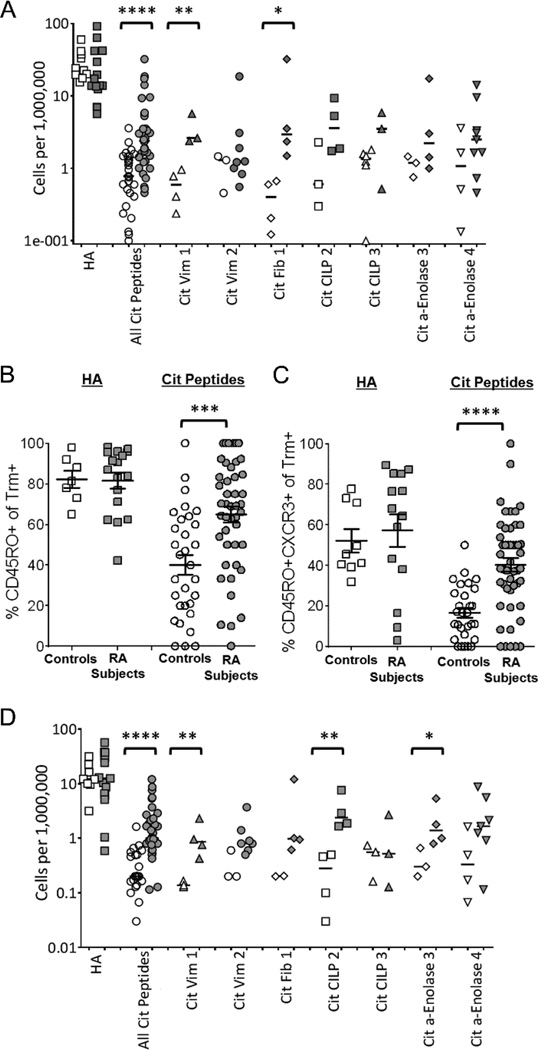
RA patients have an increased number of T cells recognizing citrullinated antigens, and these T cell are skewed towards a TH1 memory response. (A) T cell frequencies were determined directly ex vivo for DR0401-tetramer+CD45RO+ antigen specific T cells. All frequencies are expressed as number of antigen specific cells/million T cells. Comparisons are made between healthy controls (white symbols) and RA patients (gray symbols) for T cells specific for flu (HA306–318), all citrullinated antigens tested, and individual citrullinated peptides tested. Antigen specific T cells were further characterized for their memory phenotype by looking at the percentage of CD45RO+ (B) and CD45RO+CXCR3+ (C) among T cells that were tetramer+. Phenotypic comparisons were made between healthy controls and RA subjects for their flu specific T cells (controls=white boxes, RA=gray boxes) and their citrulline specific T cells (controls = white circles, RA=gray circles). (D) T cell frequencies were determined directly ex vivo for DR0401-tetramer+CD45RO+CXCR3+ antigen specific T cells. Symbols are identical to those used in panel A. Statistical significance was determined by an unpaired T test after normalization for logarithmic distribution (A&D) or by Mann-Whitney test (B&C). *=p<0.05, **=p<0.01, ***=p<0.001, and ****p=<0.0001.
Fig. 4
Fig. 4
Disease duration and treatment affect the frequency of cit-specific T cells found in RA patients. A) A comparison of ex vivo frequencies for cit-specific CD4+ T cells between 9 RA patients with disease <5 years (gray circles), 7 RA patients with disease >5 years (black circles), and 11 healthy controls (white circles) shows that RA patients with <5 year disease duration have significantly higher total frequencies of cit-specific CD4+T cells than RA patients with >5 year disease duration and healthy controls. B) A comparison of ex vivo frequencies of cit-specific CD4+ T cells in 8 RA patients on non-biologic therapies (gray circles), 8 RA patients on biologic therapies (black circles), and 11 healthy controls (white circles) shows that RA patients on non-biologic therapies have significantly more cit-specific CD4+T cells than RA patients on biologic therapies and healthy controls. Frequencies are shown as tetramer+ antigen specific T cells/million T cells. Statistical significance was determined by ANOVA using the Sidak multiple comparisons post-test after normalization for logarithmic distribution. **=p<0.01, ***=p<0.001, and ****p=<0.0001.

References

    1. Klareskog L, Catrina AI, Paget S. Rheumatoid arthritis. Lancet. 2009;373:659–672. - PubMed
    1. McInnes IB, Schett G. The pathogenesis of rheumatoid arthritis. N Engl J Med. 2011;365:2205–2219. - PubMed
    1. Aho K, Heliovaara M, Maatela J, Tuomi T, Palosuo T. Rheumatoid factors antedating clinical rheumatoid arthritis. J Rheumatol. 1991;18:1282–1284. - PubMed
    1. Aho K, von Essen R, Kurki P, Palosuo T, Heliovaara M. Antikeratin antibody and antiperinuclear factor as markers for subclinical rheumatoid disease process. J Rheumatol. 1993;20:1278–1281. - PubMed
    1. Schellekens GA, de Jong BA, van den Hoogen FH, Van de Putte LB, van Venrooij WJ. Citrulline is an essential constituent of antigenic determinants recognized by rheumatoid arthritis-specific autoantibodies. J Clin Invest. 1998;101:273–281. - PMC - PubMed

Publication types

MeSH terms