


Impact of multimorbidity: acute morbidity, area of residency and use of health services across the life span in a region of south Europe
- PMID: 24666526
- PMCID: PMC3987684
- DOI: 10.1186/1471-2296-15-55
Impact of multimorbidity: acute morbidity, area of residency and use of health services across the life span in a region of south Europe
Abstract
Background: Concurrent diseases, multiple pathologies and multimorbidity patterns are topics of increased interest as the world's population ages. To explore the impact of multimorbidity on affected patients and the consequences for health services, we designed a study to describe multimorbidity by sex and life-stage in a large population sample and to assess the association with acute morbidity, area of residency and use of health services.
Methods: A cross-sectional study was conducted in Catalonia (Spain). Participants were 1,749,710 patients aged 19+ years (251 primary care teams).
Primary outcome: Multimorbidity (≥2 chronic diseases). Secondary outcome: Number of new events of each acute disease. Other variables: number of acute diseases per patient, sex, age group (19-24, 25-44, 45-64, 65-79, and 80+ years), urban/rural residence, and number of visits during 2010.
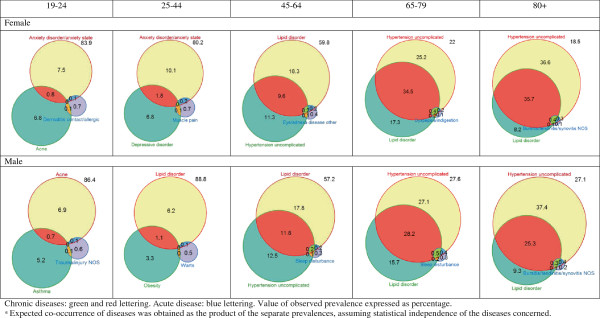
Results: Multimorbidity was present in 46.8% (95% CI, 46.7%-46.8%) of the sample, and increased as age increased, being higher in women and in rural areas. The most prevalent pair of chronic diseases was hypertension and lipid disorders in patients older than 45 years. Infections (mainly upper respiratory infection) were the most common acute diagnoses. In women, the highest significant RR of multimorbidity vs. non-multimorbidity was found for teeth/gum disease (aged 19-24) and acute upper respiratory infection. In men, this RR was only positive and significant for teeth/gum disease (aged 65-79). The adjusted analysis showed a strongly positive association with multimorbidity for the oldest women (80+ years) with acute diseases and women aged 65-79 with 3 or more acute diseases, compared to patients with no acute diseases (OR ranged from 1.16 to 1.99, p < 0.001). Living in a rural area was significantly associated with lower probability of having multimorbidity. The odds of multimorbidity increased sharply as the number of visits increased, reaching the highest probability in those aged 65-79 years.
Conclusions: Multimorbidity is related to greater use of health care services and higher incidence of acute diseases, increasing the burden on primary care services. The differences related to sex and life-stage observed for multimorbidity and acute diseases suggest that further research on multimorbidity should be stratified according to these factors.
Figures
References
-
- Bodenheimer T, Wagner EH, Grumbach K. Improving primary care for patients with chronic illness. JAMA. 2002;288:1775–1779. - PubMed
-
- Van den Akker M, Buntinx F, Knottnerus JA. Comorbidity or multimorbidity: what’s in a name? A review of literature. Eur J Gen Pract. 1996;2:65–70.
-
- Freund T, Kunz CU, Ose D, Szecsenyi J, Peters-Klimm F. Patterns of multimorbidity in primary care patients at high risk of future hospitalization. Popul Health Manag. 2012;15:119–124. - PubMed
-
- Gijsen R, Hoeymans N, Schellevis FG, Ruwaard D, Satariano WA, van den Bos GA. Causes and consequences of comorbidity: a review. J Clin Epidemiol. 2001;54:661–674. - PubMed
-
- van den Akker M, Buntinx F, Roos S, Knottnerus JA. Problems in determining occurrence rates of multimorbidity. J Clin Epidemiol. 2001;54:675–679. - PubMed
Publication types
MeSH terms
Grants and funding
LinkOut - more resources
Full Text Sources
Other Literature Sources
Medical
