


Classifying emergency 30-day readmissions in England using routine hospital data 2004-2010: what is the scope for reduction?
- PMID: 24668396
- PMCID: PMC4283684
- DOI: 10.1136/emermed-2013-202531
Classifying emergency 30-day readmissions in England using routine hospital data 2004-2010: what is the scope for reduction?
Abstract
Background: Many health systems across the globe have introduced arrangements to deny payment for patients readmitted to hospital as an emergency. The purpose of this study was to develop an exploratory categorisation based on likely causes of readmission, and then to assess the prevalence of these different types.
Methods: Retrospective analysis of 82 million routinely collected National Health Service hospital records in England (2004-2010) was undertaken using anonymised linkage of records at person-level. Numbers of 30-day readmissions were calculated. Exploratory categorisation of readmissions was applied using simple rules relating to International Classification of Diseases (ICD) diagnostic codes for both admission and readmission.
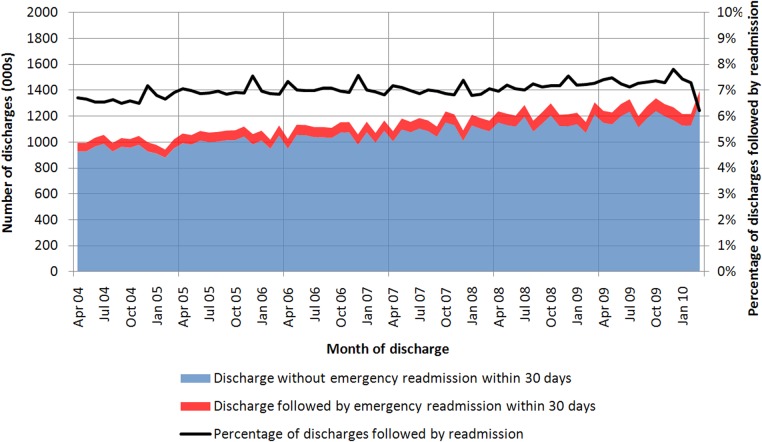
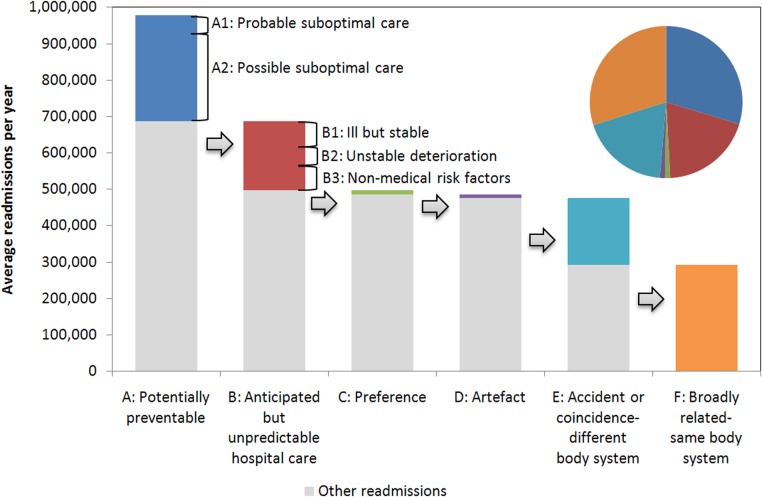
Results: There were 5 804 472 emergency 30-day readmissions over a 6-year period, equivalent to 7.0% of hospital discharges. Readmissions were grouped into hierarchically exclusive categories: potentially preventable readmission (1 739 519 (30.0% of readmissions)); anticipated but unpredictable readmission (patients with chronic disease or likely to need long-term care; 1 141 987 (19.7%)); preference-related readmission (53 718 (0.9%)); artefact of data collection (16 062 (0.3%)); readmission as a result of accident, coincidence or related to a different body system (1 101 818 (19.0%)); broadly related readmission (readmission related to the same body system (1 751 368 (30.2%)).
Conclusions: In this exploratory categorisation, a large minority of emergency readmissions (eg, those that are potentially preventable or due to data artefacts) fell into groups potentially amenable to immediate reduction. For other categories, a hospital's ability to reduce emergency readmission is less clear. Reduction strategies and payment incentives must be carefully tailored to achieve stated aims.
Published by the BMJ Publishing Group Limited. For permission to use (where not already granted under a licence) please go to http://group.bmj.com/group/rights-licensing/permissions.
Figures
References
-
- Blunt I, Bardsley M, Dixon J. Trends in emergency admissions in England 2004–2009: is greater efficiency breeding inefficiency? London: The Nuffield Trust, 2010.
-
- Podulka J, Barrett M, Jiang J, et al. 0-Day Readmissions following Hospitalizations for Chronic vs. Acute Conditions, 2008 Agency for Healthcare Research and Quality Statistical Brief #127 February 2012. - PubMed
-
- Robinson P. Hospital readmissions and the 30 day threshold. London: CHKS, 2010.
-
- Department of Health. Payment by results guidance for 2012–13. Gateway reference 17250. London: Department of Health, 2012.
-
- Centres for Medicare & Medicaid Services. Readmissions Reduction Program. 2013. http://cms.gov/Medicare/Medicare-Fee-for-Service-Payment/AcuteInpatientP...
MeSH terms
Grants and funding
LinkOut - more resources
Full Text Sources
Other Literature Sources
Medical
