


Using job-title-based physical exposures from O*NET in an epidemiological study of carpal tunnel syndrome
- PMID: 24669551
- PMCID: PMC4036526
- DOI: 10.1177/0018720813496567
Using job-title-based physical exposures from O*NET in an epidemiological study of carpal tunnel syndrome
Abstract
Objective: We studied associations between job-title-based measures of force and repetition and incident carpal tunnel syndrome (CTS).
Background: Job exposure matrices (JEMs) are not commonly used in studies of work-related upper-extremity disorders.
Method: We enrolled newly hired workers in a prospective cohort study. We assigned a Standard Occupational Classification (SOC) code to each job held and extracted physical work exposure variables from the Occupational Information Network (O*NET). CTS case definition required both characteristic symptoms and abnormal median nerve conduction.
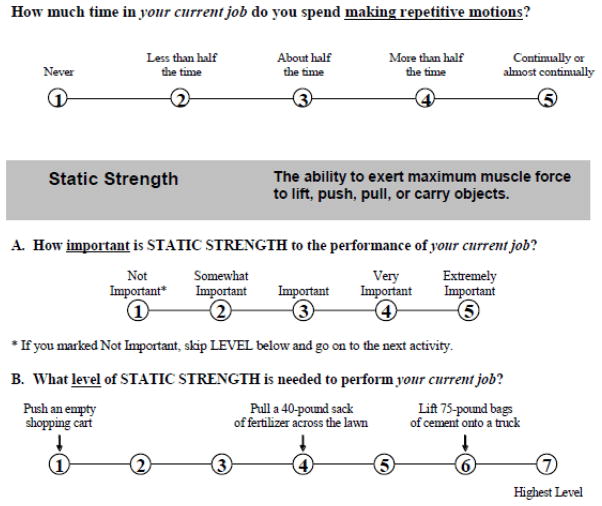
Results: Of 1,107 workers, 751 (67.8%) completed follow-up evaluations. A total of 31 respondents (4.4%) developed CTS during an average of 3.3 years of follow-up. Repetitive motion, static strength, and dynamic strength from the most recent job held were all significant predictors of CTS when included individually as physical exposures in models adjusting for age, gender, and BMI. Similar results were found using time-weighted exposure across all jobs held during the study. Repetitive motion, static strength, and dynamic strength were correlated, precluding meaningful analysis of their independent effects.
Conclusion: This study found strong relationships between workplace physical exposures assessed via a JEM and CTS, after adjusting for age, gender, and BMI. Though job-title-based exposures are likely to result in significant exposure misclassification, they can be useful for large population studies where more precise exposure data are not available.
Application: JEMs can be used as a measure of workplace physical exposures for some studies of musculoskeletal disorders.
References
-
- Barcenilla A, March LM, Chen JS, Sambrook PN. Carpal tunnel syndrome and its relationship to occupation: a meta-analysis. Rheumatology. 2012;51(2):250–261. - PubMed
-
- Bernard B. Musculoskeletal Disorders and Workplace Factors: A Critical Review of Epidemiologic Evidence for Work-Related Musculoskeletal Disorders of the Neck, Upper Extremity, and Low Back. 1997. DHHS (NIOSH) Publication No. 97-141.
-
- Blanc PD, Faucett J, Kennedy JJ, Cisternas M, Yelin E. Self-reported carpal tunnel syndrome: Predictors of work disability from the National Health Interview Survey Occupational Health Supplement. American Journal of Industrial Medicine. 1996;30(3):362–368. - PubMed
-
- Bonfiglioli R, Mattioli S, Armstrong T, Graziosi F, Marinelli F, Farioli A, Violante F. Validation of the ACGIH TLV for hand activity level in the OCTOPUS cohort: A two-year longitudinal study of carpal tunnel syndrome. Scandinavian Journal of Work, Environment & Health. 2012 doi: 10.5271/sjweh.3312. Advance online publication. - DOI - PubMed
Publication types
MeSH terms
Grants and funding
LinkOut - more resources
Full Text Sources
Other Literature Sources
Medical
Research Materials
