


Metropolitan-level ethnic residential segregation, racial identity, and body mass index among U.S. Hispanic adults: a multilevel cross-sectional study
- PMID: 24669799
- PMCID: PMC4004511
- DOI: 10.1186/1471-2458-14-283
Metropolitan-level ethnic residential segregation, racial identity, and body mass index among U.S. Hispanic adults: a multilevel cross-sectional study
Abstract
Background: The few studies that have examined whether metropolitan-level ethnic residential segregation is associated with obesity among Hispanics are mixed. The segmented assimilation theory, which suggests patterns of integration for immigrant groups varies by social factors, may provide an explanation for these mixed findings. In this study we examined whether one social factor, racial identity, modified the association between ethnic residential segregation and body mass index (BMI) among Hispanics.
Methods: We used data on 22,901 male and 37,335 non-pregnant female Hispanic adult participants of the 2003-2008 U.S. Behavioral Risk Factor Surveillance System living in 227 metropolitan or micropolitan areas (MMSAs). Participants self-identified as White, Black, and 'some other race'. BMI was calculated using self-reported height and weight; the Hispanic isolation index was used to measure Hispanic residential segregation. Using multi-level linear regression models, we examined the association of Hispanic residential segregation with BMI, and we investigated whether this relationship varied by race.
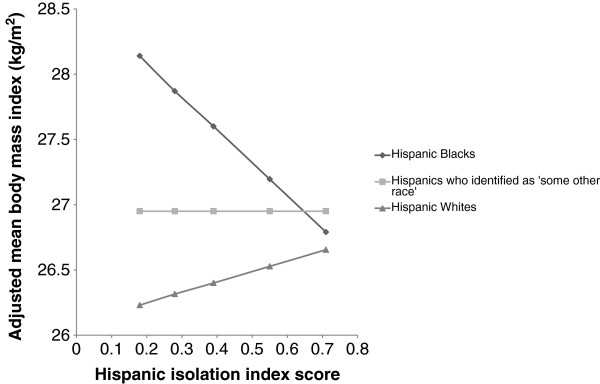
Results: Among men, Hispanic segregation was unassociated with BMI after adjusting for age, race, MMSA-level poverty, and MMSA-level population size; there was no variation in this relationship by race. Among women, significant associations between Hispanic segregation and BMI in models adjusted for demographics and MMSA-level confounders became attenuated with further adjustment for education and language of exam. However, there was statistically significant variation by race (Pinteraction = 0.03 and 0.09 for Hispanic Blacks and Hispanics who identified as some other race, respectively, vs. Hispanic Whites). Specifically, higher segregation was associated with higher mean BMI among Hispanic Whites, but it was associated with lower mean BMI among Hispanic Blacks. Segregation was unassociated with BMI among Hispanic women identifying as some other race.
Conclusions: This heterogeneity highlights the persistent influence of race on structural processes that can have downstream consequences on health. As Hispanics grow as a proportion of the U.S. population, especially across urban centers, understanding the health consequences of residence in segregated areas, and whether or not these impacts vary across different groups, will be important for the design of more comprehensive solutions to prevent adverse health outcomes.
Figures
References
-
- Humes KR, Jones NA, Ramirez RR. Overview of Race and Hispanic Origin: 2010 Census Briefs. U.S. Census Bureau: Washington, D. C; 2011.
-
- Dubowitz T, Ghosh-Dastidar M, Eibner C, Slaughter ME, Fernandes M, Whitsel EA, Bird CE, Jewell A, Margolis KL, Li W, Michael YL, Shih RA, Manson JE, Escarce JJ. The Women’s Health Initiative: the food environment, neighborhood socioeconomic status, BMI, and blood pressure. Obesity (Silver Spring) 2012;20:862–871. doi: 10.1038/oby.2011.141. - DOI - PMC - PubMed
Publication types
MeSH terms
Grants and funding
LinkOut - more resources
Full Text Sources
Other Literature Sources
Medical
Research Materials
