


Ground reaction forces and osteogenic index of the sport of cyclocross
- PMID: 24669907
- PMCID: PMC4477807
- DOI: 10.1080/02640414.2014.889839
Ground reaction forces and osteogenic index of the sport of cyclocross
Abstract
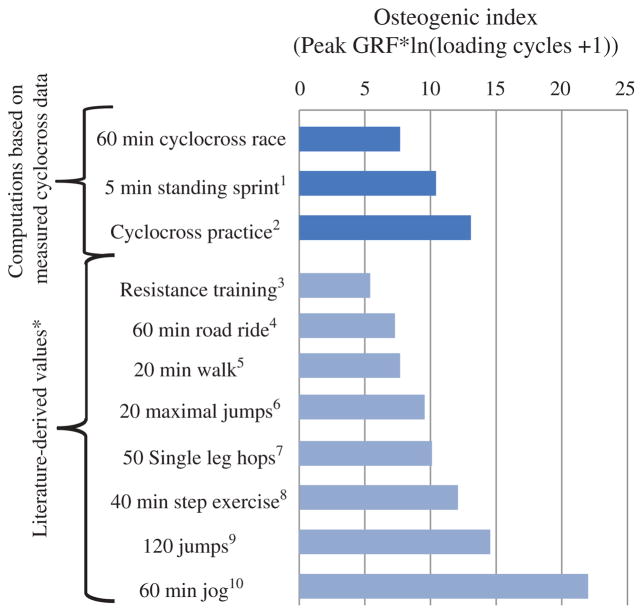
Weight-bearing activity has been shown to increase bone mineral density. Our purpose was to measure vertical ground reaction forces (GRFs) during cyclocross-specific activities and compute their osteogenic index (OI). Twenty-five healthy cyclocross athletes participated. GRF was measured using pressure-sensitive insoles during seated and standing cycling and four cyclocross-specific activities: barrier flat, barrier uphill, uphill run-up, downhill run-up. Peak and mean GRF values, according to bodyweight, were determined for each activity. OI was computed using peak GRF and number of loading cycles. GRF and OI were compared across activities using repeated-measures ANOVA. Number of loading cycles per activity was 6(1) for barrier flat, 8(1) barrier uphill, 7(1) uphill run-up, 12(3) downhill run-up. All activities had significantly (P < 0.01) higher peak GRF, mean GRF values and OI when compared to both seated and standing cycling. The barrier flat condition (P < 0.01) had highest peak (2.9 times bodyweight) and mean GRF values (2.3 times bodyweight). Downhill run-up (P < 0.01) had the highest OI (6.5). GRF generated during the barrier flat activity is similar in magnitude to reported GRFs during running and hopping. Because cyclocross involves weight bearing components, it may be more beneficial to bone health than seated road cycling.
Keywords: bone health; cycling; loading cycles; osteogenic; physical activity.
Figures


References
-
- Andreoli A, Monteleone M, Van Loan M, Promenzio L, Tarantino U, De Lorenzo A. Effects of different sports on bone density and muscle mass in highly trained athletes. [Comparative Study] Medicine and Science in Sports and Exercise. 2001;33(4):507–511. - PubMed
-
- Bailey CA, Brooke-Wavell K. Optimum frequency of exercise for bone health: Randomised controlled trial of a high-impact unilateral intervention. [Randomized Controlled Trial] Bone. 2010;46(4):1043–1049. - PubMed
-
- Barry DW, Kohrt WM. Exercise and the preservation of bone health. Journal of Cardiopulmonary Rehabilitation and Prevention. 2008;28(3):153–162. - PubMed
-
- Burnfield JM, Jorde AG, Augustin TR, Augustin TA, Bashford GR. Variations in plantar pressure variables across five cardiovascular exercises. [Research Support, Non-U.S. Gov’t] Medicine and Science in Sports and Exercise. 2007;39(11):2012–2020. - PubMed
-
- Daly RM, Bass SL. Lifetime sport and leisure activity participation is associated with greater bone size, quality and strength in older men. [Research Support, Non-U.S. Gov’t] Osteoporosis International. 2006;17(8):1258–1267. - PubMed
Publication types
MeSH terms
Grants and funding
LinkOut - more resources
Full Text Sources
Other Literature Sources
Medical