


Development and pilot testing of HIV screening program integration within public/primary health centers providing antenatal care services in Maharashtra, India
- PMID: 24670002
- PMCID: PMC3986915
- DOI: 10.1186/1756-0500-7-177
Development and pilot testing of HIV screening program integration within public/primary health centers providing antenatal care services in Maharashtra, India
Abstract
Background: The objectives of this paper are: (1) to study the feasibility and relative benefits of integrating the prevention of parent-to-child transmission (PPTCT) component of the National AIDS Control Program with the maternal and child health component of the National Rural Health Mission (NRHM) by offering HIV screening at the primary healthcare level; and (2) to estimate the incremental cost-effectiveness ratio to understand whether the costs are commensurate with the benefits.
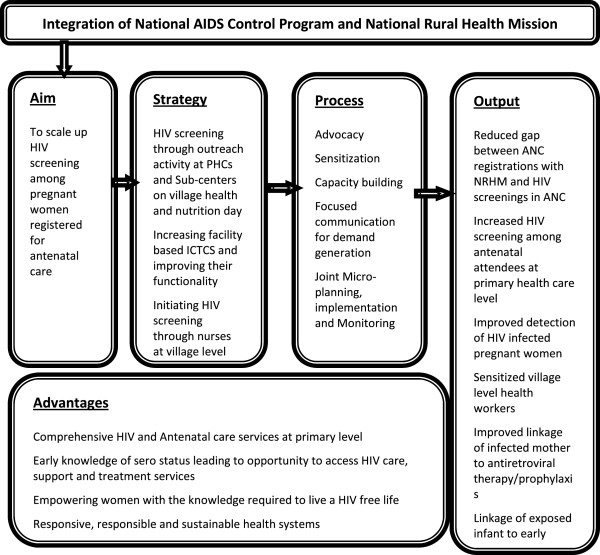
Methods: The intervention included advocacy with political, administrative/health heads, and capacity building of health staff in Satara district, Maharashtra, India. The intervention also conducted biannual outreach activities at primary health centers (PHCs)/sub-centers (SCs); initiated facility-based integrated counseling and testing centers (FICTCs) at all round-the-clock PHCs; made the existing FICTCs functional and trained PHC nurses in HIV screening. All "functional" FICTCs were equipped to screen for HIV and trained staff provided counseling and conducted HIV testing as per the national protocol. Data were collected pre- and post- integration on the number of pregnant women screened for HIV, the number of functional FICTCs and intervention costs. Trend analyses on various outcome measures were conducted. Further, the incremental cost-effectiveness ratio per pregnant woman screened was calculated.
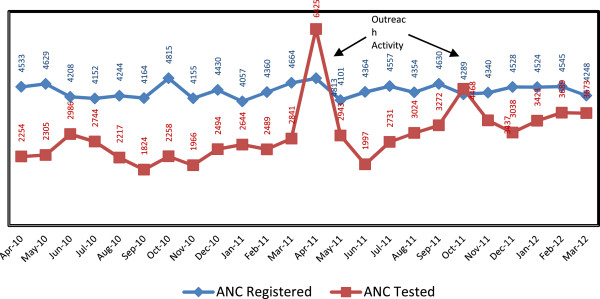
Results: An additional 27% of HIV-infected women were detected during the intervention period as the annual HIV screening increased from pre- to post-intervention (55% to 79%, p < 0.001) among antenatal care (ANC) attendees under the NRHM. A greater increase in HIV screening was observed in PHCs/SCs. The proportions of functional FICTCs increased from 47% to 97% (p < 0.001). Additionally, 93% of HIV-infected pregnant women were linked to anti-retroviral therapy centers; 92% of mother-baby pairs received Nevirapine; and 89% of exposed babies were enrolled for early infant diagnosis. The incremental cost-effectiveness ratio was estimated at INR 44 (less than 1 US$) per pregnant woman tested.
Conclusions: Integrating HIV screening with the broader Rural Health Mission is a promising opportunity to scale up the PPTCT program. However, advocacy, sensitization, capacity building and the judicious utilization of available resources are key to widening the reach of the PPTCT program in India and elsewhere.
Figures
References
-
- UNAIDS. United nation GENERAL ASSEMBLY RESOLUTION 60/262: political declaration on HIV/AIDS. New York: UN general assembly; 2006. pp. 19–20.
-
- WHO. Service delivery approaches to HIV testing and counseling: a strategic HTC programme framework. Geneva: WHO; 2012. p. 12.
-
- WHO. Towards the elimination of mother to child transmission of HIV: report of a WHO technical consultation. Geneva: WHO; 2011. p. 69,70.
-
- WHO. Global HIV/AIDS response- epidemic update and health sector progress towards universal access-progress report 2011. Geneva: WHO; 2011. p. 95. 150, 203.
Publication types
MeSH terms
LinkOut - more resources
Full Text Sources
Other Literature Sources
Medical
