


Renal failure in lithium-treated bipolar disorder: a retrospective cohort study
- PMID: 24670976
- PMCID: PMC3966731
- DOI: 10.1371/journal.pone.0090169
Renal failure in lithium-treated bipolar disorder: a retrospective cohort study
Abstract
Objective: Lithium users are offered routine renal monitoring but few studies have quantified the risk to renal health. The aim of this study was to assess the association between use of lithium carbonate and incidence of renal failure in patients with bipolar disorder.
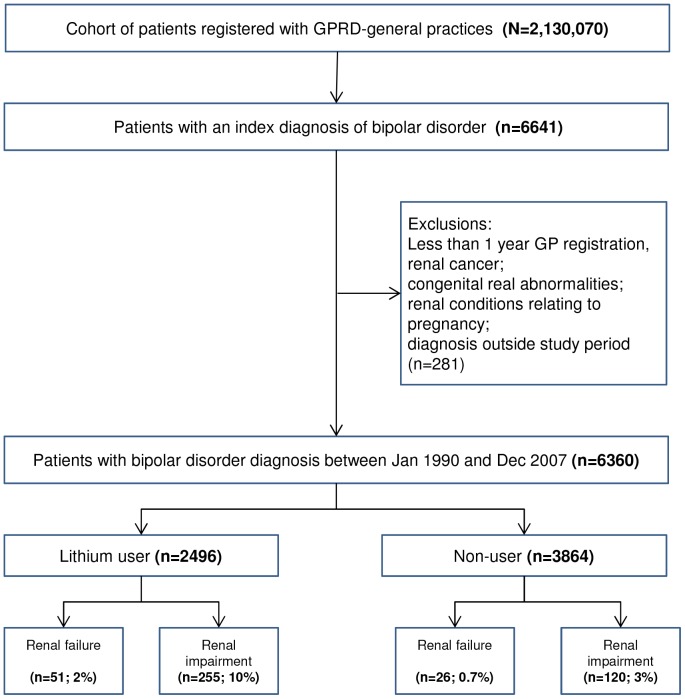
Methods: This was a retrospective cohort study using the General Practice Research Database (GPRD) and a nested validation study of lithium exposure and renal failure. A cohort of 6360 participants aged over 18 years had a first recorded diagnosis of bipolar disorder between January 1, 1990 and December 31, 2007. Data were examined from electronic primary care records from 418 general practices across the UK. The primary outcome was the hazard ratio for renal failure in participants exposed to lithium carbonate as compared with non-users of lithium, adjusting for age, gender, co-morbidities, and poly-pharmacy.
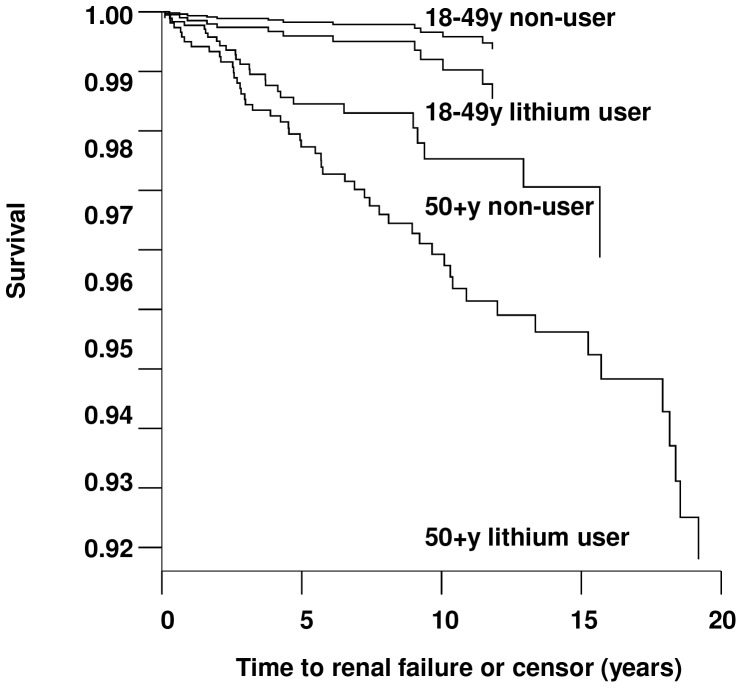
Results: Ever use of lithium was associated with a hazard ratio for renal failure of 2.5 (95% confidence interval 1.6 to 4.0) adjusted for known renal risk factors. Absolute risk was age dependent, with patients of 50 years or older at particular risk of renal failure: Number Needed to Harm (NNH) was 44 (21 to 150).
Conclusions: Lithium is associated with an increased risk of renal failure, particularly among the older age group. The absolute risk of renal failure associated with lithium use remains small.
Conflict of interest statement
Figures
References
-
- Oakley PW, Whyte IM, Carter GL (2001) Lithium toxicity: an iatrogenic problem in susceptible individuals. Australia and New Zealand Journal of Psychiatry 35: 833–40. - PubMed
-
- Kripalani M, Shawcross J, Reilly J, Main J (2009) Lithium and chronic kidney disease. BMJ 339: b2452. - PubMed
-
- Gitlin M (1999) Lithium and the kidney: an updated review. Drug Safety 20(3): 231–43. - PubMed
-
- Kallner G, Petterson U (1995) Renal, thyroid and parathyroid function during lithium treatment: Laboratory tests in 207 people treated for 1–30 years. Acta Psychiatrica Scandinavica 91(1): 48–51. - PubMed
-
- Schou M, Hansen HE, Thomsen K, Vestergaard P (1989) Lithium treatment in Aarhus. 2. Risk of renal failure and of intoxication. Pharmacopsychiatry 22(3): 101–3. - PubMed
Publication types
MeSH terms
Substances
LinkOut - more resources
Full Text Sources
Other Literature Sources
Medical
