. 2014 Mar 26;9(3):e92337.
doi: 10.1371/journal.pone.0092337. eCollection 2014.

Pan-tropical analysis of climate effects on seasonal tree growth

Affiliations

Pan-tropical analysis of climate effects on seasonal tree growth

Fabien Wagner et al. PLoS One. .

Abstract

Climate models predict a range of changes in tropical forest regions, including increased average temperatures, decreased total precipitation, reduced soil moisture and alterations in seasonal climate variations. These changes are directly related to the increase in anthropogenic greenhouse gas concentrations, primarily CO2. Assessing seasonal forest growth responses to climate is of utmost importance because woody tissues, produced by photosynthesis from atmospheric CO2, water and light, constitute the main component of carbon sequestration in the forest ecosystem. In this paper, we combine intra-annual tree growth measurements from published tree growth data and the corresponding monthly climate data for 25 pan-tropical forest sites. This meta-analysis is designed to find the shared climate drivers of tree growth and their relative importance across pan-tropical forests in order to improve carbon uptake models in a global change context. Tree growth reveals significant intra-annual seasonality at seasonally dry sites or in wet tropical forests. Of the overall variation in tree growth, 28.7% was explained by the site effect, i.e. the tree growth average per site. The best predictive model included four climate variables: precipitation, solar radiation (estimated with extrasolar radiation reaching the atmosphere), temperature amplitude and relative soil water content. This model explained more than 50% of the tree growth variations across tropical forests. Precipitation and solar radiation are the main seasonal drivers of tree growth, causing 19.8% and 16.3% of the tree growth variations. Both have a significant positive association with tree growth. These findings suggest that forest productivity due to tropical tree growth will be reduced in the future if climate extremes, such as droughts, become more frequent.


Conflict of interest statement

Competing Interests: Co-author Bruno Herault is a PLOS ONE Editorial Board member. This does not alter the authors' adherence to PLOS ONE Editorial policies and criteria.

Figures

Figure 1
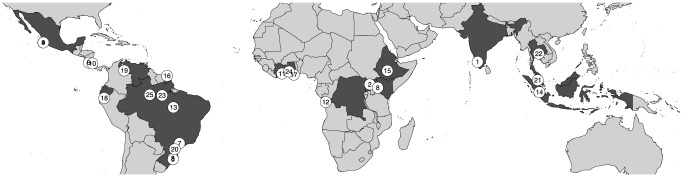
Figure 1. Locations of the 25 study sites and their countries (grey areas).
1: Attapadi; 2: Budongo; 3: CPM; 4: El Palmar; 5: FLONA SFP; 6: Guanacaste; 7: Ibicatu; 8: Kakamega; 9: La Barcinera; 10: La Selva; 11: Lamto; 12: Luki forest; 13: Marajoara; 14: Muara Bungo; 15: Munessa-Shashamene Forest; 16: Paracou; 17: Pinkwae; 18: RBSF; 19: RFC; 20: Rio Cachoiera; 21: Selangor plantation; 22: SERS; 23: Tapajos; 24: Tinte Bepo; 25: ZF-2.
Figure 2
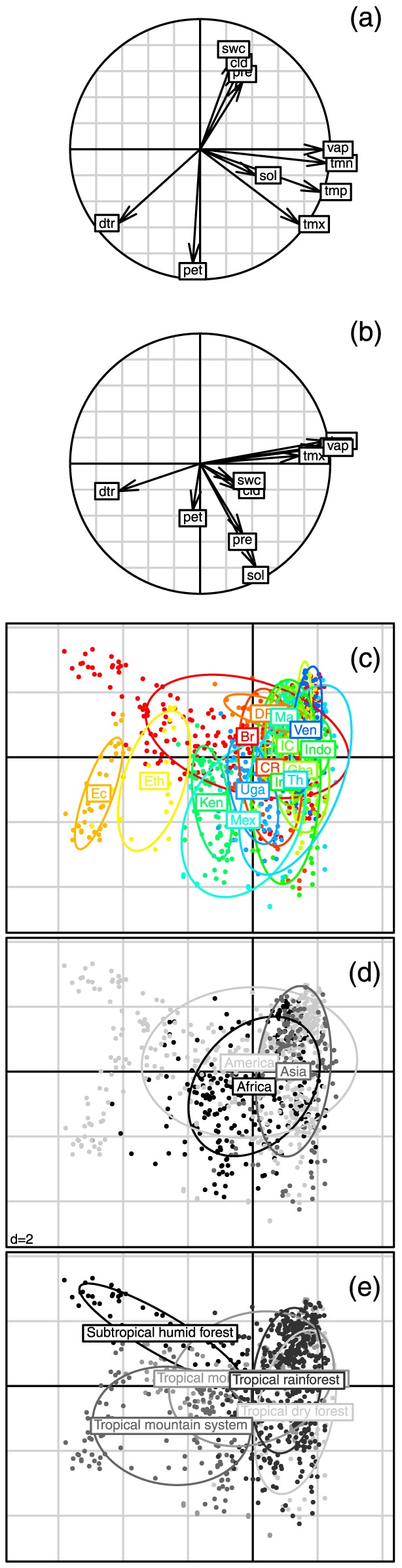
Figure 2. Principal component analysis of the climate variables.
cld: cloud cover; pre: precipitation; sol: extraterrestrial solar radiation; tmp, tmn and tmx are respectively the daily mean, minimal and maximal temperatures; dtr: temperature amplitude; vap: vapour pressure; pet: potential evapotranspiration; and swc: relative soil water content. (a) correlation circle of axis 1 and 2; (b) correlation circle of axis 1 and 3; (c) projection of the country classes on the pca axis, India (Indi), Uganda (Uga), Brazil (Bra), Mexico (Mex), Costa Rica (CR), Kenya (Ken), Ivory Coast (IC), DRC (DRC), Indonesia (Indo), Ethiopia (Eth), French Guiana (FG), Ghana (Gha), Ecuador (Ec), Venezuela (Ven), Malaysia (Ma), Thailand (Th); (d) projection of the continental classes on the pca axis; and (e) projection of the global ecological zones on the pca axis (i.e. Tropical rainforest, Tropical moist deciduous forest, Tropical dry forest, Tropical mountain system and Subtropical humid forest). Note that axis 1 and 2 explain 41.70% and 28.12% of the total variation respectively, (a). The third axis explained 11.30% of the variance and was linked negatively to sol and pre, (b).
Figure 3
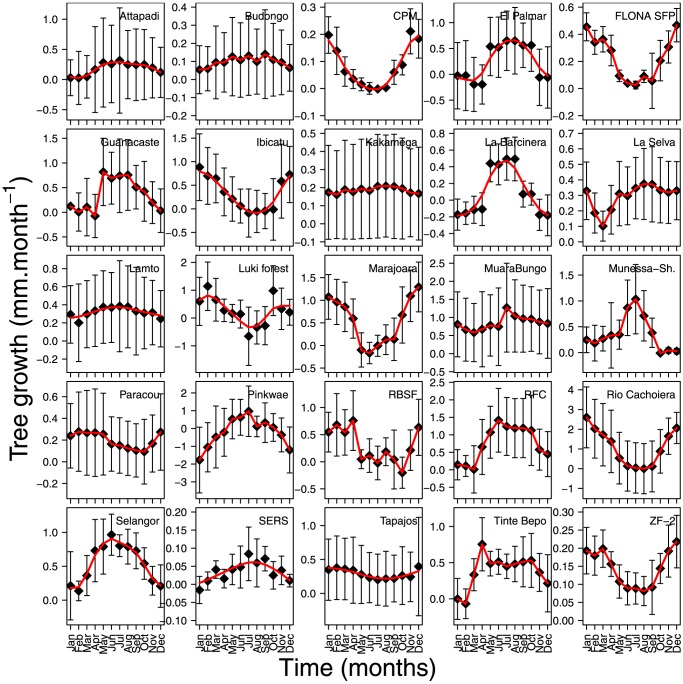
Figure 3. Evolution of mean monthly tree growth values and standard deviation for the studied forest sites.
The red line represents a cubic smoothing spline.
Figure 4
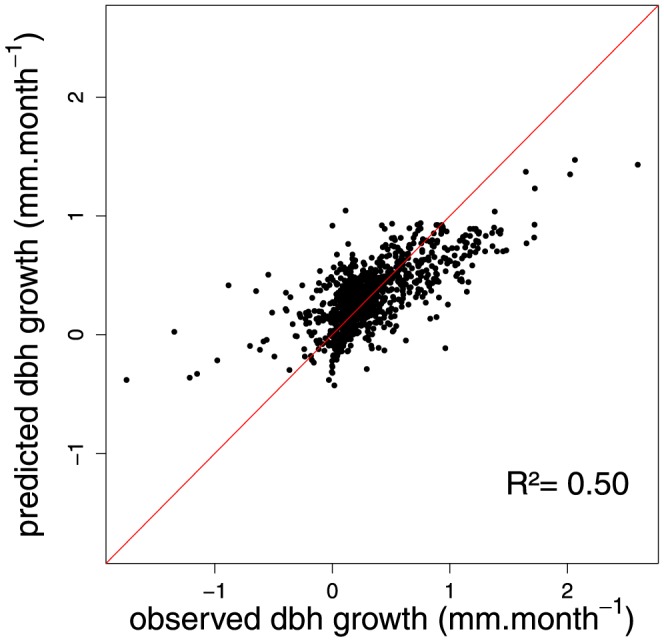
Figure 4. Observed versus predicted diameter at breast height (dbh) growth under the model mBIC.
The red line is the identity line y  =  x. Note that the model underestimated the diameter growth above 1 mm.month−1.
Figure 5
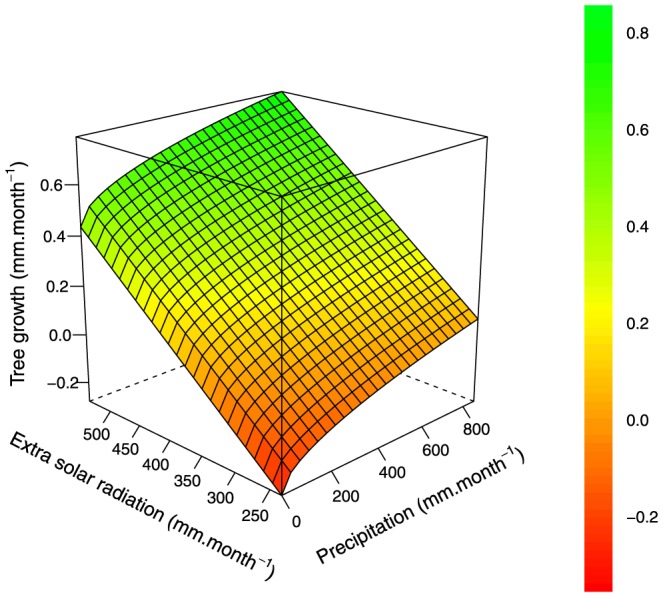
Figure 5. Predicted diameter at breast height (dbh) growth under the model mBIC and relationship with precipitation and extra solar radiation.
Predictions were computed using pre, sol, mean dtr, mean swc and mean of the random effect. The extra solar radiation unit is equivalent of evaporation in mm.month−1, 1 mm.month−1 equivalent of evaporation  =  2.45 MJ.m−2.month−1.

References

    1. Malhi Y, Wright J (2004) Spatial patterns and recent trends in the climate of tropical rainforest regions. Philosophical Transactions of the Royal Society of London Series B-Biological Sciences 359: 311–329. - PMC - PubMed
    1. Solomon S, Plattner GK, Knutti R, Friedlingstein P (2009) Irreversible climate change due to carbon dioxide emissions. Proceedings of the National Academy of Sciences of the United States of America 106: 1704–1709. - PMC - PubMed
    1. Harris NL, Hall CAS, Lugo AE (2008) Estimates of species- and ecosystem-level respiration of woody stems along an elevational gradient in the Luquillo Mountains, Puerto Rico. Ecological Modelling 216: 253–264.
    1. Spracklen D, Arnold S, Taylor C (2012) Observations of increased tropical rainfall preceded by air passage over forests. Nature 489: 282–285. - PubMed
    1. Malhi Y, Aragao LEOC, Galbraith D, Huntingford C, Fisher R, et al. (2009) Exploring the likelihood and mechanism of a climate-change-induced dieback of the Amazon rainforest. Proceedings of the National Academy of Sciences of the United States of America 106: 20610–20615. - PMC - PubMed

Publication types