. 2014 Jun 1;306(11):R804-13.
doi: 10.1152/ajpregu.00074.2014. Epub 2014 Mar 26.

Coping with dehydration: sympathetic activation and regulation of glutamatergic transmission in the hypothalamic PVN

Affiliations

Coping with dehydration: sympathetic activation and regulation of glutamatergic transmission in the hypothalamic PVN

Megan E Bardgett et al. Am J Physiol Regul Integr Comp Physiol. .

Abstract

Autonomic and endocrine profiles of chronic hypertension and heart failure resemble those of acute dehydration. Importantly, all of these conditions are associated with exaggerated sympathetic nerve activity (SNA) driven by glutamatergic activation of the hypothalamic paraventricular nucleus (PVN). Here, studies sought to gain insight into mechanisms of disease by determining the role of PVN ionotropic glutamate receptors in supporting SNA and mean arterial pressure (MAP) during dehydration and by elucidating mechanisms regulating receptor activity. Blockade of PVN N-methyl-D-aspartate (NMDA) receptors reduced (P < 0.01) renal SNA and MAP in urethane-chloralose-anesthetized dehydrated (DH) (48 h water deprivation) rats, but had no effect in euhydrated (EH) controls. Blockade of PVN α-amino-3-hydroxy-5-methyl-4-isoxazolepropionic acid (AMPA) receptors had no effect in either group. NMDA in PVN caused dose-dependent increases of renal SNA and MAP in both groups, but the maximum agonist evoked response (Emax) of the renal SNA response was greater (P < 0.05) in DH rats. The latter was not explained by increased PVN expression of NMDA receptor NR1 subunit protein, increased PVN neuronal excitability, or decreased brain water content. Interestingly, PVN injection of the pan-specific excitatory amino acid transporter (EAAT) inhibitor DL-threo-β-benzyloxyaspartic acid produced smaller sympathoexcitatory and pressor responses in DH rats, which was associated with reduced glial expression of EAAT2 in PVN. Like chronic hypertension and heart failure, dehydration increases excitatory NMDA receptor tone in PVN. Reduced glial-mediated glutamate uptake was identified as a key contributing factor. Defective glutamate uptake in PVN could therefore be an important, but as yet unexplored, mechanism driving sympathetic hyperactivity in chronic cardiovascular diseases.

Keywords: PVN; blood pressure; glutamate; sympathetic.


Figures

Fig. 1.
Fig. 1.
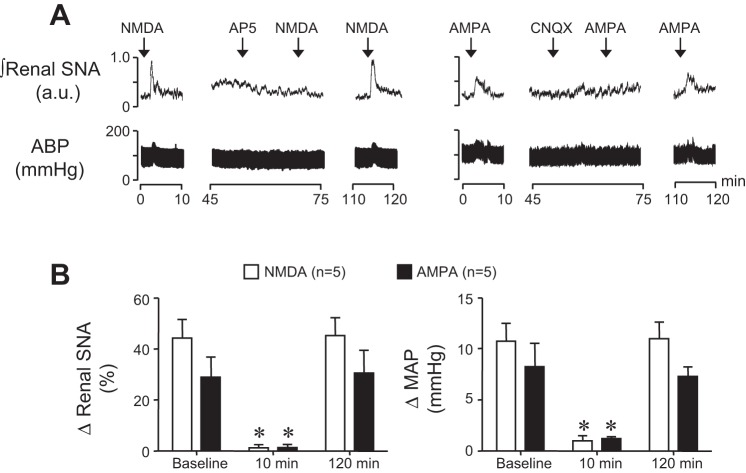
A: representative examples of renal sympathetic nerve activity (SNA) and arterial blood pressure (ABP) responses to paraventricular nucleus (PVN) injection of N-methyl-d-aspartate (NMDA) (left) and α-amino-3-hydroxy-5-methyl-4-isoxazolepropionic acid (AMPA) (right) at baseline, 10 min post-, and 120 min postmicroinjection of (2R)-amino-5-phosphonopentanoate (AP5) and 6-cyano-7-nitroquinoxaline-2,3-dione (CNQX), respectively. B: summary data of peak changes of renal SNA and mean arterial pressure (MAP) in response to PVN NMDA (n = 5) and AMPA (n = 5) at baseline, 10 min post-, and 120 min postmicroinjection of AP5 and CNQX, respectively. Note that AP5 and CNQX nearly abolished responses to their respective receptor agonists NMDA and AMPA at 10 min. Responses recovered after 120 min. *P < 0.05 vs. baseline response.
Fig. 2.
Fig. 2.
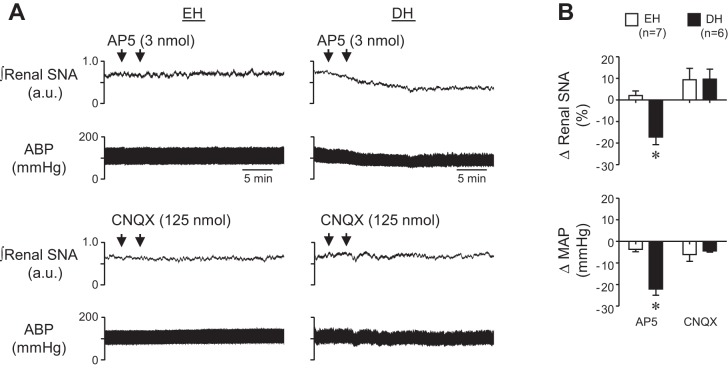
A: representative examples of renal SNA and ABP responses to PVN microinjection of AP5 (top) and CNQX (bottom) in euhydrated (EH) and dehydrated (DH) rats. B: summary data of peak changes of renal SNA and MAP after bilateral microinjection of AP5 or CNQX into PVN of EH (n = 7) and DH (n = 6) rats. Whereas AMPA receptor blockade had no effect in either EH or DH rats, blockade of PVN NMDA receptors significantly reduced ongoing renal SNA and MAP in DH rats only. *P < 0.05 vs. EH.
Fig. 3.
Fig. 3.
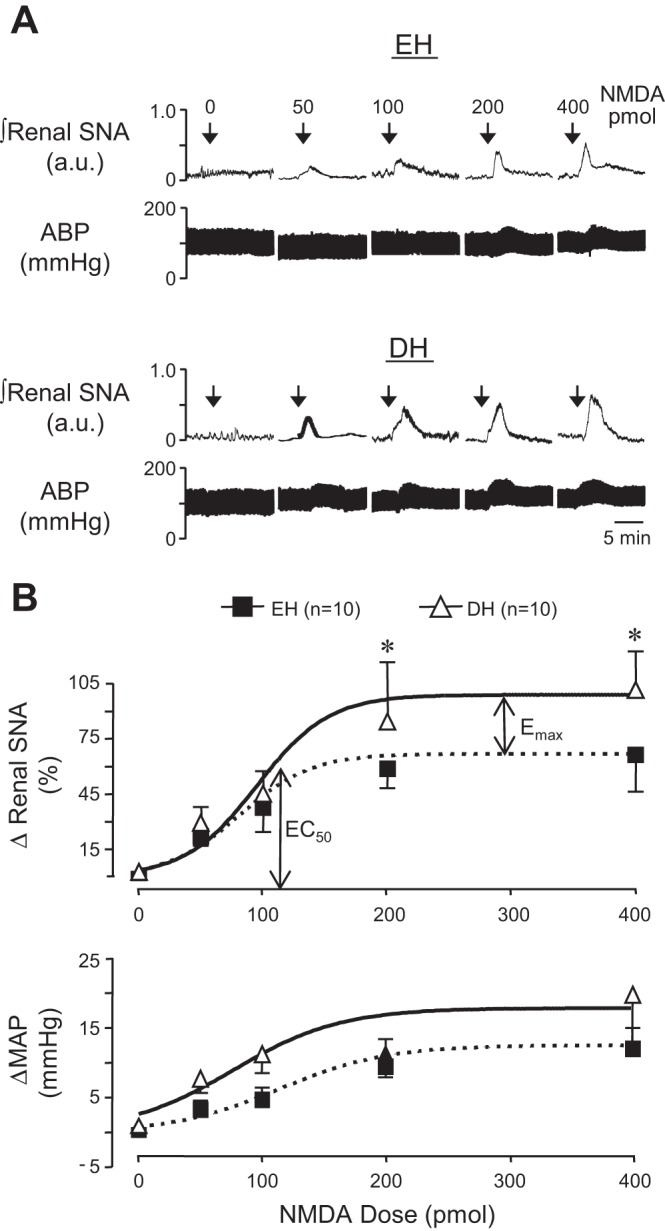
A: representative examples of renal SNA and ABP responses to PVN microinjection of graded doses of NMDA in an EH (top) and DH (bottom) rat. B: summary data illustrating peak changes of renal SNA and MAP in response to graded doses of NMDA microinjected into the PVN of control and DH rats. Data were fitted with a sigmoidal variable slope dose-response function to illustrate that, whereas the EC50 dose elicited similar responses across groups, the maximum agonist evoked response (Emax) response of renal SNA was significantly increased in DH compared with EH rats. *P < 0.05 vs. EH.
Fig. 4.
Fig. 4.
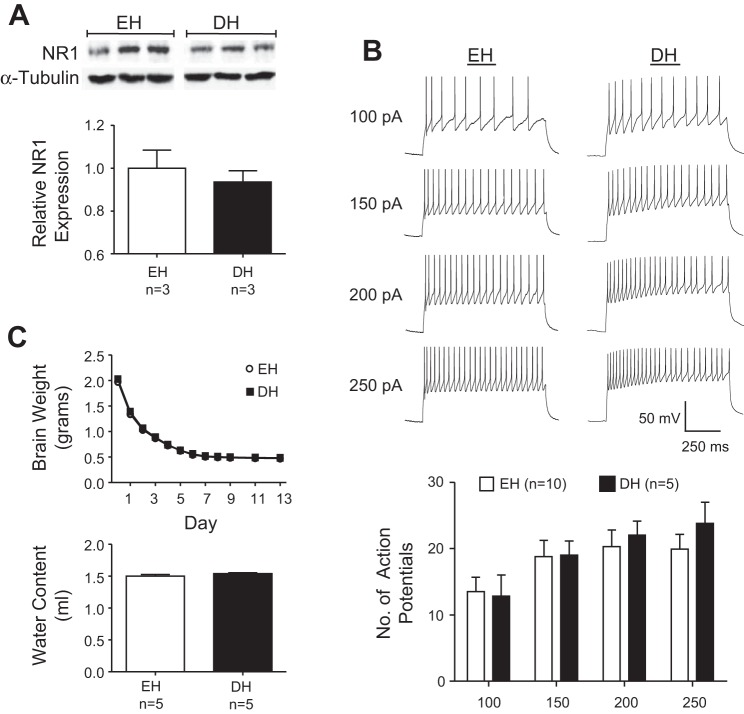
A: expression of NMDA receptor NR1 subunit protein in PVN samples measured by Western blot analysis. Mean band densities of NR1 relative to α-tubulin were not significantly different between DH and EH rats. B: representative traces of action potentials evoked by 100, 150, 200, and 250 pA current injections in a PVN-rostral ventrolateral medulla (RVLM) neuron from a control and DH rat (top). Summary of the number of action potentials evoked by graded current injections in neurons from control and DH rats (bottom). There was no difference of excitability among PVN-RVLM neurons from EH and DH rats at any level of current injection. C: weight of brains from control and DH rats. Initial weights were not significantly different between groups and remained similar through 13 days of dehydration (top). By day 13, brain weights were no longer changing and brain water content (difference between brain weight before and after desiccation) was not different between EH and DH rats (bottom).
Fig. 5.
Fig. 5.
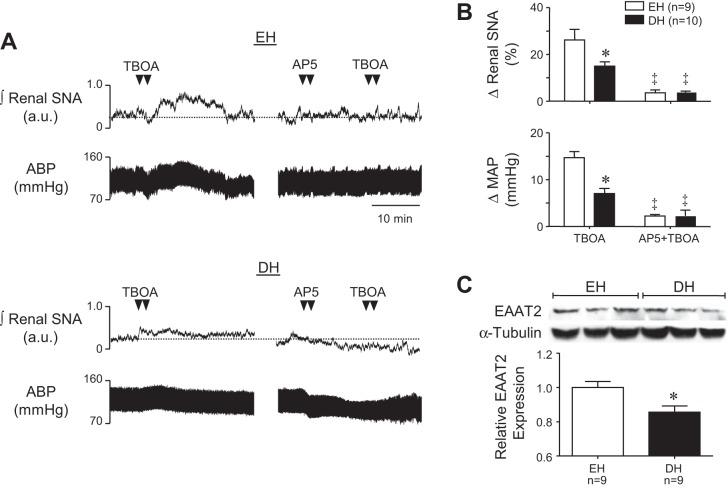
A: representative examples of renal SNA and ABP responses to PVN microinjection of the nonspecific glutamate transporter inhibitor dl-threo-β-benzyloxyaspartic acid (TBOA) (left) and AP5+TBOA (right) in an EH and DH rat. B: summary of peak changes of renal SNA (top) and MAP (bottom) in response to PVN microinjection of TBOA (250 pmol/50 nl) and TBOA+AP5 in EH and DH rats. C: protein expression of excitatory amino acid transporter-2 (EAAT2) in PVN samples measured by Western blot analysis. Mean data of band densities of EAAT2 relative to α-tubulin was significantly decreased in DH rats. *P < 0.05 vs. EH. ‡P < 0.05 vs. TBOA alone.
Fig. 6.
Fig. 6.
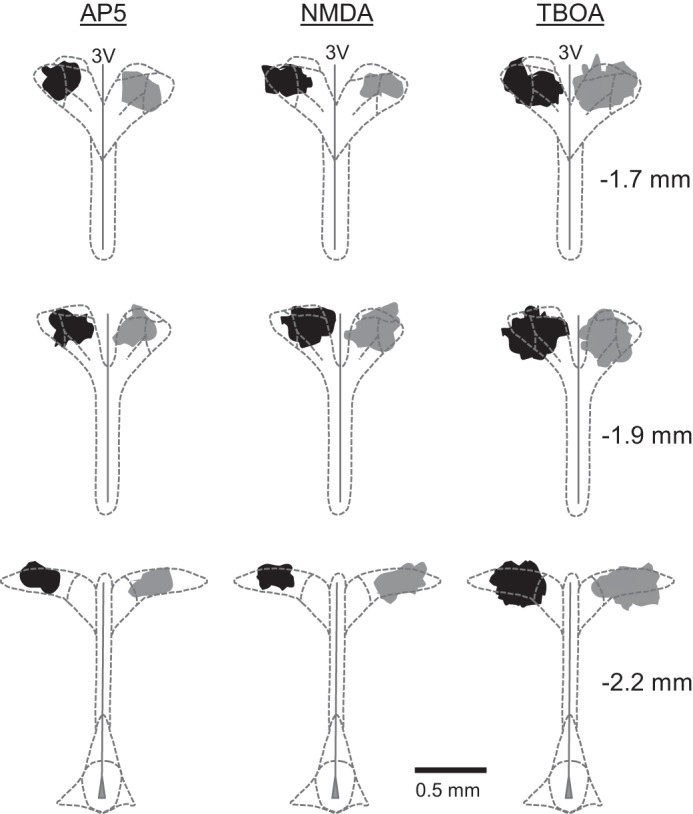
Injection sites were located within the area of the PVN in DH (black) and EH (gray) rats. Shaded regions represent the farthest distribution of fluorescent microspheres among all rats comprising each group. Sites of AP5 (n = 6–7/group), NMDA (n = 10/group), and TBOA (n = 9–10/group) injections were consistently made near the center of PVN. Coinjected fluorescent beads extended in the rostral-caudal plane to include most of the parvocellular and magnocellular subregions. Stereotaxic coordinates between the right most panels are referenced to bregma. 3V; third cerebral ventricle.

References

    1. Alvarez GE, Beske SD, Ballard TP, Davy KP. Sympathetic neural activation in visceral obesity. Circulation 106: 2533–2536, 2002 - PubMed
    1. Bardgett ME, Holbein WW, Herrera-Rosales M, Toney GM. Ang II-salt hypertension depends on neuronal activity in the hypothalamic paraventricular nucleus but not on local actions of tumor necrosis factor-α. Hypertension 2013 - PMC - PubMed
    1. Boudaba C, Schrader LA, Tasker JG. Physiological evidence for local excitatory synaptic circuits in the rat hypothalamus. J Neurophysiol 77: 3396–3400, 1997 - PubMed
    1. Brooks VL, Qi Y, O'Donaughy TL. Increased osmolality of conscious water-deprived rats supports arterial pressure and sympathetic activity via a brain action. Am J Physiol Regul Integr Comp Physiol 288: R1248–R1255, 2005 - PubMed
    1. Burnier M, Biollaz J, Brunner DB, Brunner HR. Blood pressure maintenance in awake dehydrated rats: renin, vasopressin, and sympathetic activity. Am J Physiol Heart Circ Physiol 245: H203–H209, 1983 - PubMed

Publication types

MeSH terms