. 2014 Mar;19(3):37004.
doi: 10.1117/1.JBO.19.3.037004.

Hemoglobin parameters from diffuse reflectance data

Affiliations

Hemoglobin parameters from diffuse reflectance data

Judith R Mourant et al. J Biomed Opt. 2014 Mar.

Abstract

Tissue vasculature is altered when cancer develops. Consequently, noninvasive methods of monitoring blood vessel size, density, and oxygenation would be valuable. Simple spectroscopy employing fiber optic probes to measure backscattering can potentially determine hemoglobin parameters. However, heterogeneity of blood distribution, the dependence of the tissue-volume-sampled on scattering and absorption, and the potential compression of tissue all hinder the accurate determination of hemoglobin parameters. We address each of these issues. A simple derivation of a correction factor for the absorption coefficient, μa, is presented. This correction factor depends not only on the vessel size, as others have shown, but also on the density of blood vessels. Monte Carlo simulations were used to determine the dependence of an effective pathlength of light through tissue which is parameterized as a ninth-order polynomial function of μa. The hemoglobin bands of backscattering spectra of cervical tissue are fit using these expressions to obtain effective blood vessel size and density, tissue hemoglobin concentration, and oxygenation. Hemoglobin concentration and vessel density were found to depend on the pressure applied during in vivo acquisition of the spectra. It is also shown that determined vessel size depends on the blood hemoglobin concentration used.


Figures
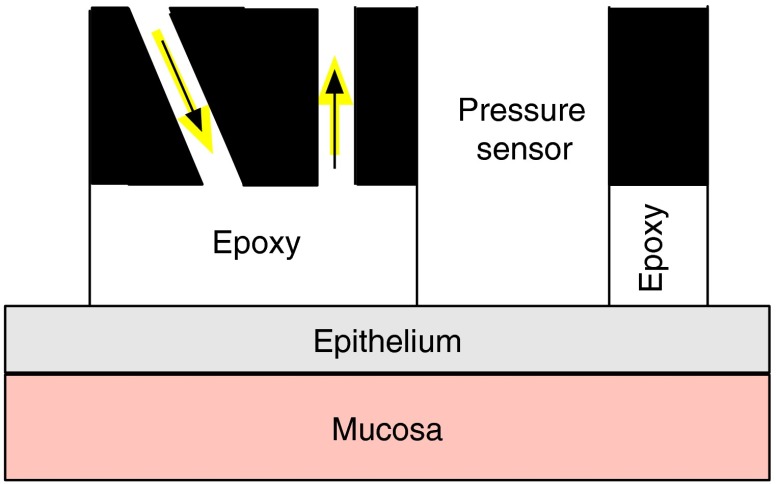
Fig. 1
Fig. 1
The geometry used for the measurements. The fiber optics were 200 μm in diameter with a numerical aperture of 0.37 and were embedded in black carbon. The epoxy spacer was several hundreds of microns thick.
Fig. 2
Fig. 2
Schematic of the geometry used for the derivation of a correction factor for μa. Light is assumed to be incident perpendicular to the page. r is the radius of the blood vessel and L is the length of the side of a cube of tissue. (a) Schematic of a blood vessel parallel to the direction of light travel. (b) Schematic for a blood vessel perpendicular to the direction of light travel.
Fig. 3
Fig. 3
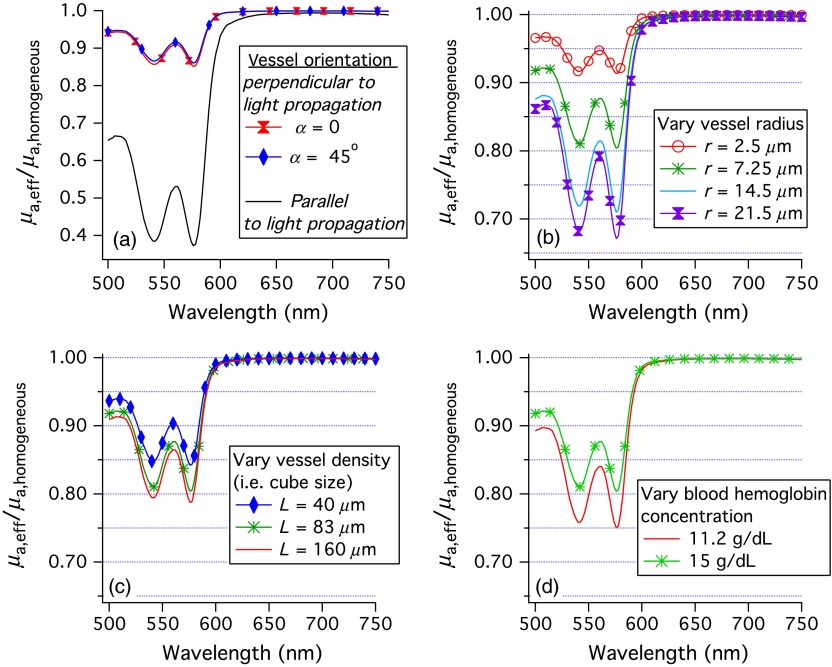
Ratios of the effective optical absorption coefficient for oxygenated blood in a vessel to the absorption coefficient if the blood were distributed homogeneously. (a) The black line correponds to the vessel orientation of Fig. 2(a) and the colored (lighter) lines correspond to the vessel orientation of Fig. 2(b). (b–d) The average ratio of the effective absorption coefficient for oxygenated blood in a vessel to the absorption coefficient if the blood was distributed homogeneously. Unless otherwise stated in the captions, L=83  μm, r=7.25  μm, and the hemoglobin concentration of blood was 15  g/dL.
Fig. 4
Fig. 4
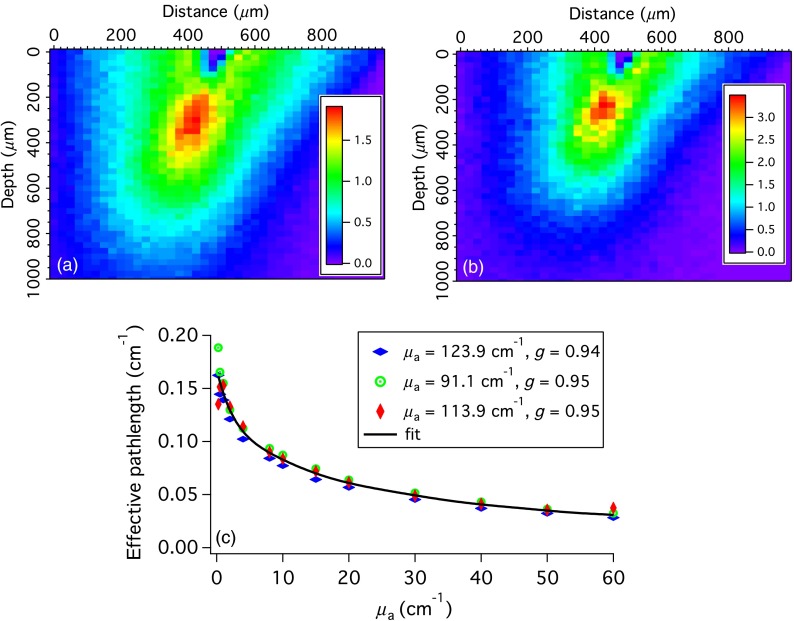
(a and b) The density of scattering events (summed over the axis perpendicular to the page). For (a) μa=0 and for (b) μa=10  cm1. The color scale is the number of scattering events per pixel. (c) The effective pathlength over which absorption occurs. The data points were calculated via Eq. (7) using Monte Carlo simulations. Each type of symbol represents a different set of scattering parameters. The black line is a polynomial fit to all of the data.
Fig. 5
Fig. 5
Examples of in vivo measurements and fits to the model of this paper.
Fig. 6
Fig. 6
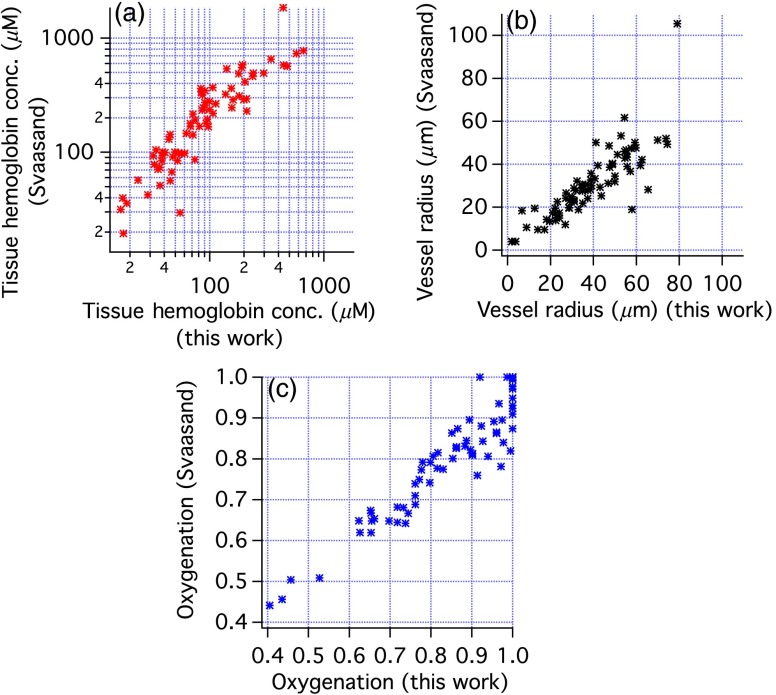
Comparison of results of fitting in vivo spectra using either the correction factor derived in this paper or by Svaasand as written by van Veen. (a) Tissue hemoglobin concentration, (b) vessel radius, and (c) oxygenation.
Fig. 7
Fig. 7
(a) Hemoglobin concentration versus probe pressure for 80 measurements. (b) Vessel density versus the pressure. Straight line fits and confidence intervals are shown.
Fig. 8
Fig. 8
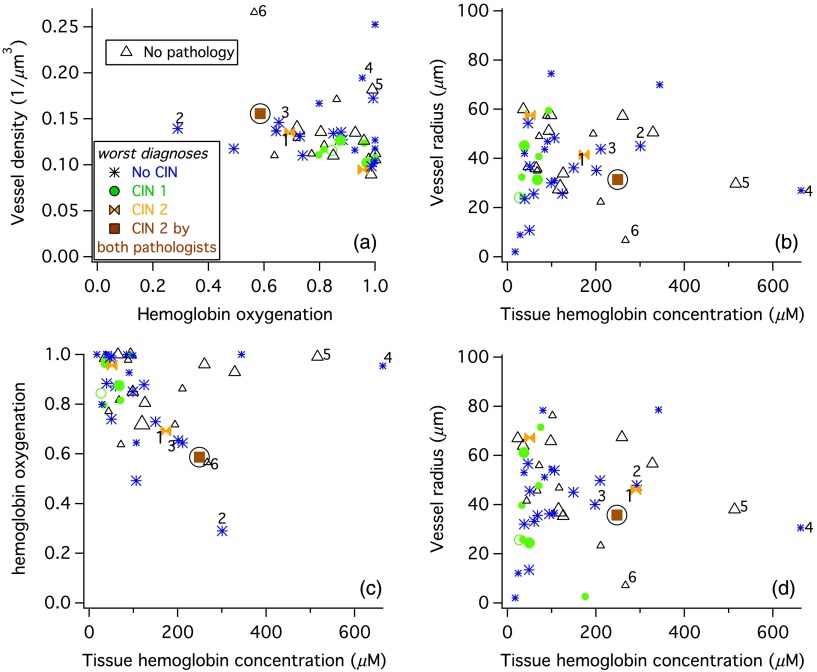
Results for 49 sites. Large symbols are averages of two (or three) spectroscopic measurements. The pathology is denoted by a color and marker as denoted in the legend of panel (a). Some sites are numbered so that their location can be compared in different panels. (a–c) Results of fits performed assuming a blood hemoglobin concentration of 15  g/dL. (d) Results of fits performed using venous blood hemoglobin measurements.

References

    1. Raica M., Cimpeana A. M., Ribatti D., “Angiogenesis in pre-malignant conditions,” Eur. J. Cancer 45(11), 1924–1934 (2009).EJCAEL10.1016/j.ejca.2009.04.007 - DOI - PubMed
    1. Tiwari A. K., et al. , “Neo-angiogenesis and the premalignant micro-circulatory augmentation of early colon carcinogenesis,” Cancer Lett. 306(2), 205–213 (2011).CALEDQ10.1016/j.canlet.2011.03.008 - DOI - PMC - PubMed
    1. Oliveira-Neto H. H., et al. , “A comparative study of microvessel density in squamous cell carcinoma of the oral cavity and lip,” Oral Surg. Oral Med. Oral Pathol. Oral Radiol. 113(3), 391–398 (2012).10.1016/j.tripleo.2011.08.010 - DOI - PubMed
    1. Astekar M., et al. , “Expression of vascular endothelial growth factor and microvessel density in oral tumorigenesis,” J. Oral Maxillofac. Pathol. 16(1), 22–26 (2012).10.4103/0973-029X.92968 - DOI - PMC - PubMed
    1. Choi W. W. L., et al. , “Angiogenic and lymphangiogenic microvessel density in breast carcinoma: correlation with clinicopathologic parameters and VEGF-family gene expression,” Mod. Pathol. 18, 143–152 (2005).MODPEO10.1038/modpathol.3800253 - DOI - PubMed

Publication types