. 2014 May;21(5):769-76.
doi: 10.1128/CVI.00063-14. Epub 2014 Mar 26.

Activation of innate immune responses by Haemophilus influenzae lipooligosaccharide

Affiliations

Activation of innate immune responses by Haemophilus influenzae lipooligosaccharide

Joshua Choi et al. Clin Vaccine Immunol. 2014 May.

Abstract

A Gram-negative pathogen Haemophilus influenzae has a truncated endotoxin known as lipooligosaccharide (LOS). Recent studies on H. influenzae LOS highlighted its structural and compositional implications for bacterial virulence; however, the role of LOS in the activation of innate and adaptive immunity is poorly understood. THP-1 monocytes were stimulated with either lipopolysaccharide (LPS) from Escherichia coli or LOS compounds derived from H. influenzae Eagan, Rd, and Rd lic1 lpsA strains. Cell surface expression of key antigen-presenting, costimulatory, and adhesion molecules, as well as gene expression of some cytokines and pattern recognition receptors, were studied. Eagan and Rd LOS had a lower capacity to induce the expression of ICAM-1, CD40, CD58, tumor necrosis factor alpha (TNF-α), and interleukin-1β (IL-1β) compared to LPS. In contrast, antigen-presenting (HLA-ABC or HLA-DR) and costimulatory (CD86) molecules and NOD2 were similarly upregulated in response to LOS and LPS. LOS from a mutant Rd strain (Rd lic1 lpsA) consistently induced higher expression of innate immune molecules than the wild-type LOS, suggesting the importance of phosphorylcholine and/or oligosaccharide extension in cellular responses to LOS. An LOS compound with a strong ability to upregulate antigen-presenting and costimulatory molecules combined with a low proinflammatory activity may be considered a vaccine candidate to immunize against H. influenzae.


Figures
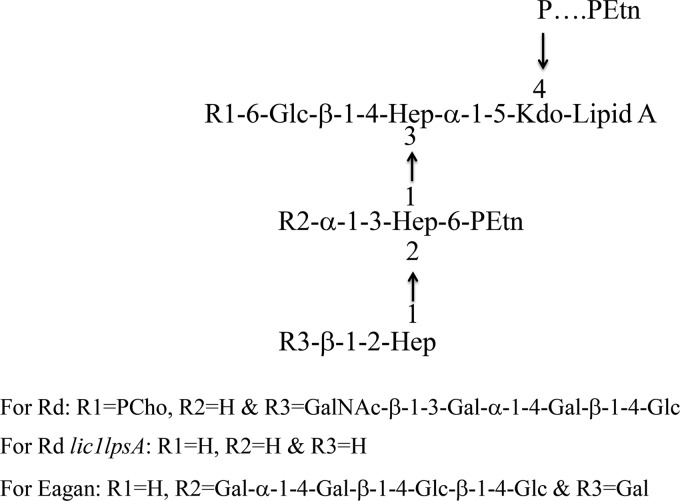
FIG 1
FIG 1
Schematic representation of LOS from H. influenzae strains Eagan, Rd, and Rd lic1 lpsA as determined by MALDI. Represented in the LOS structure are 2-keto-3-deoxyoctulosonic acid (Kdo), heptose (Hep), glucose (Glc), galactose (Gal), N-acetylgalactosamine (GalNac), phosphate (P), phosphorylcholine (PCho), and phosphoethanolamine (PEtn).
FIG 2
FIG 2
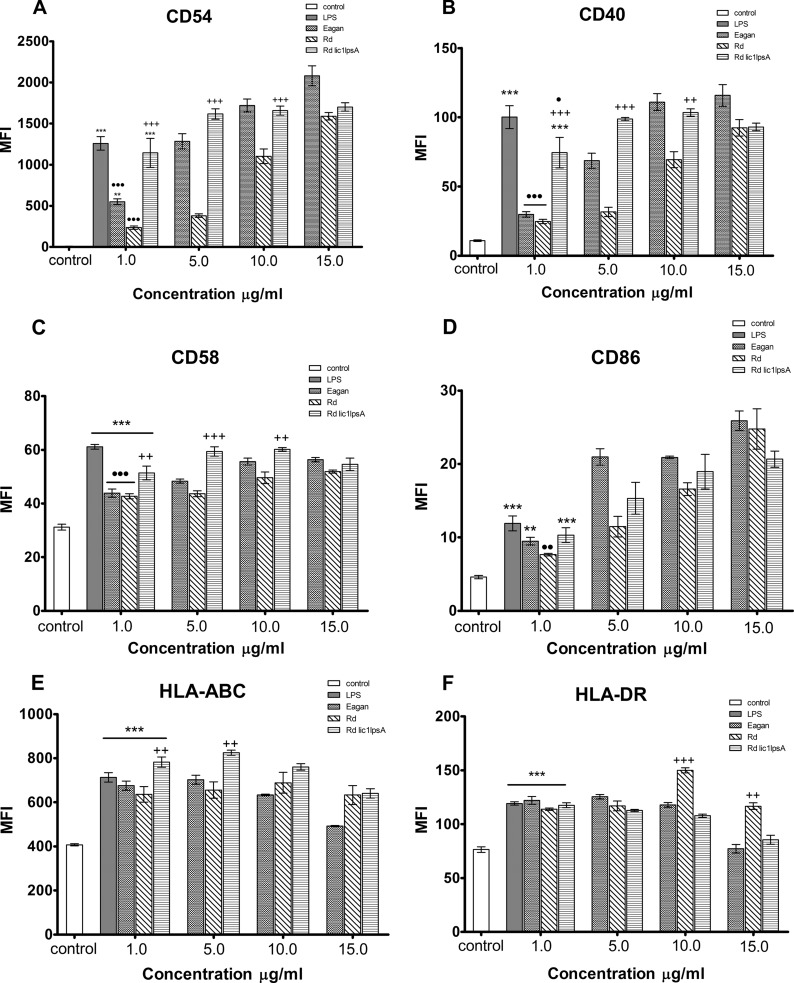
Flow cytometry analysis of costimulatory and antigen-presenting molecule expression in response to LOS stimulation on THP-1 cells. The negative control was untreated medium alone, and the positive control was LPS stimulation at 1 μg/ml. THP-1 cells were stimulated with LOS compounds for 24 h at concentrations of 1, 5, 10, and 15 μg/ml, and cell surface expression of CD54 (A), CD40 (B), CD58 (C), CD86 (D) HLA-ABC (E), and HLA-DR (F) was measured. Data represent the mean fluorescence intensity (MFI) ± the standard error of the mean (SEM) (n = 3). Significant differences are indicated as follows: *, P < 0.05 compared to the unstimulated control; +, P < 0.05 between Rd lic1 lpsA and Rd wild-type compounds; ●, P < 0.05 between LPS and LOS compounds.
FIG 3
FIG 3
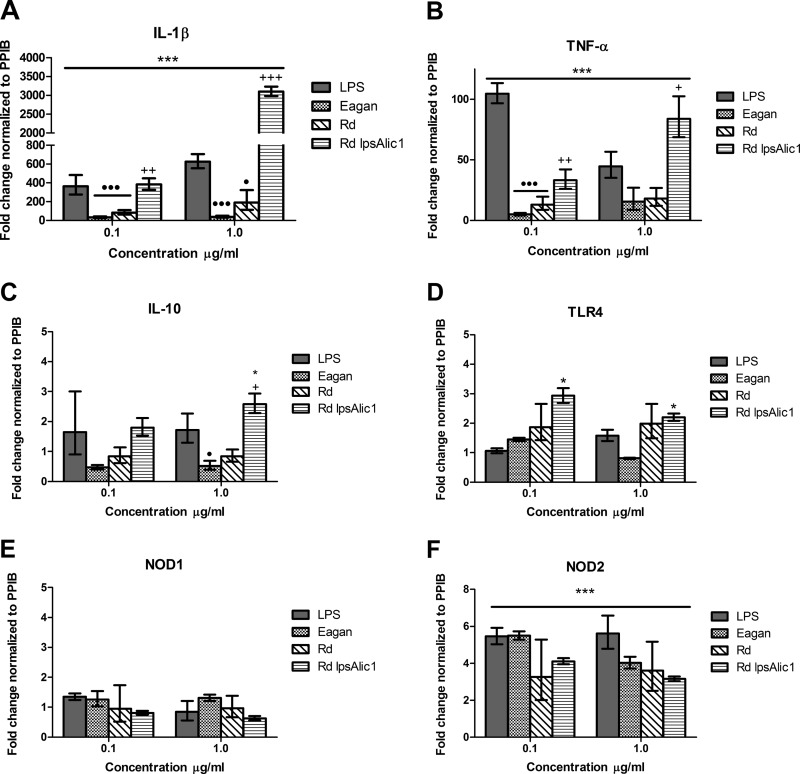
Relative gene expression of THP-1 cells in response to LOS stimulation. THP-1 cells were stimulated with LOS compounds for 4 h at concentrations of 0.1 and 1 μg/ml. RNA was extracted, and genetic expression was measured using real-time PCR and is presented as fold change relative to the unstimulated control. Expression of the genes coding for IL-1β (A), TNF-α (B), IL-10 (C), TLR4 (D), NOD1 (E), and NOD2 (F) was measured. Data represent means ± SEM (n = 3). Significant differences are indicated as follows: *, P < 0.05 compared to unstimulated control; +, P < 0.05 between Rd lic1 lpsA and Rd wild-type compounds; ●, P < 0.05 between LPS and LOS compounds.

References

    1. Turk DC. 1984. The pathogenicity of Haemophilus influenzae. J. Med. Microbiol. 18:1–16. 10.1099/00222615-18-1-1 - DOI - PubMed
    1. Kelly DF, Moxon ER, Pollard AJ. 2004. Haemophilus influenzae type b conjugate vaccines. Immunology 113:163–174. 10.1111/j.1365-2567.2004.01971.x - DOI - PMC - PubMed
    1. Ladhani S, Slack MP, Heath PT, von Gottberg A, Chandra M, Ramsay ME, European Union Invasive Bacterial Infection Surveillance 2010. Invasive Haemophilus influenzae disease, Europe, 1996–2006. Emerg. Infect. Dis. 16:455–463. 10.3201/eid1603.090290 - DOI - PMC - PubMed
    1. Dworkin MS, Park L, Borchardt SM. 2007. The changing epidemiology of invasive Haemophilus influenzae disease, especially in persons ≥65 years old. Clin. Infect. Dis. 44:810–816. 10.1086/511861 - DOI - PubMed
    1. Moxon ER, Vaughn KA. 1981. The type b capsular polysaccharide as a virulence determinant of Haemophilus influenzae: studies using clinical isolates and laboratory transformants. J. Infect. Dis. 143:517–524. 10.1093/infdis/143.4.517 - DOI - PubMed

Publication types

LinkOut - more resources