Review
. 2015 Mar;123(3):241-53.
doi: 10.1007/s11120-014-9991-x. Epub 2014 Mar 27.

Engineering photosynthetic organisms for the production of biohydrogen

Affiliations
Review

Engineering photosynthetic organisms for the production of biohydrogen

Alexandra Dubini et al. Photosynth Res. 2015 Mar.

Abstract

Oxygenic photosynthetic organisms such as green algae are capable of absorbing sunlight and converting the chemical energy into hydrogen gas. This process takes advantage of the photosynthetic apparatus of these organisms which links water oxidation to H2 production. Biological H2 has therefore the potential to be an alternative fuel of the future and shows great promise for generating large scale sustainable energy. Microalgae are able to produce H2 under light anoxic or dark anoxic condition by activating 3 different pathways that utilize the hydrogenases as catalysts. In this review, we highlight the principal barriers that prevent hydrogen production in green algae and how those limitations are being addressed, through metabolic and genetic engineering. We also discuss the major challenges and bottlenecks facing the development of future commercial algal photobiological systems for H2 production. Finally we provide suggestions for future strategies and potential new techniques to be developed towards an integrated system with optimized hydrogen production.


Figures
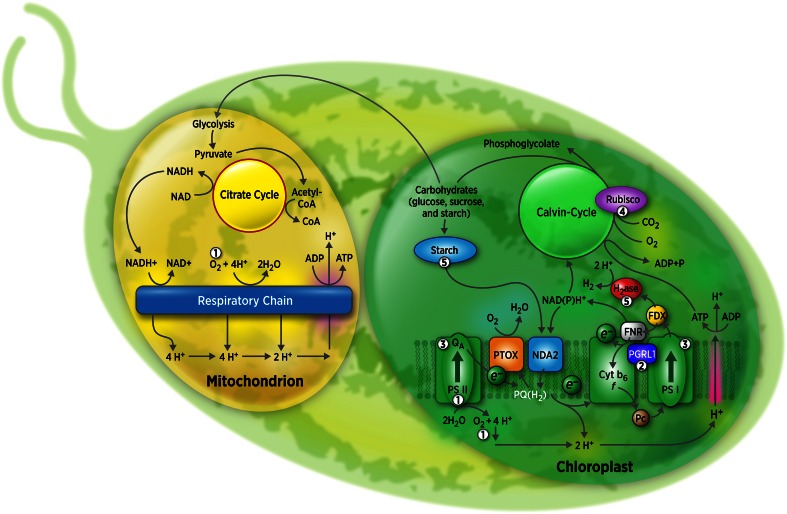
Fig. 1
Fig. 1
Representation of the hydrogen photoproduction-related pathways in Chlamydomonas. Hydrogen production occurs in the chloroplast, where the photosynthetic chain and the hydrogenases are located (see text for more details). The respiratory chain is located in the mitochondrion, and there is an extensive communication between the two organelles that can impact the level of hydrogen production (adapted from Kruse et al. 2005). The circled numbers indicate where current genetic engineering efforts have impacted H2 photoproduction, as described in the text. The barriers overcome by these modifications are: (1) O2 sensitivity, addressed by PSII inactivation and/or increased O2 consumption; (2) proton gradient dissipation, addressed by the pgrl1 knockout mutation (decreased CEF); (3) photosynthetic efficiency, addressed by knockdown of light-harvesting antennae or truncating antenna proteins; (4) competition for electron, addressed by Rubisco mutagenesis; (5) low reductant flux and hydrogenase expression, addressed by impacting starch accumulation/degradation, FDX-HYD fusion, and overexpressing hydrogenase, respectively. It must be noted that, for clarity, not all the genetic engineering approaches mentioned in the text are represented in the figure
Fig. 2
Fig. 2
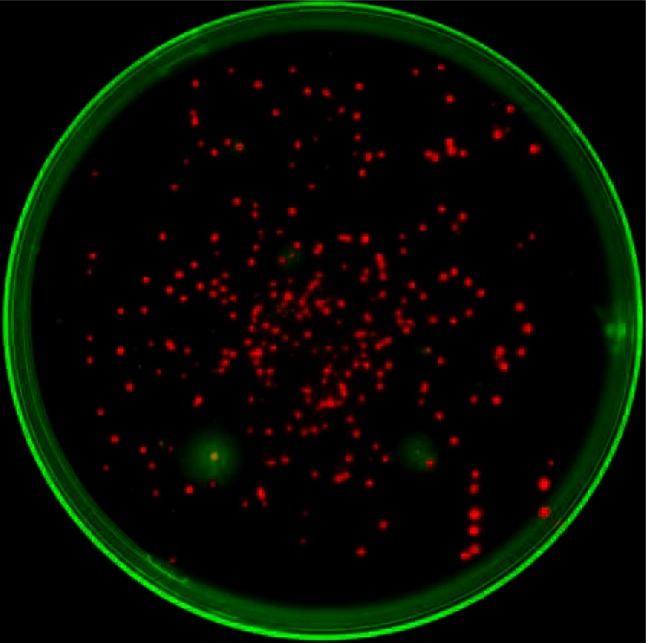
Detection of H2 photoproduction by algal colonies at high light fluxes using the R. capsulatus emGFP overlay screening assay. Composite images indicating H2 production in green and colony density in red, as taken with a Fluorchem Q imaging system, are shown. Transformants from a Chlamydomonas reinhardtii insertional mutagenesis library were plated on hygromycin plates, and overlaid with the Rhodobacter capsulatus GFP-based H2-sensing system. The plate was incubated for 16 h at 300 μE m−2 s−1 light prior to fluorescence imaging. The figure shows four strains capable of H2 production at this light level (Wecker et al. 2011)

References

    1. Antal T, Mattila H, Hakala-Yatkin M, Tyystjarvi T, Tyystjarvi E. Acclimation of photosynthesis to nitrogen deficiency in Phaseolus vulgaris. Planta. 2010;232(4):887–898. doi: 10.1007/s00425-010-1227-5. - DOI - PubMed
    1. Chang C, King P, Ghirardi M, Kim K. Atomic resolution Modeling of the ferredoxin :[FeFe] hydrogenase complex from Chlamydomonas reinhardtii. Biophys J. 2007;93(9):3034–3045. doi: 10.1529/biophysj.107.108589. - DOI - PMC - PubMed
    1. Chen H, Newton A, Melis A. Role of SulP, a nuclear-encoded chloroplast sulfate permease, in sulfate transport and H-2 evolution in Chlamydomonas reinhardtii. Photosynth Res. 2005;84(1–3):289–296. doi: 10.1007/s11120-004-7157-y. - DOI - PubMed
    1. Chien L, Kuo T, Liu B, Lin H, Feng T, Huang C. Solar-to-bioH2 production enhanced by homologous overexpression of hydrogenase in green alga Chlorella sp. DT. Int J Hydrogen Energy. 2012;37(23):17738–17748. doi: 10.1016/j.ijhydene.2012.09.068. - DOI
    1. Chochois V, Constans L, Dauvillée D, Beyly A, Solivérès M, Ball S, Peltier G, Cournac L. Relationships between PSII-independent hydrogen bioproduction and starch metabolism as evidenced from isolation of starch catabolism mutants in the green alga Chlamydomonas reinhardtii. Int J Hydrogen Energy. 2010;35(19):10731–10740. doi: 10.1016/j.ijhydene.2010.03.052. - DOI

Publication types