. 2014 Mar 14:8:80.
doi: 10.3389/fnbeh.2014.00080. eCollection 2014.

Conceptualization of relative size by honeybees

Affiliations

Conceptualization of relative size by honeybees

Aurore Avarguès-Weber et al. Front Behav Neurosci. .

Abstract

The ability to process visual information using relational rules allows for decisions independent of the specific physical attributes of individual stimuli. Until recently, the manipulation of relational concepts was considered as a prerogative of large mammalian brains. Here we show that individual free flying honeybees can learn to use size relationship rules to choose either the larger or smaller stimulus as the correct solution in a given context, and subsequently apply the learnt rule to novel colors and shapes providing that there is sufficient input to the long wavelength (green) photoreceptor channel. Our results add a novel, size-based conceptual rule to the set of relational concepts that honeybees have been shown to master and underline the value of bees as an animal model for studying the emergence of conceptualization abilities.

Keywords: Apis mellifera; honeybee; long wavelength photoreceptor; relational concept learning; relative size.


Figures
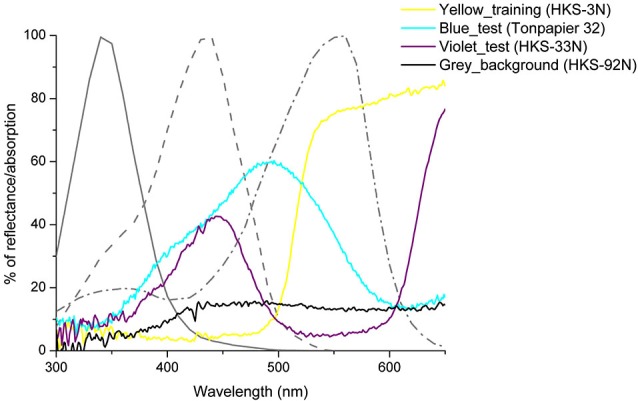
Figure 1
Figure 1
Spectral reflection curves of the stimuli used in our experiments and relative absorptions of the three honeybee’s photoreceptors, S, M and L (shown in gray). The colors distances between these colors in two perceptual spaces proposed for the honey bee, the color hexagon (Chittka, 1992) and the color opponent coding space (Backhaus, 1991) were high enough as to allow discrimination in all cases (Dyer et al., ; see Table 1).
Figure 2
Figure 2
Training and testing procedure. The bees had to choose between stimuli varying only in size. At each foraging bout, the bees faced stimuli of two different sizes taken randomly between the six available sizes (from 1 to 6 cm with 1 cm step). Depending on testing group, the smallest or the largest stimuli were rewarded with a sucrose solution while the alternative stimuli were associated with a quinine solution. Each stimulus was presented twice. Four stimuli (two identical S+ and two identical S−) were then simultaneously offered to the bees. During training, stimuli shapes and size combinations varied to facilitate concept learning. Once training was completed, the bees were subjected to non-rewarded transfer tests intermingled with refreshing training trials. Note that only a subset of all possible tests was proposed to each bee (see text for details). The insert show a representation of the rotating screen on which the four stimuli are vertically presented in a random spatial organization (Dyer et al., 2005).
Figure 3
Figure 3
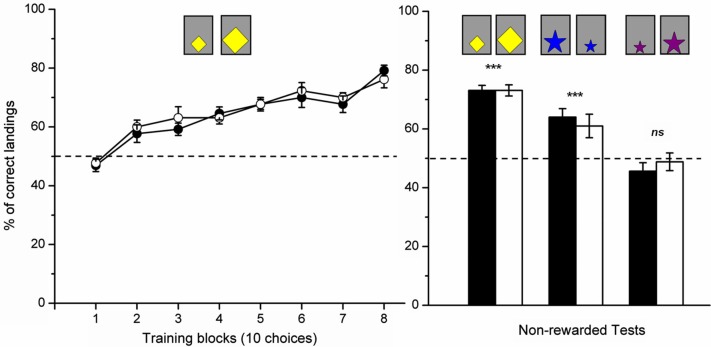
Performance of the tested honeybees. Percentage of correct choices in the training (left panel) and tests (right panel) phases. Performance of the bees rewarded on the larger stimuli are presented in black while performance of the bees rewarded on the smaller stimuli are presented in white. The dashed line indicates chance level performance. Data shown are means +s.e.m. n = 26 for the acquisition curve and learning test. 10 of the 26 bees were tested in the “blue stars transfer test” while the others were tested in the “violet stars transfer test” (***: p < 0.001; n.s: p > 0.05).

References

    1. Avarguès-Weber A., De Brito Sanchez M. G., Giurfa M., Dyer A. G. (2010a). Aversive reinforcement improves visual discrimination learning in free-flying honeybees. PLoS One 5:e15370 10.1371/journal.pone.0015370 - DOI - PMC - PubMed
    1. Avarguès-Weber A., Deisig N., Giurfa M. (2011a). Visual cognition in social insects. Ann. Rev. Entomol. 56, 423–443 10.1146/annurev-ento-120709-144855 - DOI - PubMed
    1. Avarguès-Weber A., Dyer A. G., Combe M., Giurfa M. (2012). Simultaneous mastering of two abstract concepts with a miniature brain. Proc. Natl. Acad. Sci. U S A 109, 7481–7486 10.1073/pnas.1202576109 - DOI - PMC - PubMed
    1. Avarguès-Weber A., Dyer A. G., Giurfa M. (2011b). Conceptualization of above and below relationships by an insect. Proc. Biol. Sci. 278, 898–905 10.1098/rspb.2010.1891 - DOI - PMC - PubMed
    1. Avarguès-Weber A., Giurfa M. (2013). Conceptual learning by miniature brains. Proc. Biol. Sci. 280:20131907 10.1098/rspb.2013.1907 - DOI - PMC - PubMed

LinkOut - more resources