. 2014 Mar 14:8:22.
doi: 10.3389/fncom.2014.00022. eCollection 2014.

Chunking dynamics: heteroclinics in mind

Affiliations

Chunking dynamics: heteroclinics in mind

Mikhail I Rabinovich et al. Front Comput Neurosci. .

Abstract

Recent results of imaging technologies and non-linear dynamics make possible to relate the structure and dynamics of functional brain networks to different mental tasks and to build theoretical models for the description and prediction of cognitive activity. Such models are non-linear dynamical descriptions of the interaction of the core components-brain modes-participating in a specific mental function. The dynamical images of different mental processes depend on their temporal features. The dynamics of many cognitive functions are transient. They are often observed as a chain of sequentially changing metastable states. A stable heteroclinic channel (SHC) consisting of a chain of saddles-metastable states-connected by unstable separatrices is a mathematical image for robust transients. In this paper we focus on hierarchical chunking dynamics that can represent several forms of transient cognitive activity. Chunking is a dynamical phenomenon that nature uses to perform information processing of long sequences by dividing them in shorter information items. Chunking, for example, makes more efficient the use of short-term memory by breaking up long strings of information (like in language where one can see the separation of a novel on chapters, paragraphs, sentences, and finally words). Chunking is important in many processes of perception, learning, and cognition in humans and animals. Based on anatomical information about the hierarchical organization of functional brain networks, we propose a cognitive network architecture that hierarchically chunks and super-chunks switching sequences of metastable states produced by winnerless competitive heteroclinic dynamics.

Keywords: chunking and superchunking; cognition modeling principles; cognitive dynamics; hierarchical sequences; low dimensionality of brain activity; stable heteroclinic channel; transient dynamics.


Figures
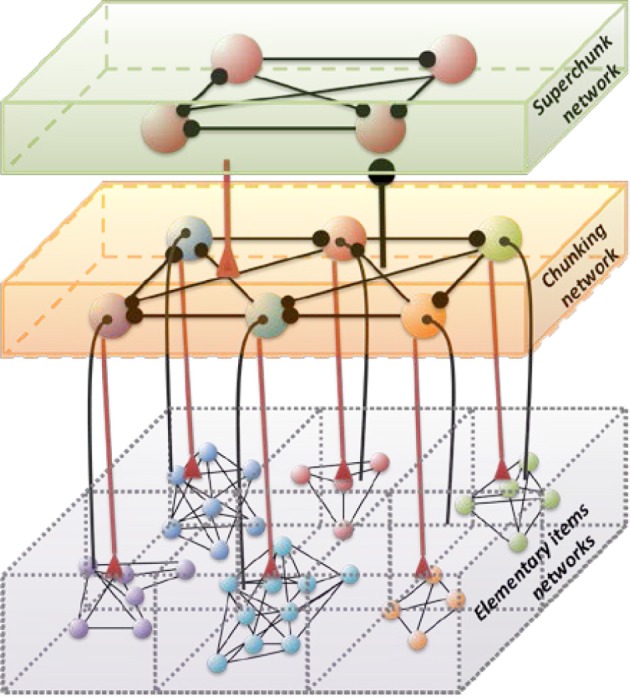
Figure 1
Figure 1
Architecture of the three level cognitive network responsible for the grouping of informational items. Each level of hierarchy is described by its own Lotka–Volterra type Equations (see 2–6) with connection matrices ρ, ξ and ς. Black circles represent inhibitory connections; triangles represent excitatory connections responsible for the choosing of the informational items. Spheres represent the informational items or units (metastable stables). Different colors indicate different chunks. All connections inside the elementary items are inhibitory.
Figure 2
Figure 2
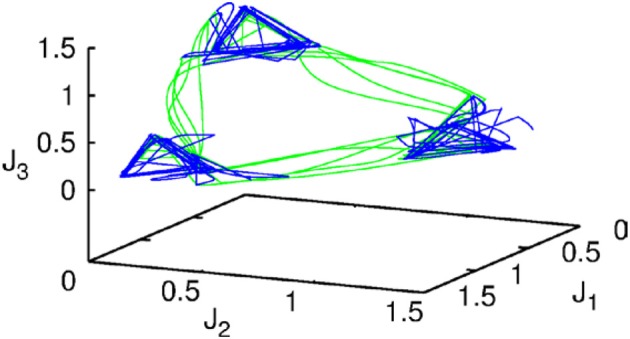
The projection of a nine-dimensional phase portrait of a two-level chunking hierarchical dynamics in the space of the three-dimensional auxiliary variables [see the Equations (2)–(4)] J1 = Y1 + 0.04 · (X11 + X21 + X31), J2 = Y2 + 0.04 · (X12 + X22 + X32), J3 = Y3 + 0.04 · (X13 + X23 + X33). Blue represents the elementary informational item activity—individual chunk. Green represents the chunking sequence.
Figure 3
Figure 3
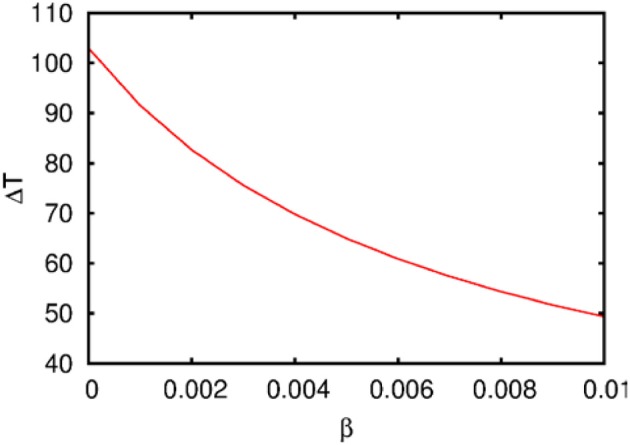
The dependence of the chunking interval timing [see Equation (1)] on the control parameter β. One can see that the chunking interval strongly decreases together with the increasing of the adaptation parameter β. When β increases the effective excitation of variable Y decreases.
Figure 4
Figure 4
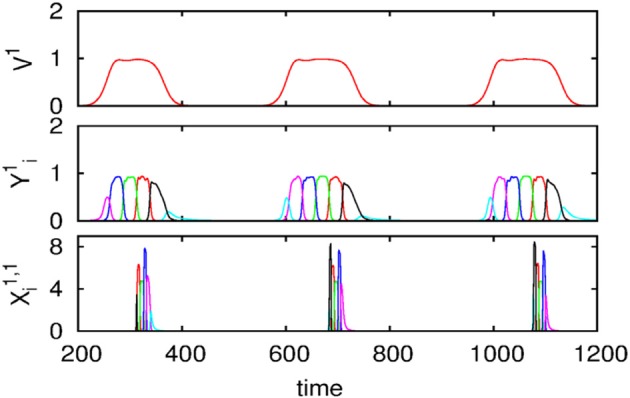
Time series of the sequences of the three-level hierarchy—108 items groupped in 18 chunks of 6 items; these chunks form 3 superchunks of 6 elements each displaying reproducible dynamics according to the model (2)–(6). Different colors correspond to different items inside each group (switching the color means moving from the previous item to the next one).

References

    1. Afraimovich V. S., Zhigulin V. P., Rabinovich M. I. (2004). On the origin of reproducible sequential activity in neural circuits. Chaos 14, 1123 10.1063/1.1819625 - DOI - PubMed
    1. Amari S.-I. (1972). Learning patterns and pattern sequences by self-organizing nets of threshold elements. IEEE Trans. Comput. C-21, 1197–1206 10.1109/T-C.1972.223477 - DOI
    1. Ashwin P., Field M., Rucklidge A. M., Sturman R. (2003). Phase resetting effects for robust cycles between chaotic sets. Chaos 13, 973–981 10.1063/1.1586531 - DOI - PubMed
    1. Bahlmann J., Schubotz R. I., Friederici A. D. (2008). Hierarchical artificial grammar processing engages Broca's area. Neuroimage 42, 525–534 10.1016/j.neuroimage.2008.04.249 - DOI - PubMed
    1. Bahlmann J., Schubotz R. I., Mueller J. L., Koester D., Friederici A. D. (2009). Neural circuits of hierarchical visuo-spatial sequence processing. Brain Res. 1298, 161–170 10.1016/j.brainres.2009.08.017 - DOI - PubMed

LinkOut - more resources