Review
. 2014 Mar 14:5:96.
doi: 10.3389/fphys.2014.00096. eCollection 2014.

Role of Pannexin-1 hemichannels and purinergic receptors in the pathogenesis of human diseases

Affiliations
Review

Role of Pannexin-1 hemichannels and purinergic receptors in the pathogenesis of human diseases

Stephani Velasquez et al. Front Physiol. .

Abstract

In the last decade several groups have determined the key role of hemichannels formed by pannexins or connexins, extracellular ATP and purinergic receptors in physiological and pathological conditions. Our work and the work of others, indicate that the opening of Pannexin-1 hemichannels and activation of purinergic receptors by extracellular ATP is essential for HIV infection, cellular migration, inflammation, atherosclerosis, stroke, and apoptosis. Thus, this review discusses the importance of purinergic receptors, Panx-1 hemichannels and extracellular ATP in the pathogenesis of several human diseases and their potential use to design novel therapeutic approaches.

Keywords: ATP; HIV; atherosclerosis; connexins; inflammation.


Figures
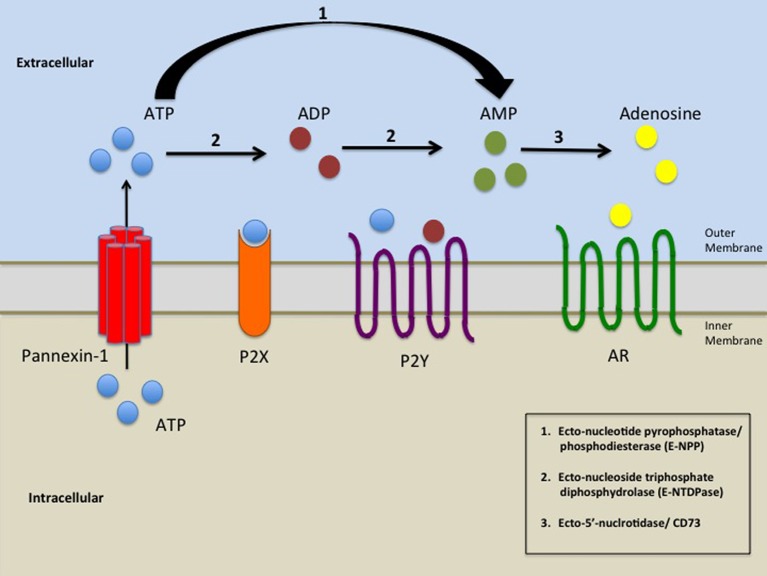
Figure 1
Figure 1
A schematic representation of the elements involved in the release of ATP by opening of Panx-1 hemichannels and subsequent activation of purinergic signaling. Pathological or physiological stimuli result in the opening of Panx-1 hemichannels promoting the release of ATP from the cell. ATP/ADP/AMP could then bind to P2X and P2Y receptors. Ecto-nucleoside triphosphate diphosphydrolase (E-NTDPase) including ecto-ATPase and ATP-diphospho-hydrolase promotes the hydrolysis of ATP to ADP or from ADP to AMP (2). Ecto-nucleotide pyrophosphatase/phosphodiesterase (E-NPP) hydrolysis ATP to AMP (1). AMP is further hydrolyzed by Ecto-5'-nucleotidase/ CD73 (3) which promotes the formation of adenosine. Adenosine then activates adenosine receptors (AR).
Figure 2
Figure 2
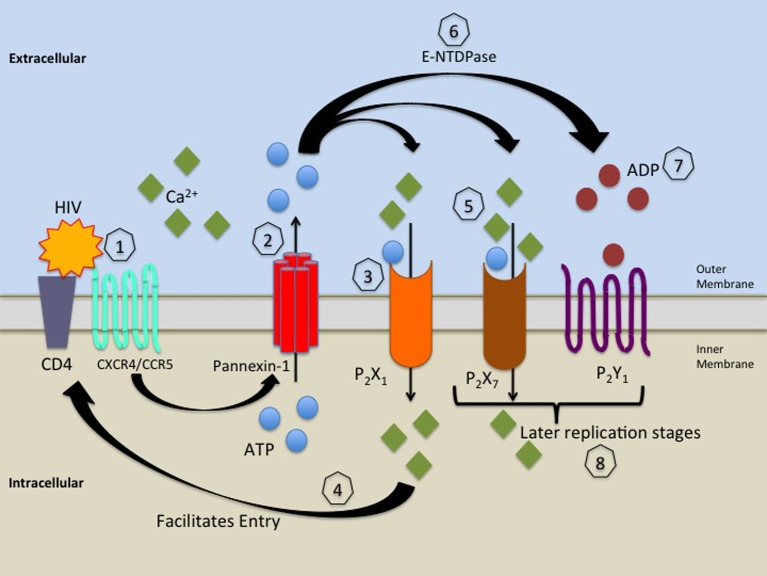
Proposed model for the role of Panx-1 hemichannels and purinergic receptors in HIV infection. HIV's binding to CD4 and CXCR4/CCR5 (1) induces signaling which leads to opening of Panx-1 hemichannels and release of ATP (2). Extracellular ATP released through open Panx-1 hemichannels binds to and activates P2X1 receptors causing calcium influx (3), which facilitates HIV entry (4). The release of ATP continues and activates P2X7 and P2Y1 receptors (5), causing further calcium influx inducing downstream signaling, which facilitates later stages of the HIV life cycle (8). Ecto-nucleoside triphosphate diphosphydrolase (E-NTDPase) converts ATP to ADP (6), which activates P2Y1 receptors (7), which increases intracellular calcium, which causes signaling that facilitates later stages of the HIV life cycle (8).

References

    1. Abbracchio M. P., Burnstock G. (1998). Purinergic signaling: pathophysiological roles. Jpn. J. Pharmacol. 78, 113–145 10.1254/jjp.78.113 - DOI - PubMed
    1. Adair T. H. (2005). Growth regulation of the vascular system: an emerging role for adenosine. Am. J. Physiol. Regul. Integr. Comp. Physiol. 289, R283–R296 10.1152/ajpregu.00840.2004 - DOI - PubMed
    1. Antonioli L., Pacher P., Vizi E. S., Haskó G. (2013). CD39 and CD73 in immunity and inflammation. Trends Mol. Med. 19, 355–367 10.1016/j.molmed.2013.03.005 - DOI - PMC - PubMed
    1. Arthos J., Rubbert A., Rabin R. L., Cicala C., Machado E., Wildt K., et al. (2000). CCR5 signal transduction in macrophages by human immunodeficiency virus and simian immunodeficiency virus envelopes. J. Virol. 74, 6418–6424 10.1128/JVI.74.14.6418-6424.2000 - DOI - PMC - PubMed
    1. Ayna G., Krysko D. V., Kaczmarek A., Petrovski G., Vandenabeele P. (2012). ATP release from dying autophagic cells and their phagocytosis are crucial for inflammasome activation in macrophages. PLoS ONE 7:e40069 10.1371/journal.pone.0040069 - DOI - PMC - PubMed

LinkOut - more resources