


Thyroid hormone analogues and derivatives: Actions in fatty liver
- PMID: 24672641
- PMCID: PMC3959112
- DOI: 10.4254/wjh.v6.i3.114
Thyroid hormone analogues and derivatives: Actions in fatty liver
Abstract
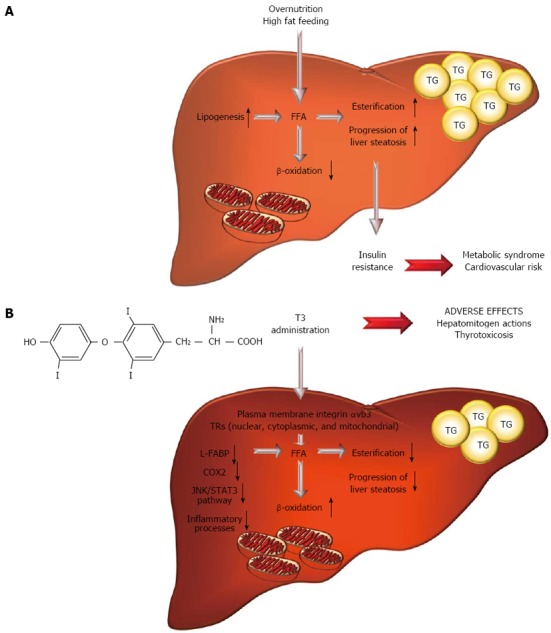
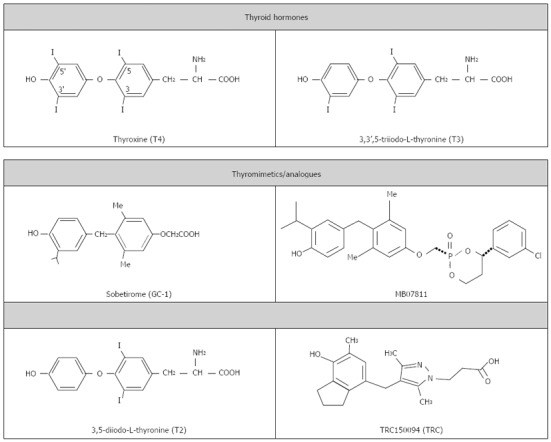
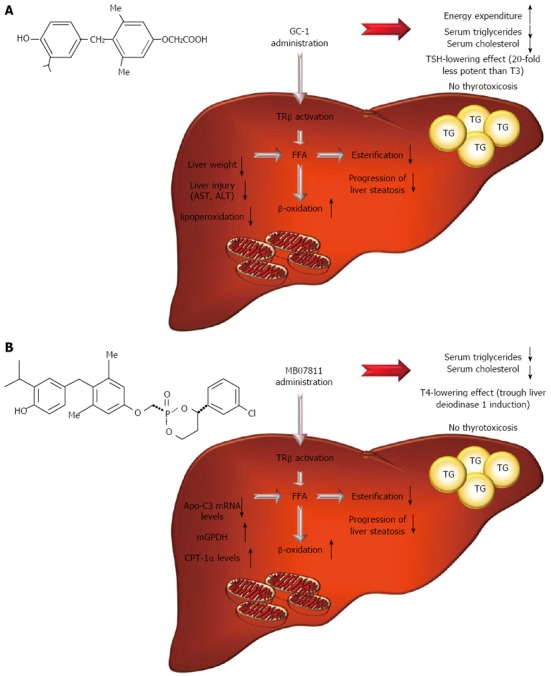
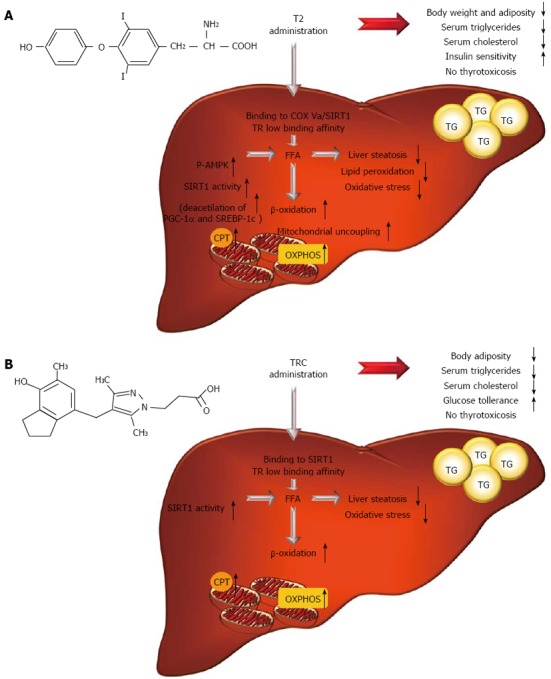
Fatty liver or nonalcoholic fatty liver disease (NAFLD), a problem of increasing clinical significance and prevalence worldwide, is associated with increased risk for the development of cirrhosis and hepatocellular carcinoma. Although several therapeutic approaches can be used in the context of NAFLD, dietary and physical activities are still the most frequently used strategies. Some pharmacological agents show promising results although no conclusions can be drawn from recent clinical trials. Thyroid hormones [THs; thyroxine (T4) and 3,3',5-triiodo-L-thyronine (T3)] coordinate a diverse array of physiological events during development and lipid/energy homeostasis and have some potentially therapeutic actions which include inducing weight loss, and lowering plasma cholesterol levels and tissue adiposity. The thyroid hormones exert their physiological effects by binding to specific nuclear receptors [thyroid hormone receptors (TR)] of which the TRβ isoform is liver specific and has been considered a putative target for the treatment of dyslipidemia and fatty liver. In view of this, the aim of the review is (1) to provide an overview of the action of T3 on lipid metabolism with implications for liver steatosis and (2) to provide an update on the current knowledge concerning the administration of TRβ selective thyromimetics (GC-1 and MB07811), as well as of 3,5-diiodo-L-thyronine and its novel functional analogue TRC150094 in animal models of overweight and related disorders including primarily fatty liver.
Keywords: 3,5-diiodo-L-thyronine; Fatty liver; Lipid metabolism; Thyroid hormones; Thyromimetics.
Figures
References
-
- Ibrahim MA, Kelleni M, Geddawy A. Nonalcoholic fatty liver disease: current and potential therapies. Life Sci. 2013;92:114–118. - PubMed
-
- Bradbury MW, Berk PD. Lipid metabolism in hepatic steatosis. Clin Liver Dis. 2004;8:639–71, xi. - PubMed
-
- Postic C, Girard J. The role of the lipogenic pathway in the development of hepatic steatosis. Diabetes Metab. 2008;34:643–648. - PubMed
-
- Pessayre D. Role of mitochondria in non-alcoholic fatty liver disease. J Gastroenterol Hepatol. 2007;22 Suppl 1:S20–S27. - PubMed
Publication types
LinkOut - more resources
Full Text Sources
Other Literature Sources
Miscellaneous
