


Significance of Anti-retinal Autoantibodies in Cancer-associated Retinopathy with Gynecological Cancers
- PMID: 24672741
- PMCID: PMC3963281
- DOI: 10.4172/2155-9570.1000307
Significance of Anti-retinal Autoantibodies in Cancer-associated Retinopathy with Gynecological Cancers
Abstract
Background: The presence of autoantibodies (AAbs) is the primary serological indicator of autoimmunity. Cancer-associated retinopathy (CAR) is associated with AAbs and different types of cancer. The goal of the study was to examine the profile of serum autoantibodies in women with gynecological cancers with and without paraneoplastic visual manifestation.
Methods: Retrospective studies of a cohort of 46 women with symptoms of CAR and gynecological tumors, including endometrial, cervical, ovarian, and fallopian tubes, 111 women with similar tumors without symptoms of CAR, and 60 age-matched healthy controls. Presence of serum AAbs and the identity of targeted antigens were performed by western blotting and their significance was evaluated using an Fisher's exact test.
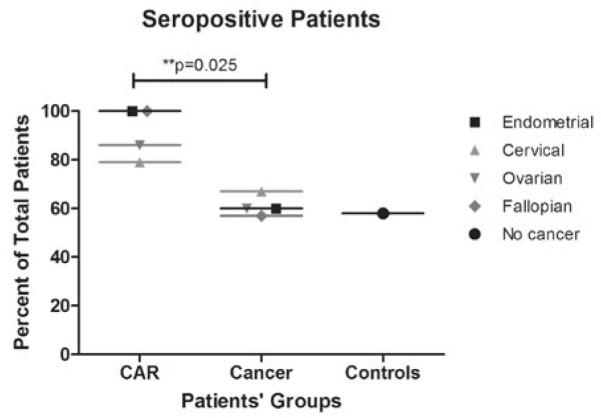
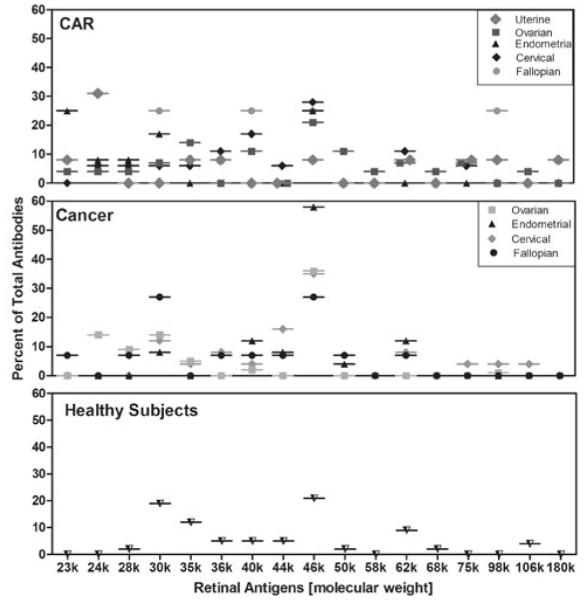
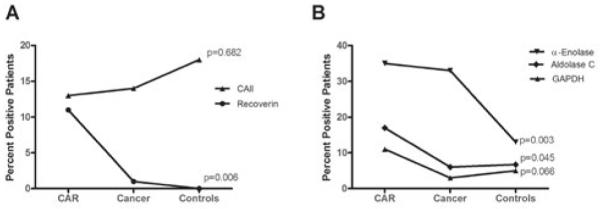
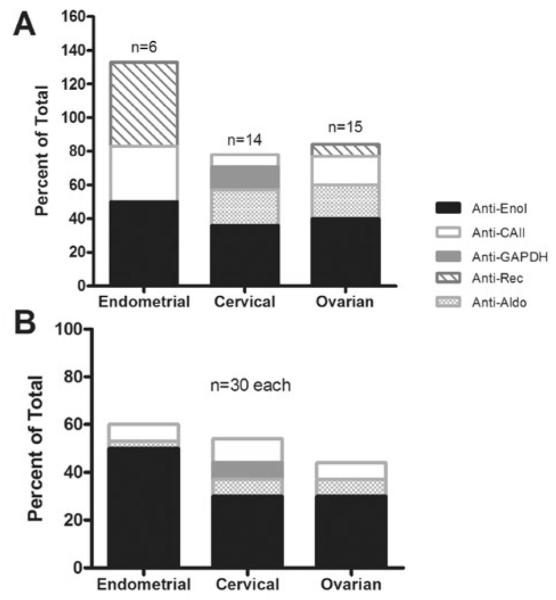
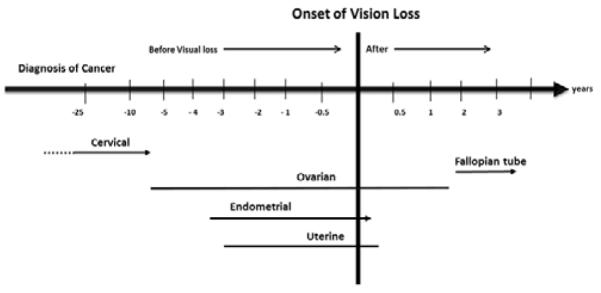
Results: The patients with gynecological CAR had the highest proportion of seropositivity (80%), followed by patients with gynecological cancers without CAR (61%) and healthy controls (58%). Differences in recognition frequencies were found for 17 antigens and 5 retinal antigens were frequently targeted: enolase, aldolase C, carbonic anhydrase II, recoverin and GAPDH. The occurrence of anti-glycolytic enzymes was 2-3 times more frequent in CAR and cancer patients than healthy controls. Anti-recoverin AAbs were prevalent in endometrial CAR. Anti-CAII antibodies were not significantly different between groups of women. In this cohort, cancer was diagnosed before the onset of retinopathy with latency from 2 months to 30 years. The discovery of the ovarian and endometrial cancers and manifestation of visual problems often coincided but Fallopian tube carcinoma was found after visual onset.
Conclusion: New retinal targets were identified for gynecological CAR. Each gynecological-CAR has its own autoantibody profile different from non-CAR profile, implying that a complex autoantibody signature may be more predictable for diagnosis than a singular AAb. Specific anti-retinal AAbs were most prevalent in women with CAR but their profiles were not fully distinguished from cancer controls.
Keywords: Antibody profiling; Autoantibodies; Autoantigen; Autoimmune retinopathy; Cancer; Paraneoplastic; Retina.
Figures
References
-
- Barr CC, Zimmerman LE, Curtin VT, Font RL. Bilateral diffuse melanocytic uveal tumors associated with systemic malignant neoplasms. A recently recognized syndrome. Arch Ophthalmol. 1982;100:249–255. - PubMed
-
- Adamus G. Autoantibody-induced apoptosis as a possible mechanism of autoimmune retinopathy. Autoimmun Rev. 2003;2:63–68. - PubMed
-
- Shanbhogue AK, Shanbhogue DK, Prasad SR, Surabhi VR, Fasih N, et al. Clinical syndromes associated with ovarian neoplasms: a comprehensive review. Radiographics. 2010;30:903–919. - PubMed
-
- Adamus G, Amundson D, MacKay C, Gouras P. Long-term persistence of antirecoverin antibodies in endometrial cancer-associated retinopathy. Arch Ophthalmol. 1998;116:251–253. - PubMed
Grants and funding
LinkOut - more resources
Full Text Sources
Other Literature Sources
Research Materials