


Adolescent deviant peer clustering as an amplifying mechanism underlying the progression from early substance use to late adolescent dependence
- PMID: 24673521
- PMCID: PMC4133330
- DOI: 10.1111/jcpp.12211
Adolescent deviant peer clustering as an amplifying mechanism underlying the progression from early substance use to late adolescent dependence
Abstract
Background: Early substance use co-occurs with youths' self-organization into deviant peer groups in which substance use is central to social interaction. We hypothesized that the social dynamics of deviant peer groups amplify the risk of progressing from early use to later dependence, and that this influence occurs over and above escalations in use that typically accompany early substance use and membership in deviant groups.
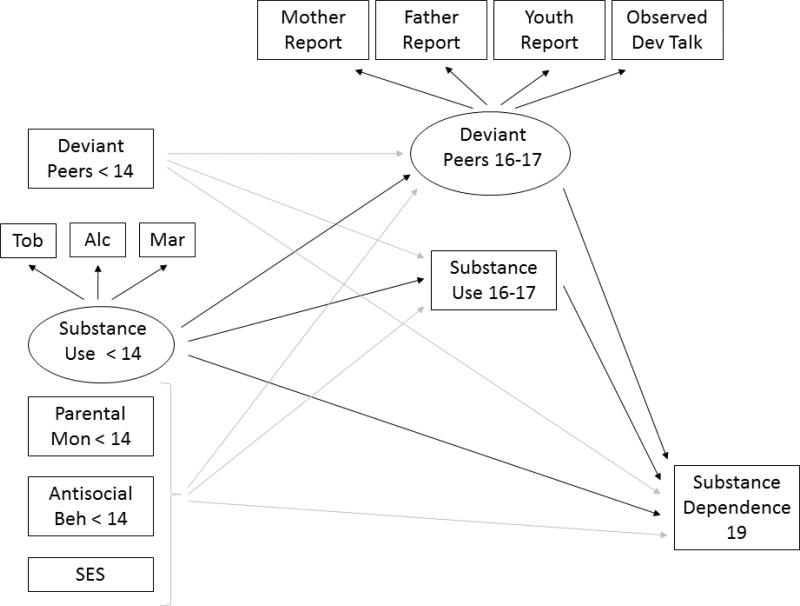
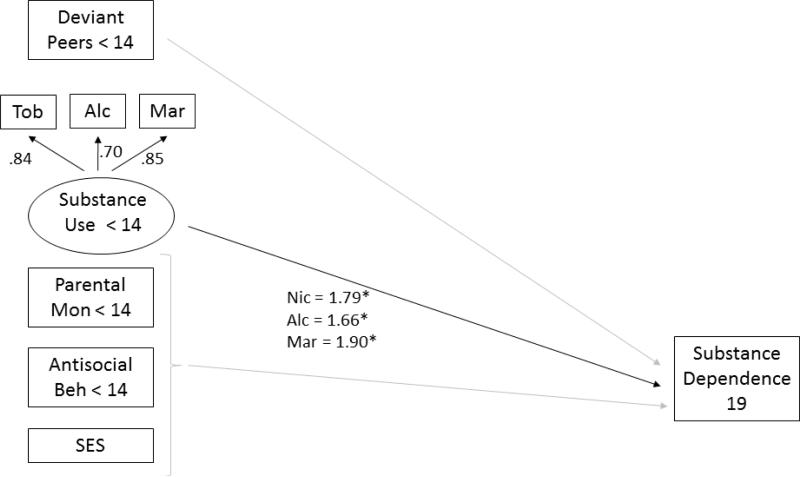
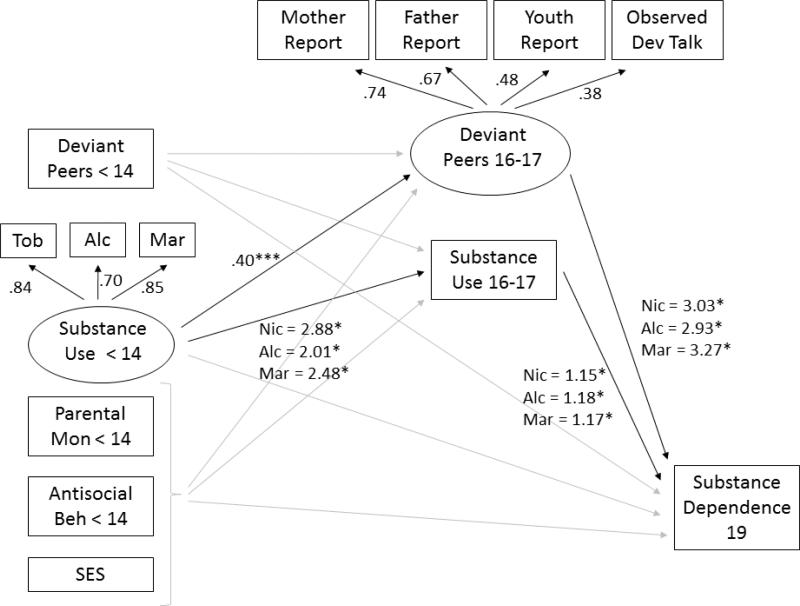
Methods: Our study used a longitudinal, multimethod dataset consisting of 998 adolescents and their families. Participants were recruited from middle schools in a large metropolitan area in the Pacific Northwest. The sample was 47.3% female and ethnically diverse (42.3% European American, 29.1% African American, and 28.6% other, including biracial). We examined deviant peer clustering as a mediator between early substance use and later dependence, controlling for proximal levels of use, SES, early antisocial behavior, and parental monitoring. Tobacco, alcohol, and marijuana use were assessed at ages 12, 13, and 16-17. Past-year nicotine, alcohol, and marijuana dependence (DSM-IV) was assessed at age 19. Youth and parent reports and observational data were used to assess deviant peer clustering at age 16-17, and youth reported on antisocial behavior and parental monitoring at ages 12 and 13.
Results: Early substance use predicted increased likelihood of dependence on tobacco, alcohol, and marijuana by late adolescence. Deviant peer affiliation mediated these links, even when accounting for proximal levels of substance use.
Conclusions: Early substance use not only promotes escalations in use across adolescence but also provides entry into a deviant social context that contributes to increased risk of dependence. Our results emphasize the importance of identifying and intervening in early substance use before it becomes an organizing factor in friendship selection and interaction. Deviant peer clusters are clearly an important avenue for intervention when seeking to interrupt the progression to substance dependence.
Keywords: Substance dependence; deviant peer clustering; early substance use; mediation; prevention.
© 2014 The Authors. Journal of Child Psychology and Psychiatry. © 2014 Association for Child and Adolescent Mental Health.
Figures
References
-
- Adalbjarnardottir S, Rafnsson FD. Adolescent antisocial behavior and substance use: Longitudinal analyses. Addictive Behaviors. 2002;27:227–240. - PubMed
-
- Behrendt S, Wittchen HU, Höfler M, Lieb R, Beesdo K. Transitions from first substance use to substance use disorders in adolescence: Is early onset associated with a rapid escalation? Drug and Alcohol Dependence. 2009;99:68–78. - PubMed
-
- Brown SA, Tapert SF, Granholm E, Delis DC. Neurocognitive functioning of adolescents: Effects of protracted alcohol use. Alcoholism: Clinical and Experimental Research. 2000;24:164–171. - PubMed
-
- Chassin L, Pillow DR, Curran PJ, Molina BSG, Barrera M., Jr. Relation of parental alcoholism to early adolescent substance use: A test of three mediating mechanisms. Journal of Abnormal Psychology. 1993;102:3–19. - PubMed
-
- Clark DB, Kirisci L, Tarter RE. Adolescent versus adult onset and the development of substance use disorders in males. Drug and Alcohol Dependence. 1998;49:115–121. - PubMed
Publication types
MeSH terms
Grants and funding
LinkOut - more resources
Full Text Sources
Other Literature Sources
Medical
Miscellaneous
