


Do patients with advanced cancer and unmet palliative care needs have an interest in receiving palliative care services?
- PMID: 24673544
- PMCID: PMC4039000
- DOI: 10.1089/jpm.2013.0537
Do patients with advanced cancer and unmet palliative care needs have an interest in receiving palliative care services?
Abstract
Background: It is not known whether unmet palliative care needs are associated with an interest in palliative care services among patients with advanced cancer receiving ongoing oncology care.
Objective: To assess the association between unmet palliative care needs and patient interest in subspecialty palliative care services.
Design: Cross-sectional telephone survey.
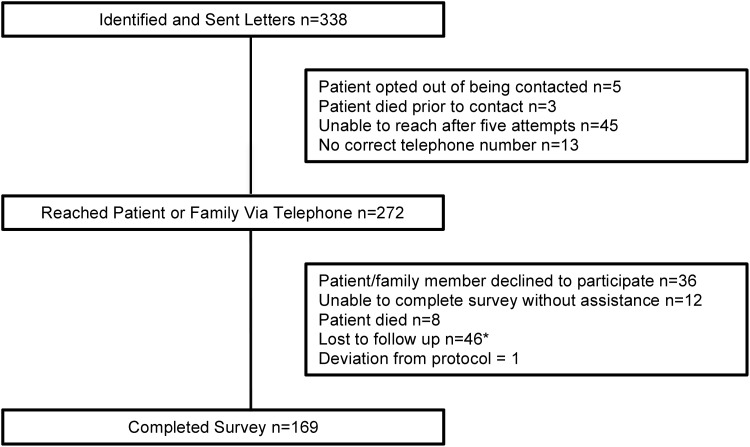
Subjects and setting: One hundred sixty-nine patients with advanced cancer receiving care from 20 oncologists at two academic cancer centers.
Measurements: Surveys assessed palliative care needs in six domains. Patients were read a description of palliative care and then asked three questions about their current interest in subspecialty palliative care services (perceived need, likelihood of requesting, willingness to see if their oncologist recommended; all outcomes on 0-10 Likert scale).
Results: The vast majority of patients described unmet palliative care needs, most commonly related to psychological/emotional distress (62%) and symptoms (62%). In fully adjusted models accounting for clustering by oncologist, unmet needs in these domains were associated with a higher perceived need for subspecialty palliative care services (psychological/emotional needs odds ratio [OR] 1.30; 95% confidence interval [CI] 1.06-1.58; p=0.01; symptom needs OR 1.27; 95% CI 1.01-1.60; p=0.04). There was no significant association between unmet needs and likelihood of requesting palliative care services. Willingness to see palliative care if oncologist recommended was high (mean 8.6/10, standard deviation [SD] 2).
Conclusion: Patients with advanced cancer and unmet symptom and psychological/emotional needs perceive a high need for subspecialty palliative care services but may not request them. Efforts to increase appropriate use of subspecialty palliative care for cancer may require oncologist-initiated referrals.
Figures
References
-
- Levy MH, Adolph MD, Back A, Block S, Codada SN, Dalal S, Deshields TL, Dexter E, Dy SM, Knight SJ, Misra S, Ritchie CS, Sauer TM, Smith T, Spiegel D, Sutton L, Taylor RM, Temel J, Thomas J, Tickoo R, Urba SG, Von Roenn JH, Weems JL, Weinstein SM, Freedman-Cass DA, Bergman MA; NCCN (National Comprehensive Cancer Network): Palliative care. J Natl Compr Cancer Netw 2012;10:1284–1309 - PubMed
-
- Smith TJ, Temin S, Alesi ER, Abernethy AP, Balboni TA, Basch EM, Ferrell BR, Loscalzo M, Meier DE, Paice JA, Peppercorn JM, Somerfield M, Stovall E, Von Roenn JH: American Society of Clinical Oncology provisional clinical opinion: the integration of palliative care into standard oncology care. J Clin Oncol 2012;30:880–887 - PubMed
-
- Quill TE, Abernethy AP: Generalist plus specialist palliative care: Creating a more sustainable model. N Engl J Med 2013;368:1173–1175 - PubMed
-
- Temel JS, Greer JA, Muzikansky A, Gallagher ER, Admane S, Jackson VA, Dahlin CM, Blinderman CD, Jacobsen J, Pirl WF, Billings JA, Lynch TJ: Early palliative care for patients with metastatic non-small-cell lung cancer. N Engl J Med 2010;363:733–442 - PubMed
-
- Bakitas M, Lyons KD, Hegel MT, Balan S, Brokaw FC, Seville J, Hull JG, Li Z, Tosteson TD, Byock IR, Ahles TA, et al. Effects of a palliative care intervention on clinical outcomes in patients with advanced cancer: the Project ENABLE II randomized controlled trial. JAMA 2009;302:741–749 - PMC - PubMed
Publication types
MeSH terms
Grants and funding
LinkOut - more resources
Full Text Sources
Other Literature Sources
Medical
