


The role of muscle mass in exercise-induced hyperemia
- PMID: 24674856
- PMCID: PMC4097826
- DOI: 10.1152/japplphysiol.00103.2014
The role of muscle mass in exercise-induced hyperemia
Abstract
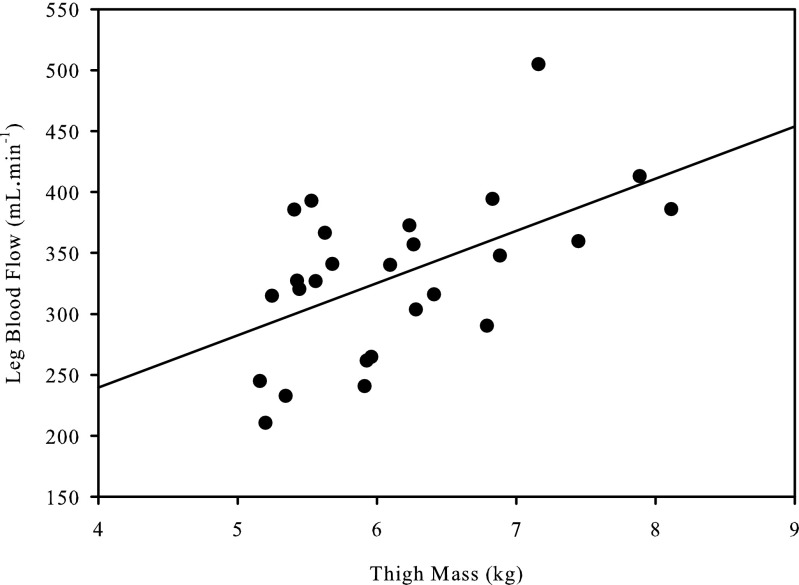
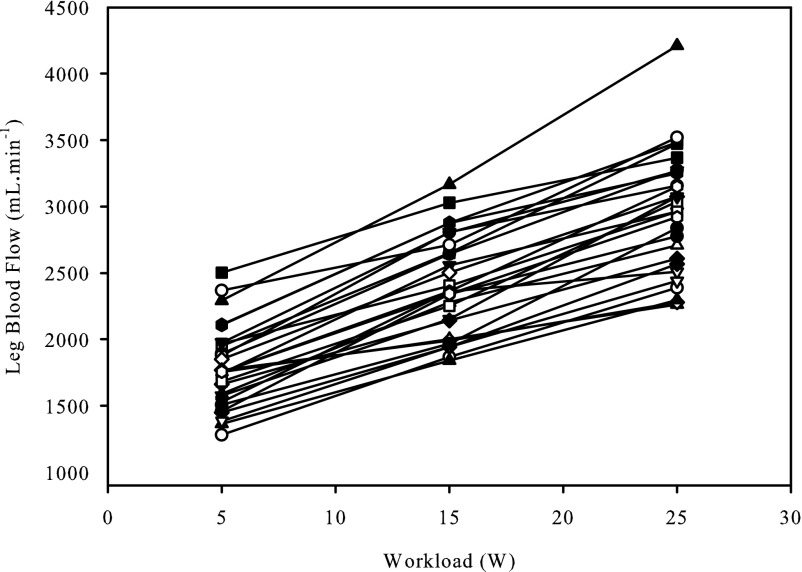
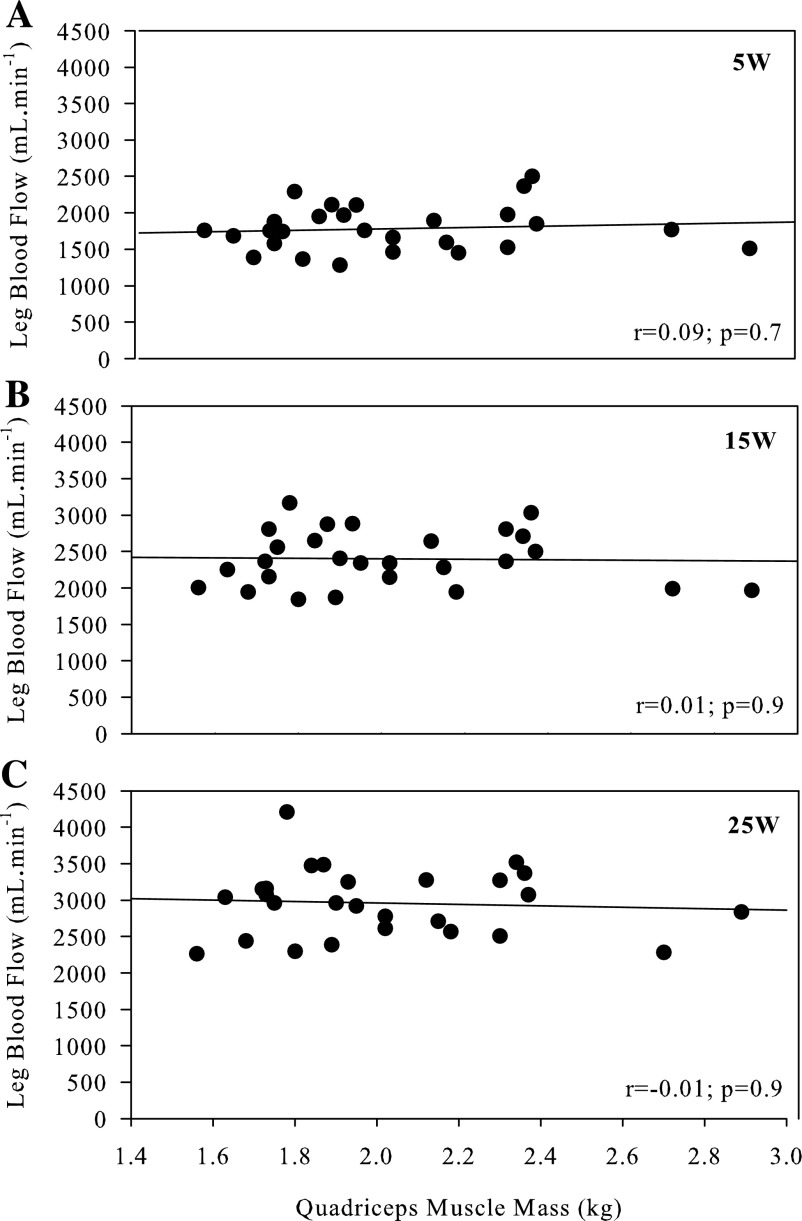
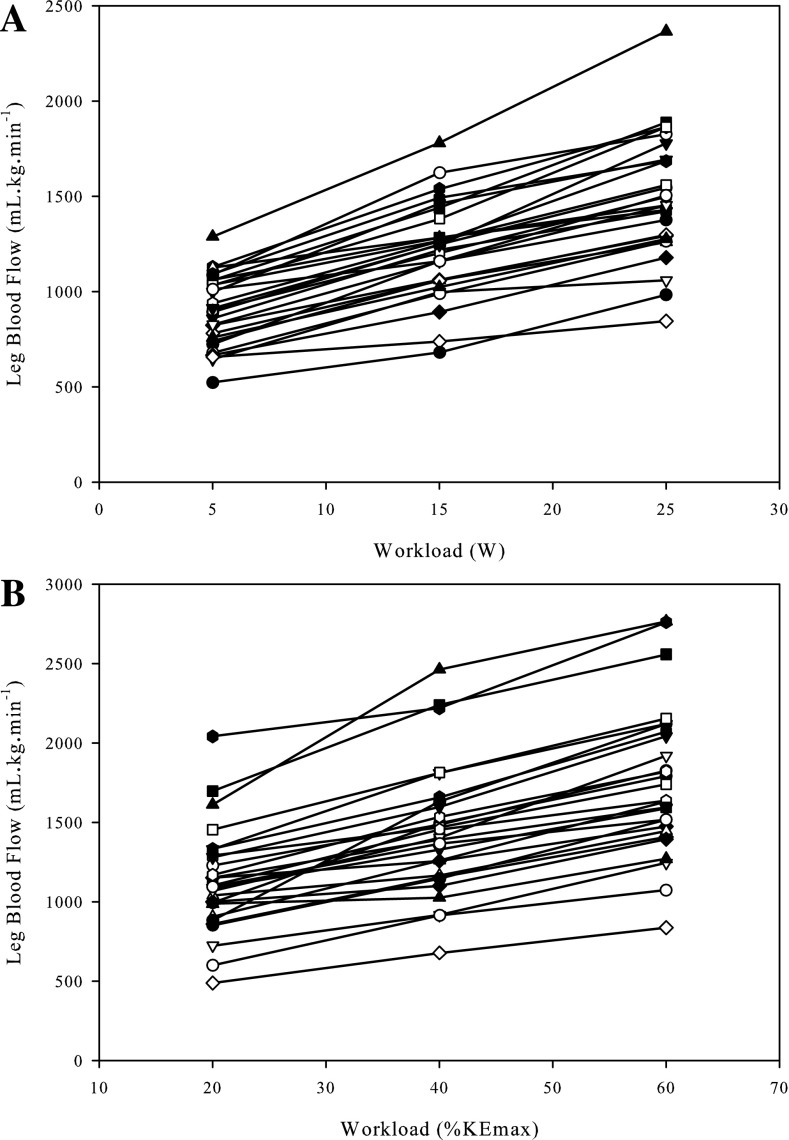
Exercise-induced hyperemia is often normalized for muscle mass, and this value is sometimes evaluated at relative exercise intensities to take muscle recruitment into account. Therefore, this study sought to better understand the impact of muscle mass on leg blood flow (LBF) during exercise. LBF was assessed by Doppler ultrasound in 27 young healthy male subjects performing knee-extensor (KE) exercise at three absolute (5, 15, and 25 W) and three relative [20, 40, and 60% of maximum KE (KEmax)] workloads. Thigh muscle mass (5.2-8.1 kg) and LBF were significantly correlated at rest (r = 0.54; P = 0.004). Exercise-induced hyperemia was linearly related to absolute workload, but revealed substantial between-subject variability, documented by the coefficient of variation (5 W: 17%; 15 W: 16%; 25 W: 16%). Quadriceps muscle mass (1.5-2.7 kg) and LBF were not correlated at 5, 15, or 25 W (r = 0.09-0.01; P = 0.7-0.9). Normalizing blood flow for quadriceps muscle mass did not improve the coefficient of variation at each absolute workload (5 W: 21%; 15 W: 21%; 25 W: 22%), while the additional evaluation at relative exercise intensities resulted in even greater variance (20% KEmax: 29%; 40% KEmax: 29%; 60% KEmax: 27%). Similar findings were documented when subjects were parsed into high and low aerobic capacity. Thus, in contrast to rest, blood flow during exercise is unrelated to muscle mass, and simply normalizing for muscle mass or comparing normalized blood flow at a given relative exercise intensity has no effect on the inherent blood flow variability. Therefore, during exercise, muscle mass does not appear to be a determinant of the hyperemic response.
Keywords: blood flow; knee extension; muscle mass; normalization.
Figures
References
-
- Amann M, Subudhi A, Foster C. Influence of testing protocol on ventilatory thresholds and cycling performance. Med Sci Sports Exerc 36: 613–622, 2004 - PubMed
-
- Armstrong RB, Delp MD, Goljan EF, Laughlin MH. Distribution of blood flow in muscles of miniature swine during exercise. J Appl Physiol (1985) 62: 1285–1298, 1987 - PubMed
-
- Carlson RE, Kirby BS, Voyles WF, Dinenno FA. Evidence for impaired skeletal muscle contraction-induced rapid vasodilation in aging humans. Am J Physiol Heart Circ Physiol 294: H1963–H1970, 2008 - PubMed
Publication types
MeSH terms
Grants and funding
LinkOut - more resources
Full Text Sources
Other Literature Sources
Medical
