. 2014 Apr 4;344(6179):55-8.
doi: 10.1126/science.1249252. Epub 2014 Mar 27.

Total synthesis of a functional designer eukaryotic chromosome

Affiliations

Total synthesis of a functional designer eukaryotic chromosome

Narayana Annaluru et al. Science. .

Erratum in

  • Science. 2014 May 23;344(6186):816

Abstract

Rapid advances in DNA synthesis techniques have made it possible to engineer viruses, biochemical pathways and assemble bacterial genomes. Here, we report the synthesis of a functional 272,871-base pair designer eukaryotic chromosome, synIII, which is based on the 316,617-base pair native Saccharomyces cerevisiae chromosome III. Changes to synIII include TAG/TAA stop-codon replacements, deletion of subtelomeric regions, introns, transfer RNAs, transposons, and silent mating loci as well as insertion of loxPsym sites to enable genome scrambling. SynIII is functional in S. cerevisiae. Scrambling of the chromosome in a heterozygous diploid reveals a large increase in a-mater derivatives resulting from loss of the MATα allele on synIII. The complete design and synthesis of synIII establishes S. cerevisiae as the basis for designer eukaryotic genome biology.


Conflict of interest statement

The authors declare no competing financial interests.

“This manuscript has been accepted for publication in Science. This version has not undergone final editing. Please refer to the complete version of record at http://www.sciencemag.org/. The manuscript may not be reproduced or used in any manner that does not fall within the fair use provisions of the Copyright Act without the prior, written permission of AAAS.”

Figures

Fig. 1
Fig. 1. SynIII design
Representative synIII design segments for loxPsym site insertion (A & B) and stop codon TAG to TAA editing (C) are shown. Green diamonds represent loxPsym sites embedded in the 3′ UTR of non-essential genes and at several other landmarks. Fuchsia circles indicate synthetic stop codons (TAG recoded to TAA). Complete maps of designed synIII chromosome with common and systematic ORF names, respectively, are shown in Figures S1 & S2.
Fig. 2
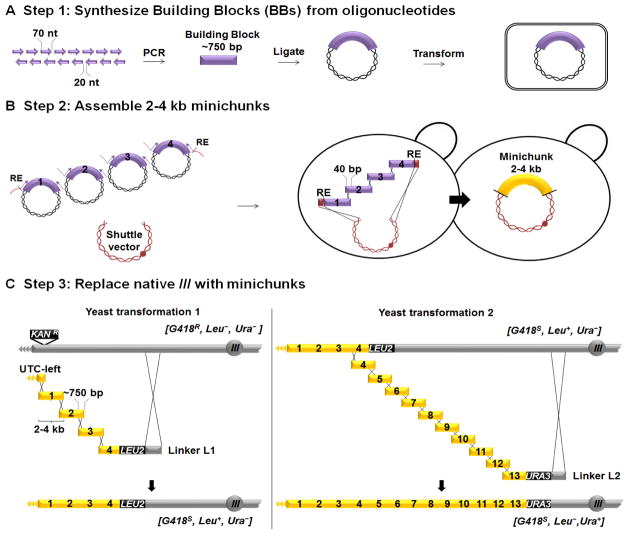
Fig. 2. SynIII construction
(A) Building block (BB) synthesis. 750 bp BBs (purple) were synthesized from oligonucleotides at Johns Hopkins University by students in the Build-AGenome course. (B) Assembly of minichunks. 2–4 kb minichunks (yellow) were assembled by homologous recombination in S. cerevisiae (Table S1). Adjacent minichunks were designed to encode overlap of one BB to facilitate downstream assembly steps. Minichunks were flanked by a rare cutting restriction enzyme (RE) site, XmaI or NotI. (C) Direct replacement of native yeast chromosome III with pools of synthetic minichunks. Eleven iterative one-step assemblies and replacements of native genomic segments of yeast chromosome III were carried out using pools of overlapping synthetic DNA minichunks (Table S2), encoding alternating genetic markers (LEU2 or URA3), which enabled complete replacement of native III with synIII in yeast.
Fig. 3
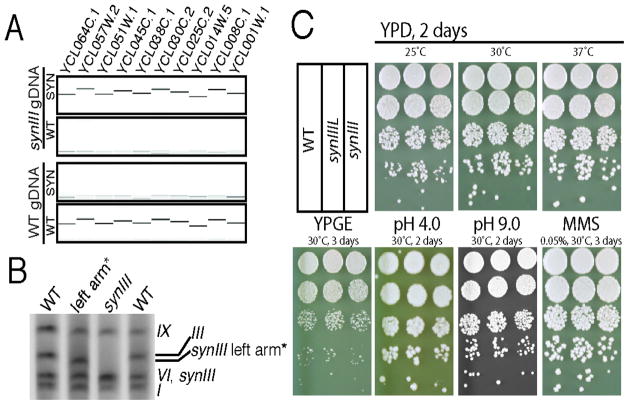
Fig. 3. Characterization and testing of synIII strain
(A) PCRTag analysis (one PCRTag/10 kb) of the left arm of SynIII and wild-type yeast (BY4742) DNA is shown. Analysis of the complete set of PCRTags is shown in Figures S4, S5 & S6. (B) Karyotypic analysis of synIII and synIIIL strains by pulsed-field gel electrophoresis revealed the size reduction of synIII and synIIIL compared to native III. Yeast chromosome numbers are indicated on the right side. SynIII (272,871 bp) and native chromosome VI (270,148 bp) co-migrate in the gel. Karyotypic analysis of synIII and all intermediate strains is shown in Fig. S8. (C) SynIII and synIIIL phenotyping on various types of media. Ten-fold serial dilutions of saturated cultures of wild type (BY4742), synIIIL and synIII strains were plated on the indicated media and temperatures. YPD, yeast extract peptone dextrose; YPGE, yeast extract peptone glycerol ethanol; MMS, methyl methanosulfate. Complete set of synIII and synIIIL phenotyping under various conditions is shown in Fig. S11.
Fig. 4
Fig. 4. Genomic stability of the synIII strain
(A) PCRTag analysis of synIII strain after ~125 generations. We assayed for the loss of 58 different segments lacking essential genes in the absence of SCRaMbLEing; no losses were observed after over 200,000 segment-generations analyzed; reported frequency is a maximum estimate of segment loss frequency per generation. (B) Evaluation of the loss rate of synIII chromosome using a-like faker assay. No significant change in the loss frequency was observed, although the absolute loss rate value is modestly higher in synIII. (C) SCRaMbLE leads to a gain of mating type a behavior in synIII heterozygous diploids. Frequency of a-mater and α-mater colonies post-SCRaMbLE (induction with estradiol) in synIII/III and III/III strains. Complete SCRaMbLE analysis is shown in Fig. S18.

Comment in

References

    1. Goffeau A, et al. Life with 6000 genes. Science. 1996;274:546, 563–7. - PubMed
    1. Dymond JS, et al. Synthetic chromosome arms function in yeast and generate phenotypic diversity by design. Nature. 2011;477:471–476. - PMC - PubMed
    1. Dymond J, Boeke J. The Saccharomyces cerevisiae SCRaMbLE system and genome minimization. Bioeng Bugs. 2012;3:168–171. - PMC - PubMed
    1. Cello J, Paul AV, Wimmer E. Chemical synthesis of poliovirus cDNA: generation of infectious virus in the absence of natural template. Science. 2002;297:1016–1018. - PubMed
    1. Chan LY, Kosuri S, Endy D. Refactoring bacteriophage T7. Mol Syst Biol. 2005;1:2005.0018. - PMC - PubMed

Publication types

MeSH terms

Associated data