


Acute drop in blood monocyte count differentiates NEC from other causes of feeding intolerance
- PMID: 24674979
- PMCID: PMC4074443
- DOI: 10.1038/jp.2014.52
Acute drop in blood monocyte count differentiates NEC from other causes of feeding intolerance
Abstract
Objective: Necrotizing enterocolitis (NEC) is characterized by macrophage infiltration into affected tissues. Because intestinal macrophages are derived from recruitment and in situ differentiation of blood monocytes in the gut mucosa, we hypothesized that increased recruitment of monocytes to the intestine during NEC reduces the blood monocyte concentration and that this fall in blood monocytes can be a useful biomarker for NEC.
Study design: We reviewed medical records of very-low-birth-weight (VLBW) infants treated for NEC and compared them with a matched control group comprised of infants with feeding intolerance but no signs of NEC. Clinical characteristics and absolute monocyte counts (AMCs) were recorded. Diagnostic accuracy of AMC values was tested using receiver-operator characteristics (ROC).
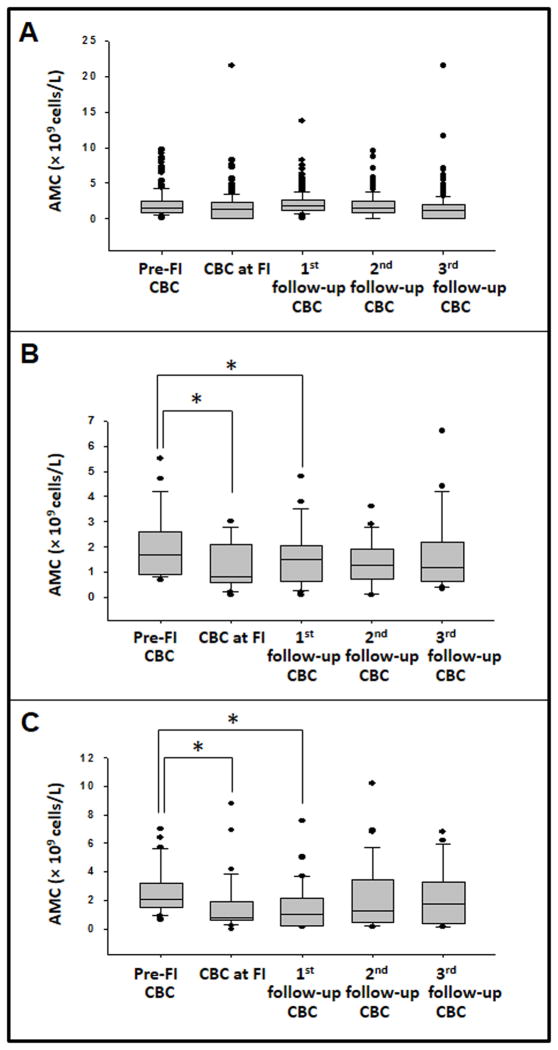
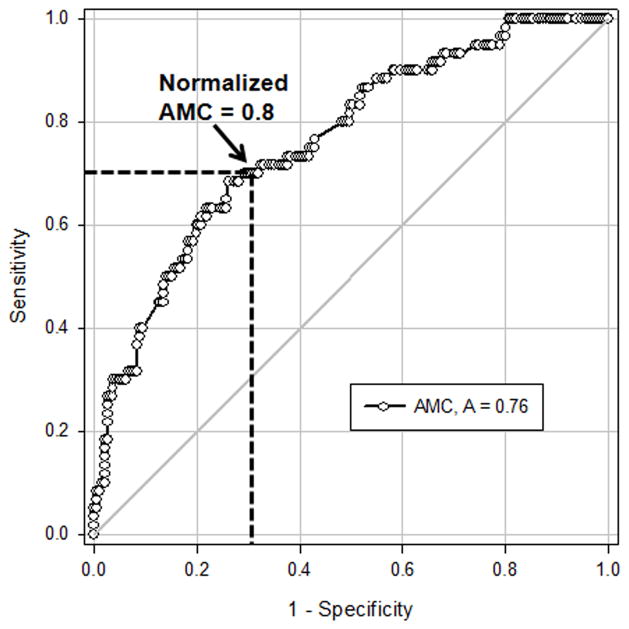
Result: We compared 69 cases and 257 controls (median 27 weeks, range 26 to 29 in both the groups). In stage II NEC, AMCs decreased from median 1.7 × 10(9) l(-1) (interquartile range (IQR) 0.98 to 2.4) to 0.8 (IQR 0.62 to 2.1); P < 0.05. In stage III NEC, monocyte counts decreased from median 2.1 × 10(9) l(-1) (IQR 0.1.5 to 3.2) to 0.8 (IQR 0.6 to 1.9); P < 0.05. There was no change in AMCs in control infants. ROC of AMC values showed a diagnostic accuracy (area under the curve) of 0.76. In a given infant with feeding intolerance, a drop in AMCs of > 20% indicated NEC with sensitivity of 0.70 (95% confidence interval (CI) 0.57 to 0.81) and specificity of 0.71 (95% CI 0.64 to 0.77).
Conclusion: We have identified a fall in blood monocyte concentration as a novel biomarker for NEC in VLBW infants.
Figures
References
-
- Fanaroff AA, Stoll BJ, Wright LL, Carlo WA, Ehrenkranz RA, Stark AR, et al. Trends in neonatal morbidity and mortality for very low birthweight infants. Am J Obstet Gynecol. 2007;196(2):147, e141–148. - PubMed
-
- Buonomo C. The radiology of necrotizing enterocolitis. Radiol Clin North Am. 1999;37 (6):1187–1198. vii. - PubMed
Publication types
MeSH terms
Substances
Grants and funding
LinkOut - more resources
Full Text Sources
Other Literature Sources
