


Review
doi: 10.18632/oncotarget.1584.
Heat shock proteins in multiple myeloma
- PMID: 24675290
- PMCID: PMC4012740
- DOI: 10.18632/oncotarget.1584
Item in Clipboard
Review
Heat shock proteins in multiple myeloma
Oncotarget.
.
Abstract
Heat shock proteins are molecular chaperones with a central role in protein folding and cellular protein homeostasis. They also play major roles in the development of cancer and in recent years have emerged as promising therapeutic targets. In this review, we discuss the known molecular mechanisms of various heat shock protein families and their involvement in cancer and in particular, multiple myeloma. In addition, we address the current progress and challenges in pharmacologically targeting these proteins as anti-cancer therapeutic strategies.
Figures
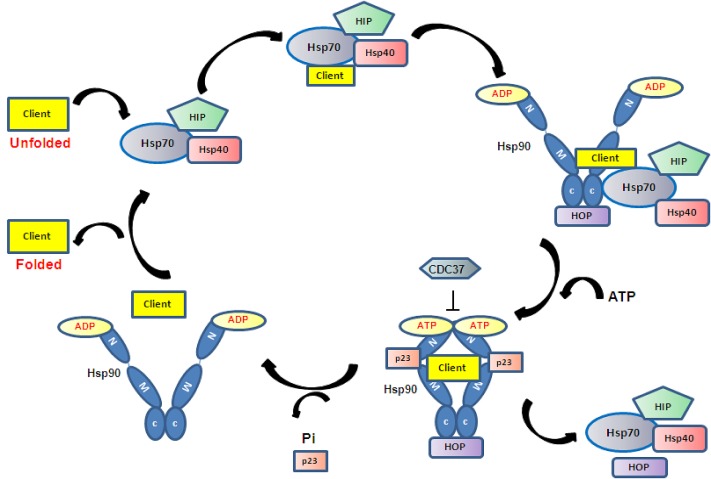
ATP binding and hydrolysis drive Hsp90 conformational changes resulting in the binding and release of client proteins. Client proteins are presented to Hsp90 by the Hsp70 chaperone complex.
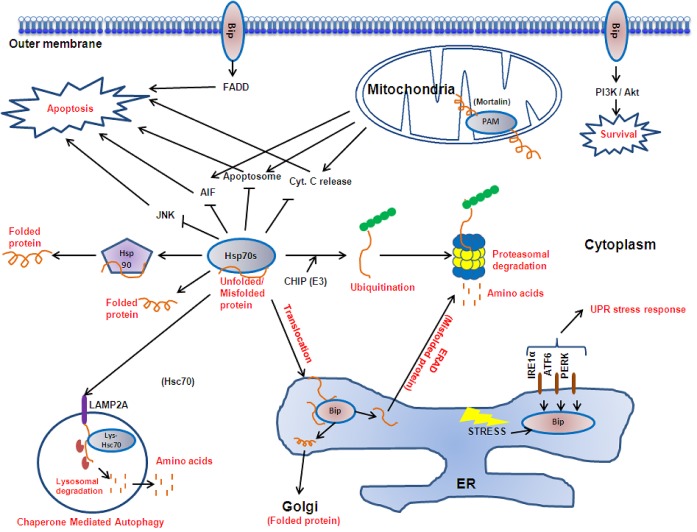
Hsp70 protein isoforms (Bip, cytoplasmic Hsp70s, lys-Hsc70 and mortalin) reside at various subcellular localisations to perform specific roles in protein folding, translocation, degradation and signal transduction, thereby mediating cell survival and apoptosis.
References
-
- Craig EA. Chaperones: helpers along the pathways to protein folding. Science. 1993;260(5116):1902–1903. - PubMed
-
- Hartl FU. Molecular chaperones in cellular protein folding. Nature. 1996;381(6583):571–579. - PubMed
-
- Hartl FU, Hayer-Hartl M. Molecular chaperones in the cytosol: from nascent chain to folded protein. Science. 2002;295(5561):1852–1858. - PubMed
-
- Udono H, Ichiyanagi T, Mizukami S, Imai T. Heat shock proteins in antigen trafficking--implications on antigen presentation to T cells. Int J Hyperthermia. 2009;25(8):617–625. - PubMed
Publication types
MeSH terms
Substances
Grants and funding
LinkOut - more resources
Full Text Sources
Other Literature Sources
Medical
