


Psychological and behavioral changes during confinement in a 520-day simulated interplanetary mission to mars
- PMID: 24675720
- PMCID: PMC3968121
- DOI: 10.1371/journal.pone.0093298
Psychological and behavioral changes during confinement in a 520-day simulated interplanetary mission to mars
Abstract
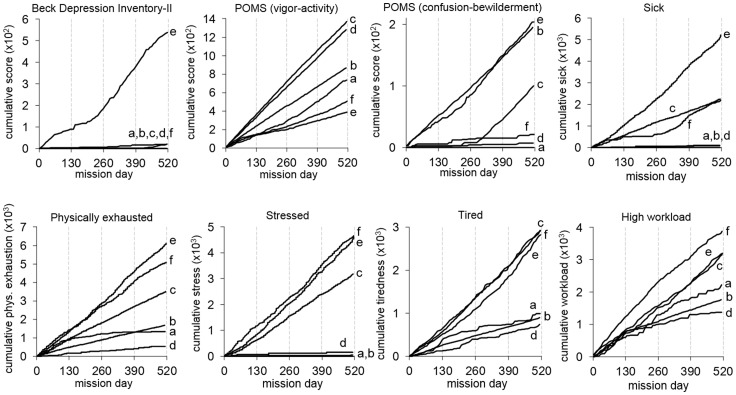
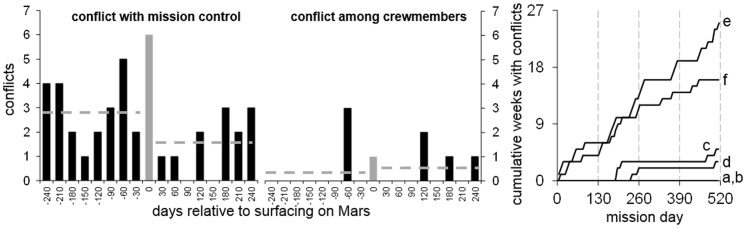
Behavioral health risks are among the most serious and difficult to mitigate risks of confinement in space craft during long-duration space exploration missions. We report on behavioral and psychological reactions of a multinational crew of 6 healthy males confined in a 550 m(3) chamber for 520 days during the first Earth-based, high-fidelity simulated mission to Mars. Rest-activity of crewmembers was objectively measured throughout the mission with wrist-worn actigraphs. Once weekly throughout the mission crewmembers completed the Beck Depression Inventory-II (BDI-II), Profile of Moods State short form (POMS), conflict questionnaire, the Psychomotor Vigilance Test (PVT-B), and series of visual analogue scales on stress and fatigue. We observed substantial inter-individual differences in the behavioral responses of crewmembers to the prolonged mission confinement and isolation. The crewmember with the highest average POMS total mood disturbance score throughout the mission also reported symptoms of depression in 93% of mission weeks, which reached mild-to-moderate levels in >10% of mission weeks. Conflicts with mission control were reported five times more often than conflicts among crewmembers. Two crewmembers who had the highest ratings of stress and physical exhaustion accounted for 85% of the perceived conflicts. One of them developed a persistent sleep onset insomnia with ratings of poor sleep quality, which resulted in chronic partial sleep deprivation, elevated ratings of daytime tiredness, and frequent deficits in behavioral alertness. Sleep-wake timing was altered in two other crewmembers, beginning in the first few months of the mission and persisting throughout. Two crewmembers showed neither behavioral disturbances nor reports of psychological distress during the 17-month period of mission confinement. These results highlight the importance of identifying behavioral, psychological, and biological markers of characteristics that predispose prospective crewmembers to both effective and ineffective behavioral reactions during the confinement of prolonged spaceflight, to inform crew selection, training, and individualized countermeasures.
Conflict of interest statement
Figures

References
-
- Lapierrea J, Bouchard S, Martin T, Perreault M (2009) Transcultural group performance in extreme environment: Issues, concepts and emerging theory. Acta Astronaut 64: 1304–1313.
-
- Sandal GM (2004) Culture and tension during an International Space Station simulation: Results from SFINCSS'99. Aviat Space Environ Med 75: C44–C51. - PubMed
-
- Inoue N, Matsuzaki I, Ohshima H (2004) Group Interactions in SFINCSS-99: Lessons for Improving Behavioral Support Programs. Aviat Space Environ Med 75: C28–C35. - PubMed
-
- Kanas N, Sandal G, Boyd JE, Gushin VI, Manzey D, et al. (2009) Psychology and culture during long-duration space missions. Acta Astronaut 64: 659–677.
-
- Ball JR, Evans CH (2001) Safe passage: Astronaut care for exploration missions. Washington: National Academy Press. 273 p. - PubMed
Publication types
MeSH terms
LinkOut - more resources
Full Text Sources
Other Literature Sources
Medical
Miscellaneous
