


Platelet immunoreceptor tyrosine-based activation motif (ITAM) signaling and vascular integrity
- PMID: 24677237
- PMCID: PMC4000726
- DOI: 10.1161/CIRCRESAHA.114.301611
Platelet immunoreceptor tyrosine-based activation motif (ITAM) signaling and vascular integrity
Abstract
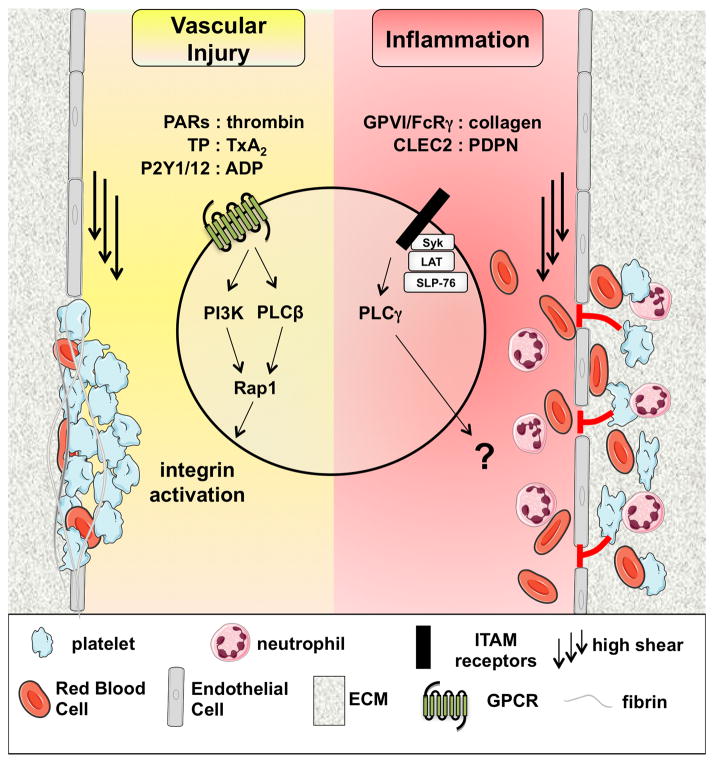
Platelets are well-known for their critical role in hemostasis, that is, the prevention of blood loss at sites of mechanical vessel injury. Inappropriate platelet activation and adhesion, however, can lead to thrombotic complications, such as myocardial infarction and stroke. To fulfill its role in hemostasis, the platelet is equipped with various G protein-coupled receptors that mediate the response to soluble agonists such as thrombin, ADP, and thromboxane A2. In addition to G protein-coupled receptors, platelets express 3 glycoproteins that belong to the family of immunoreceptor tyrosine-based activation motif receptors: Fc receptor γ chain, which is noncovalently associated with the glycoprotein VI collagen receptor, C-type lectin 2, the receptor for podoplanin, and Fc receptor γII A, a low-affinity receptor for immune complexes. Although both genetic and chemical approaches have documented a critical role for platelet G protein-coupled receptors in hemostasis, the contribution of immunoreceptor tyrosine-based activation motif receptors to this process is less defined. Studies performed during the past decade, however, have identified new roles for platelet immunoreceptor tyrosine-based activation motif signaling in vascular integrity in utero and at sites of inflammation. The purpose of this review is to summarize recent findings on how platelet immunoreceptor tyrosine-based activation motif signaling controls vascular integrity, both in the presence and absence of mechanical injury.
Keywords: blood and lymphatic vessels; blood platelets; hemostasis; inflammation.
Figures
References
-
- Ruggeri ZM. Platelets in atherothrombosis. Nat Med. 2002;8:1227–1234. - PubMed
-
- Sachs UJ, Nieswandt B. In vivo thrombus formation in murine models. Circ Res. 2007;100:979–991. - PubMed
-
- Versteeg HH, Heemskerk JW, Levi M, Reitsma PH. New fundamentals in hemostasis. Physiol Rev. 2013;93:327–358. - PubMed
-
- Kuijpers MJ, Schulte V, Bergmeier W, Lindhout T, Brakebusch C, Offermanns S, Fassler R, Heemskerk JW, Nieswandt B. Complementary roles of glycoprotein vi and alpha2beta1 integrin in collagen-induced thrombus formation in flowing whole blood ex vivo. Faseb J. 2003;17:685–687. - PubMed
Publication types
MeSH terms
Substances
Grants and funding
LinkOut - more resources
Full Text Sources
Other Literature Sources
Miscellaneous
