. 2014 May;23(5):515-25.
doi: 10.1002/pds.3595. Epub 2014 Feb 18.

Correlates and variance decomposition analysis of heparin dosing for maintenance hemodialysis in older US patients

Affiliations

Correlates and variance decomposition analysis of heparin dosing for maintenance hemodialysis in older US patients

Jenny I Shen et al. Pharmacoepidemiol Drug Saf. 2014 May.

Abstract

Purpose: Heparin is commonly used to anticoagulate the hemodialysis (HD) circuit. Despite the bleeding risk, no American standards exist for its administration. We identified correlates and quantified sources of variance in heparin dosing for HD.

Methods: We performed a cross-sectional study of patients aged 67 years or older who underwent HD with heparin on one of two randomly chosen days in 2008 at a national chain of dialysis facilities. Using a mixed effects model with random intercept for facility and fixed patient and facility characteristics, we examined heparin dosing at patient and facility levels.

Results: The median heparin dose among the 17 722 patients treated in 1366 facilities was 4000 (25th-75th percentile: 2625-6000) units. In multivariable-adjusted analyses, higher weight, longer session duration, catheter use, and dialyzer reuse were significantly associated with higher heparin dose. Dose also varied considerably among census divisions. Of the overall variance in dose, 21% was due to between-facility differences, independent of facilities' case mix, geography, size, or rurality; 79% was due to differences at the patient level. The patient and facility characteristics in our model explained only 25% of the variance at the patient level.

Conclusions: Despite the lack of standards for heparin administration, we noted patterns of use, including weight-based and time-dependent dosing. Most of the variance was at the patient level; however, only a quarter of it could be explained. The high amount of unexplained variance suggests that factors other than clinical need are driving heparin dosing and that there is likely room for more judicious dosing of heparin.

Keywords: anticoagulation; facility; hemodialysis; heparin; pharmacoepidemiology.


Conflict of interest statement

Conflict of Interest Statement: The authors have no pertinent conflicts of interest to disclose. The study sponsors had no involvement in the study design, in the collection, analysis or interpretation of data, in the writing of the report, or in the decision to submit the report for publication.

Figures

Figure 1
Figure 1
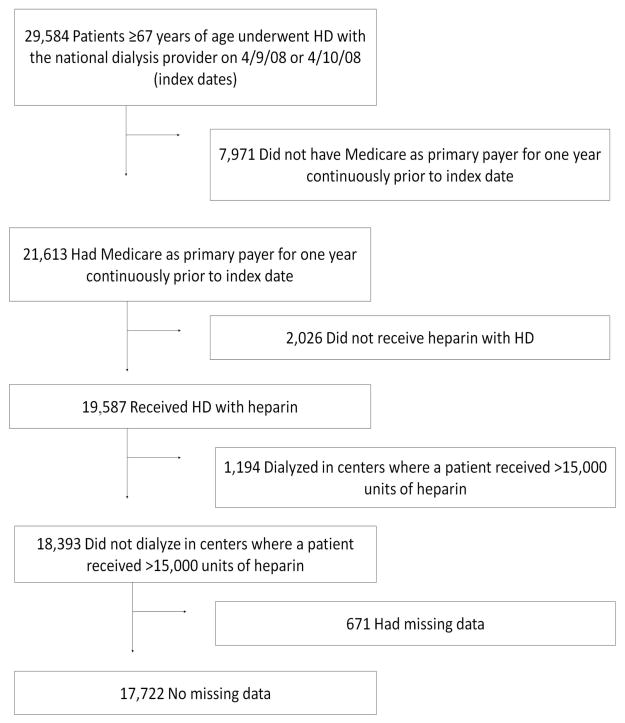
Study population selection from the United States Renal Data System. We selected a cohort of patients 67 years of age or older whose primary payer was Medicare who underwent hemodialysis with heparin at a participating facility on April 9 or 10, 2008. HD=hemodialysis.
Figure 2
Figure 2
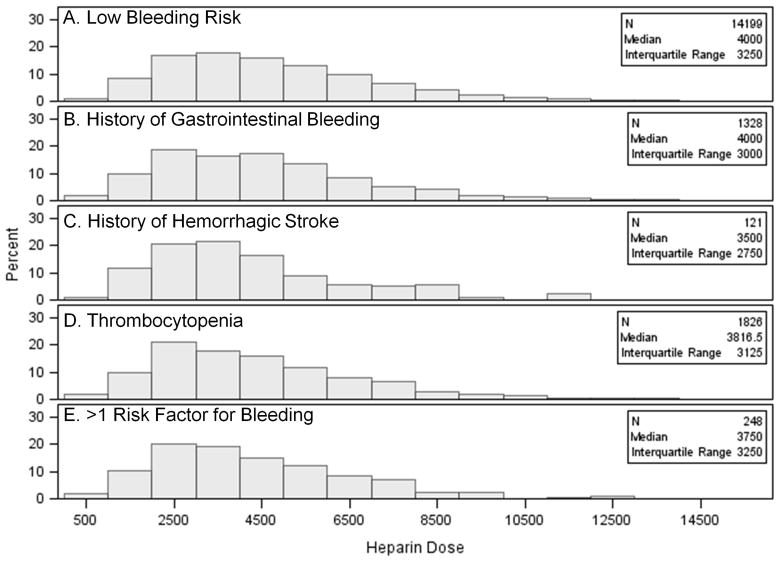
Distribution of heparin dose in subgroups with different risk factors for bleeding: Panel A) patients with low bleeding risk (no history of gastrointestinal bleeding, hemorrhagic stroke, or thrombocytopenia); Panel B) patients with only a history of gastrointestinal bleeding; Panel C) patients with only a history of hemorrhagic stroke; Panel D) patients with only thrombocytopenia (platelet count <150,000/μL within 90 days of heparin administration); Panel E) Patients with more than one risk factor for bleeding. Subgroups are mutually exclusive.
Figure 3
Figure 3
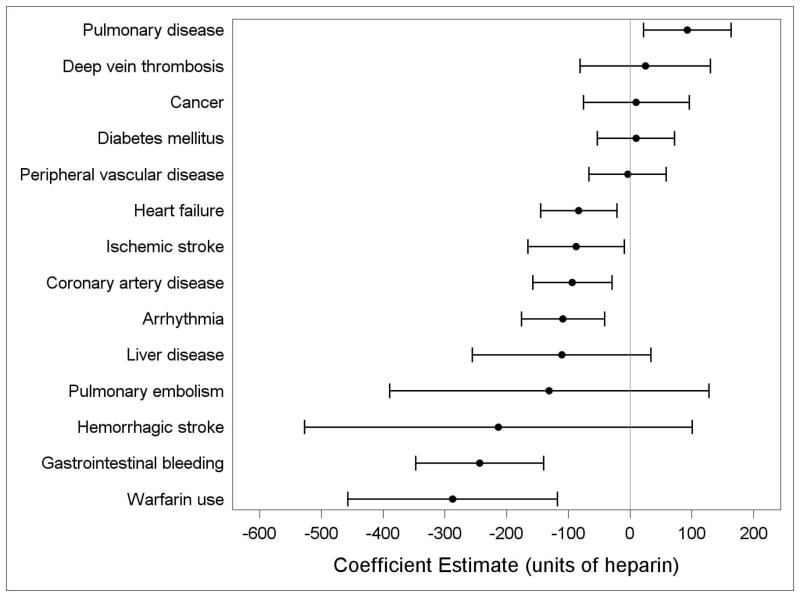
Association of comorbidities with heparin dose in maintenance hemodialysis in older U.S. patients (coefficient and 95% confidence intervals) estimated from a multivariable mixed effects model for heparin dose with a random intercept for facility.
Figure 4
Figure 4
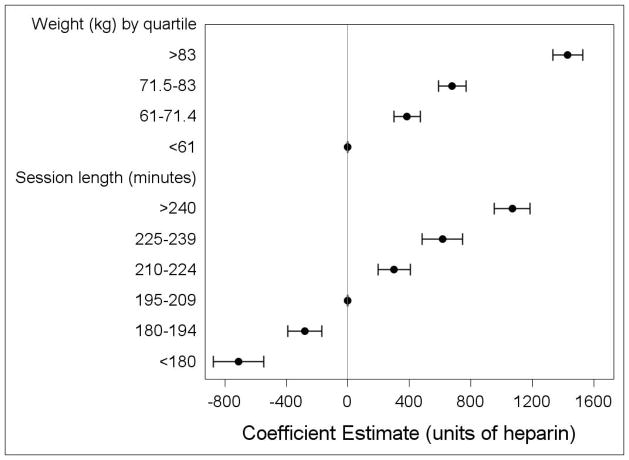
Association of weight and time with heparin dose in maintenance hemodialysis in older U.S. patients (coefficient and 95% confidence intervals) estimated from a multivariable mixed effects model for heparin dose with a random intercept for facility. P for trend<0.001 for both variables.
Figure 5
Figure 5
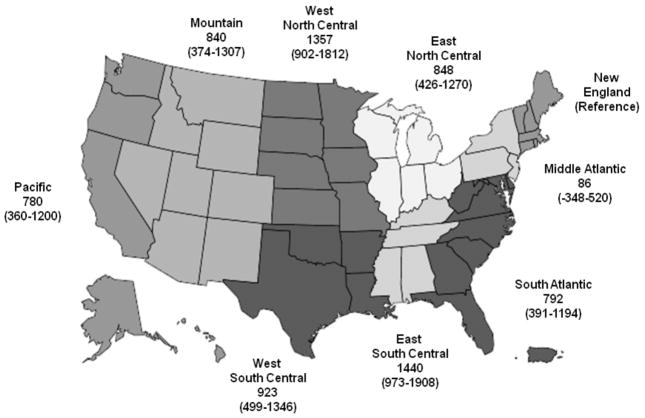
Association of Census Bureau Divisions with heparin dose (in units) in maintenance hemodialysis in older U.S. patients estimated (coefficient estimate and 95% confidence intervals) from a multivariable mixed effects model for heparin dose with a random intercept for facility.

References

    1. Cronin RE, Reilly RF. Unfractionated heparin for hemodialysis: still the best option. Semin Dial. 2010 Sep-Oct;23(5):510–515. - PMC - PubMed
    1. Shen JI, Mitani AA, Chang TI, Winkelmayer WC. Use and safety of heparin-free maintenance hemodialysis in the USA. Nephrol Dial Transplant. 2013 Apr 5; - PMC - PubMed
    1. Yang JY, Lee TC, Montez-Rath ME, et al. Trends in acute nonvariceal upper gastrointestinal bleeding in dialysis patients. J Am Soc Nephrol. 2012 Mar;23(3):495–506. - PMC - PubMed
    1. Shen JI, Winkelmayer WC. Use and safety of unfractionated heparin for anticoagulation during maintenance hemodialysis. Am J Kidney Dis. 2012 Sep;60(3):473–486. - PMC - PubMed
    1. Krumholz HM. Variations in health care, patient preferences, and high-quality decision making. JAMA. 2013 Jul 10;310(2):151–152. - PMC - PubMed

Publication types