


Review
doi: 10.1002/mabi.201400061.
Epub 2014 Mar 28.
Bioreducible polycations in nucleic acid delivery: past, present, and future trends
Affiliations
- PMID: 24678057
- PMCID: PMC4410047
- DOI: 10.1002/mabi.201400061
Item in Clipboard
Review
Bioreducible polycations in nucleic acid delivery: past, present, and future trends
Macromol Biosci.
2014 Jul.
Abstract
Polycations that are degradable by reduction of disulfide bonds are developed for applications in delivery of nucleic acids. This Feature Article surveys methods of synthesis of bioreducible polycations and discusses current understanding of the mechanism of action of bioreducible polyplexes. Emphasis is placed on the relationship between the biological redox environment and toxicity, trafficking, transfection activity, and in vivo behavior of bioreducible polycations and polyplexes.
Keywords: bioreducible; disulfides; gene delivery; polycations; polyplexes.
© 2014 WILEY-VCH Verlag GmbH & Co. KGaA, Weinheim.
Figures

Mechanism of thiol-disulfide exchange by oxidoreductases. Reproduced with permission.[39] Copyright 2002, Nature Publishing Group.
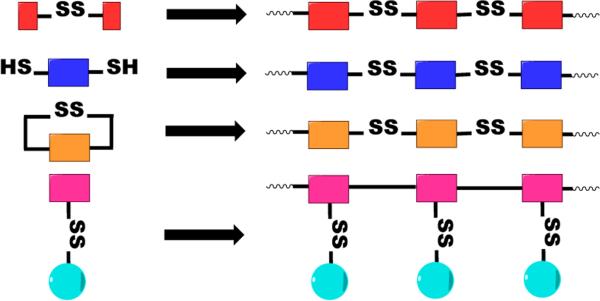
Synthetic approaches to bioreducible polycations.
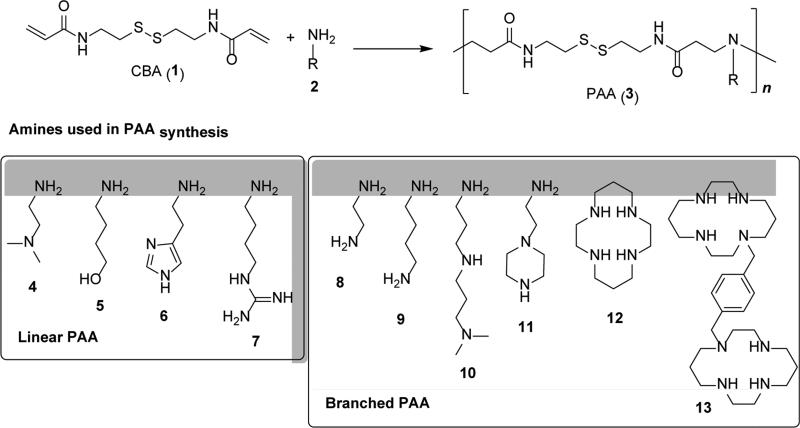
Synthesis of bioreducible PAA by Michael polyaddition and examples of common amines used in the synthesis of linear and branched PAA.
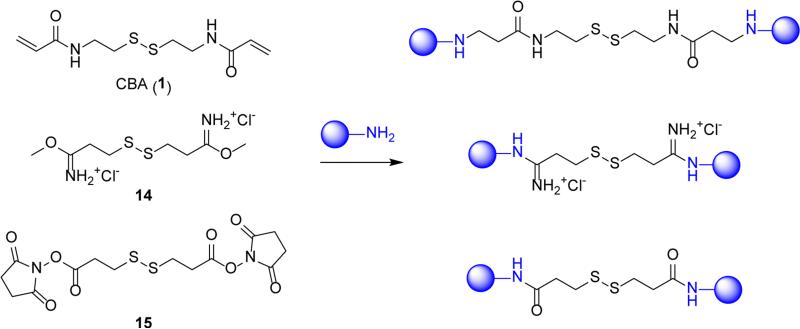
Bioreducible crosslinkers used in the synthesis of bioreducible polycations.

Cationic peptides used in the synthesis of bioreducible polypeptides based on cysteine (left) and penicillamine with sterically hindered thiol (right).
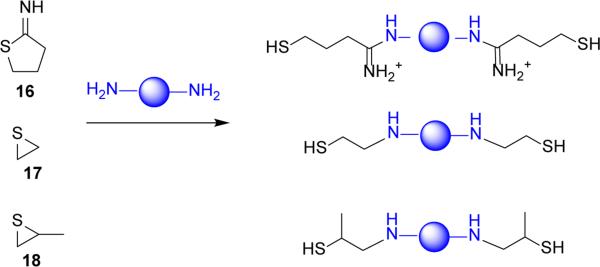
Common thiolation methods of polyamines.
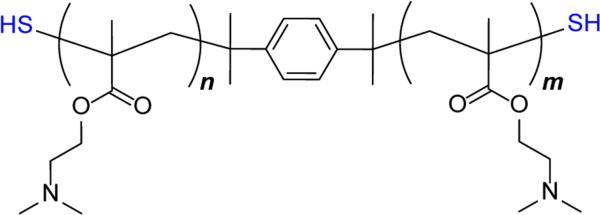
Structure of well-defined α,ω-bisthiol polycation based on N,N-dimethylaminoethyl methacrylate prepared by RAFT polymerization.[105]
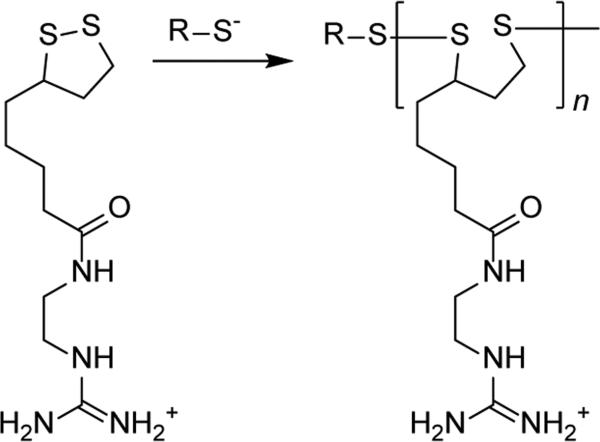
Thiol-disulfide exchange polymerization of cationic lipoic acid derivative.[109]
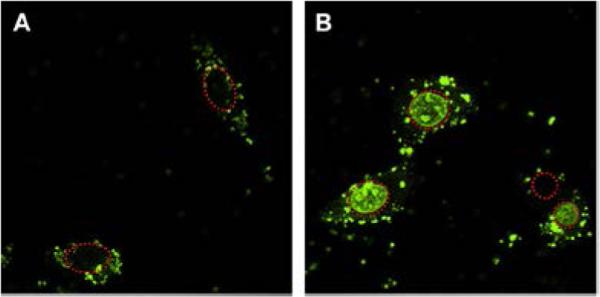
Improved cytoplasmic release of DNA from polyplexes prepared with bioreducible PAA. Intracellular distribution of fluorescently labeled DNA delivered with PEI (A) or bioreducible PAA (B). (red dashed circles indicate cell nuclei) Reproduced with permission.[122] Copyright 2009, Elsevier Ltd.
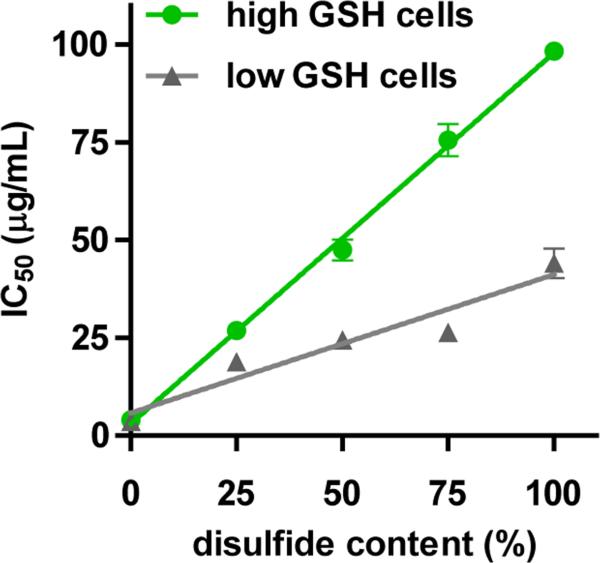
Cytotoxicity of bioreducible polycations decreases with increasing disulfide content and cellular GSH levels. (Adapted from [151])
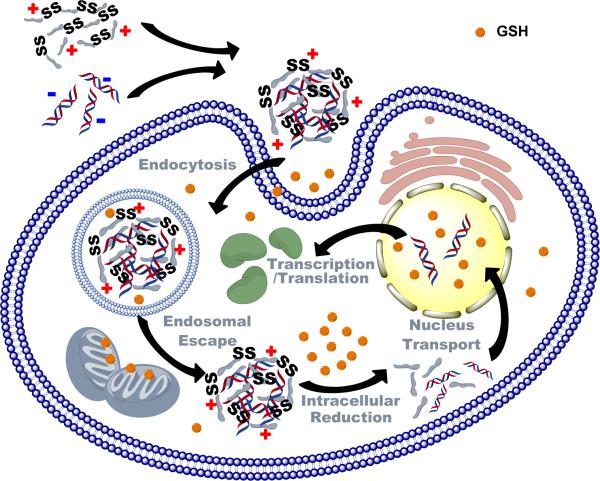
Principle of nucleic acid delivery by bioreducible polycations.
References
-
- Bang EK, Lista M, Sforazzini G, Sakai N, Matile S. Chem. Sci. 2012;3:1752.
-
- Wu AM, Senter PD. Nat. Biotechnol. 2005;23:1137. - PubMed
-
- Corbett PT, Leclaire J, Vial L, West KR, Wietor J-L, Sanders JK, Otto S. Chem. Rev. 2006;106:3652. - PubMed
-
- Yoon JA, Kamada J, Koynov K, Mohin J, Nicolaÿ R, Zhang Y, Balazs AC, Kowalewski T, Matyjaszewski K. Macromolecules. 2011;45:142.
-
- Otto S, Furlan RL, Sanders JK. Science. 2002;297:590. - PubMed
Publication types
MeSH terms
Substances
Grants and funding
LinkOut - more resources
Full Text Sources
Other Literature Sources
Miscellaneous
