Prototyping of cerebral vasculature physical models
- PMID: 24678427
- PMCID: PMC3942610
- DOI: 10.4103/2152-7806.125858
Prototyping of cerebral vasculature physical models
Abstract
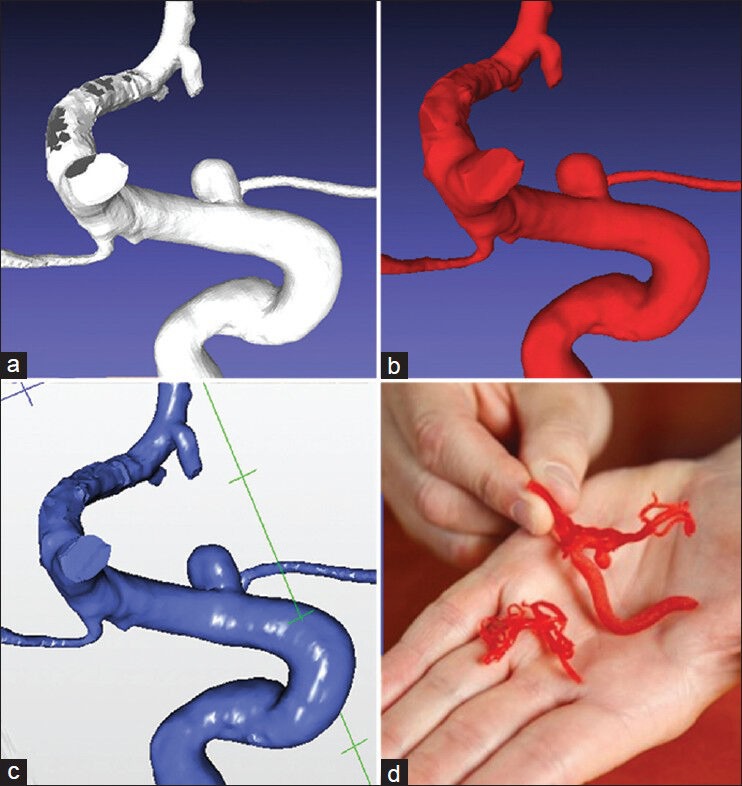
Background: Prototyping of cerebral vasculature models through stereolithographic methods have the ability to accurately depict the 3D structures of complicated aneurysms with high accuracy. We describe the method to manufacture such a model and review some of its uses in the context of treatment planning, research, and surgical training.
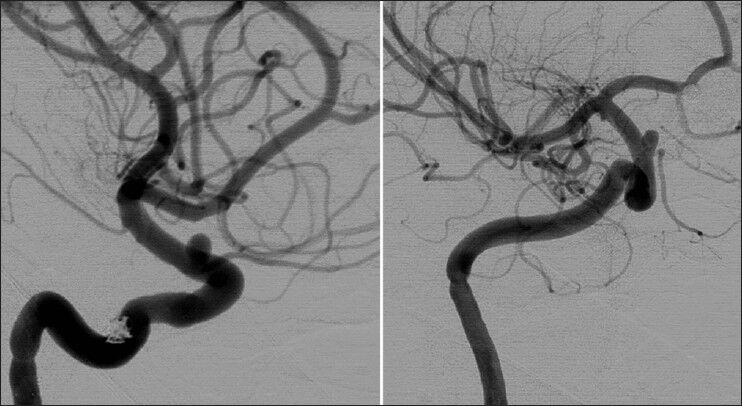
Methods: We prospectively used the data from the rotational angiography of a 40-year-old female who presented with an unruptured right paraclinoid aneurysm. The 3D virtual model was then converted to a physical life-sized model.
Results: The model constructed was shown to be a very accurate depiction of the aneurysm and its associated vasculature. It was found to be useful, among other things, for surgical training and as a patient education tool.
Conclusion: With improving and more widespread printing options, these models have the potential to become an important part of research and training modalities.
Keywords: 3D modeling; Cerebral aneurysm; physical model; rapid prototyping; stereolithographic methods; training tool.
Figures
References
-
- D’Urso PS, Thompson RG, Atkinson RL, Weidmann MJ, Redmond MJ, Hall BI, et al. Cerebrovascular biomodelling: A technical note. Surg Neurol. 1999;52:490–500. - PubMed
-
- Gailloud P, Pray JR, Muster M, Piotin M, Fasel JH, Rüfenacht DA. An in vitro anatomic model of the human cerebral arteries with saccular arterial aneurysms. Surg Radiol Anat. 1997;19:119–21. - PubMed
-
- Hull C. Washington, DC: US Patent Office; 4,575,330; Apparatus for production of three-dimensional objects by stereolithography [Internet] Available from: http://www.google.com/patents/US4575330 .
-
- Kimura T, Morita A, Nishimura K, Aiyama H, Itoh H, Fukaya S, et al. Simulation of and training for cerebral aneurysm clipping with 3-dimensional models. Neurosurgery. 2009;65:719–25. - PubMed
-
- Mankovich NJ, Cheeseman AM, Stoker NG. The display of three-dimensional anatomy with stereolithographic models. J Digit Imaging. 1990;3:200–3. - PubMed
LinkOut - more resources
Full Text Sources
Other Literature Sources