


Predicting In-Hospital Mortality of ICU Patients: The PhysioNet/Computing in Cardiology Challenge 2012
- PMID: 24678516
- PMCID: PMC3965265
Predicting In-Hospital Mortality of ICU Patients: The PhysioNet/Computing in Cardiology Challenge 2012
Abstract
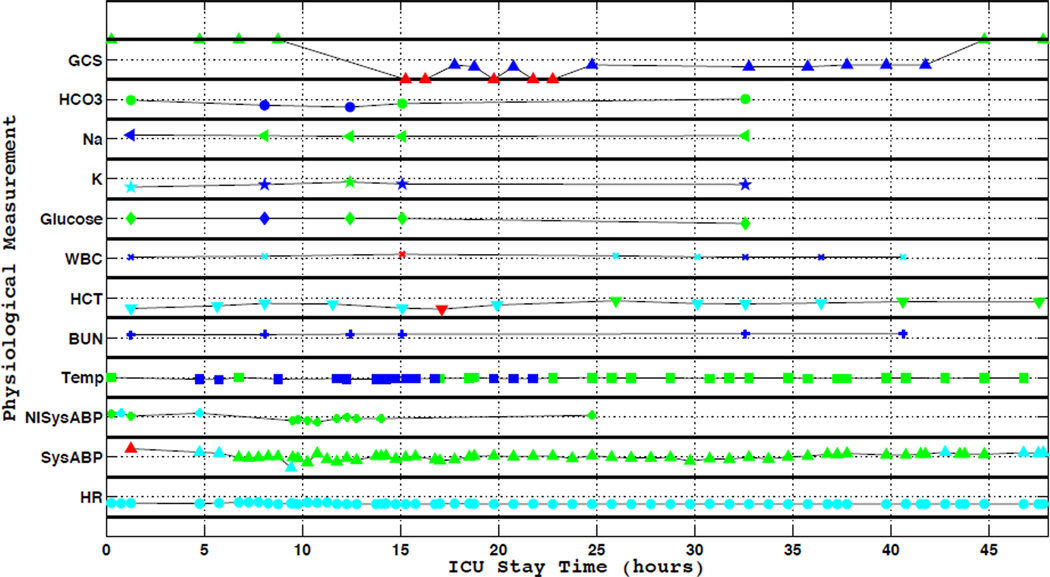
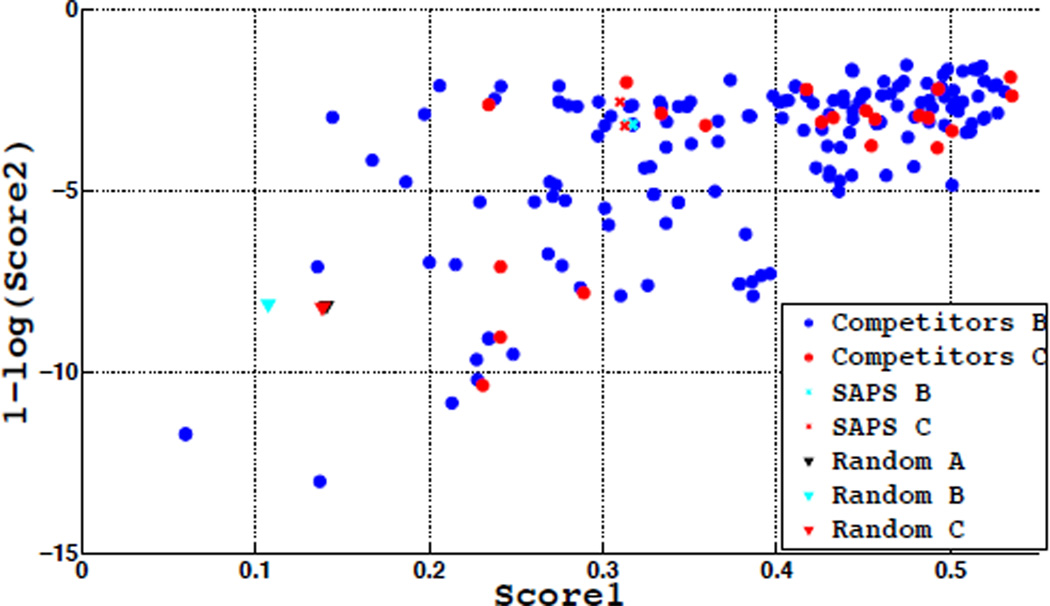
Acuity scores, such as APACHE, SAPS, MPM, and SOFA, are widely used to account for population differences in studies aiming to compare how medications, care guidelines, surgery, and other interventions impact mortality in Intensive Care Unit (ICU) patients. By contrast, the focus of the PhysioNet/CinC Challenge 2012 is to develop methods for patient-specific prediction of in-hospital mortality. The data used for the challenge consisted of 5 general descriptors and 36 time series (measurements of vital signs and laboratory results) from the first 48 hours of the first available ICU stay of 12,000 adult patients from the MIMIC II database. The challenge was organized as two events: event 1 measured performance of a binary classifier, and event 2 measured performance of a risk estimator. The score of event 1 was the lower of sensitivity and positive predictive value. The score for event 2 was a range-normalized Hosmer-Lemeshow statistic. A baseline algorithm (using SAPS-1) obtained event 1 and 2 scores of 0.3125 and 68.58 respectively. Most participants submitted entries that outperformed the baseline algorithm. The top final scores for events 1 and 2 were 0.5353 and 17.88 respectively.
Figures
References
-
- Le Gall J, Loirat P, Alperovitch A, Glaser P, Granthil C, Mathieu D, Mercier P, Thomas R, Villers D. A simplified acute physiology score for ICU patients. Critical Care Medicine. 1984;12(11):975–977. - PubMed
-
- Ferreira F, Bota D, Bross A, Mlot C, Vincent J. Serial evaluation of the SOFA score to predict outcome in critically ill patients. JAMA. 2001;286(14):1754–1758. - PubMed
-
- Le Gall J, Lemeshow S, Saulnier F. A new simplified acute physiology score (SAPS II) based on a European/North American multicenter study. JAMA. 1993;270(24):2957–2963. - PubMed
-
- Lemeshow S, Teres D, Klar J, Avrunin J, Gehlbach S, Rapoport J. Mortality probability models (MPM II) based on an international cohort of intensive care unit patients. JAMA. 1993;270(24):2478–2486. - PubMed
Grants and funding
LinkOut - more resources
Full Text Sources
Other Literature Sources