


Biting by Anopheles funestus in broad daylight after use of long-lasting insecticidal nets: a new challenge to malaria elimination
- PMID: 24678587
- PMCID: PMC3973838
- DOI: 10.1186/1475-2875-13-125
Biting by Anopheles funestus in broad daylight after use of long-lasting insecticidal nets: a new challenge to malaria elimination
Abstract
Background: Malaria control is mainly based on indoor residual spraying and insecticide-treated bed nets. The efficacy of these tools depends on the behaviour of mosquitoes, which varies by species. With resistance to insecticides, mosquitoes adapt their behaviour to ensure their survival and reproduction. The aim of this study was to assess the biting behaviour of Anopheles funestus after the implementation of long-lasting insecticidal nets (LLINs).
Methods: A study was conducted in Dielmo, a rural Senegalese village, after a second massive deployment of LLINs in July 2011. Adult mosquitoes were collected by human landing catch and by pyrethrum spray catch monthly between July 2011 and April 2013. Anophelines were identified by stereomicroscope and sub-species by PCR. The presence of circumsporozoite protein of Plasmodium falciparum and the blood meal origin were detected by ELISA.
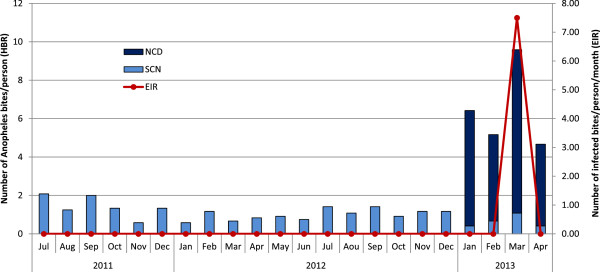
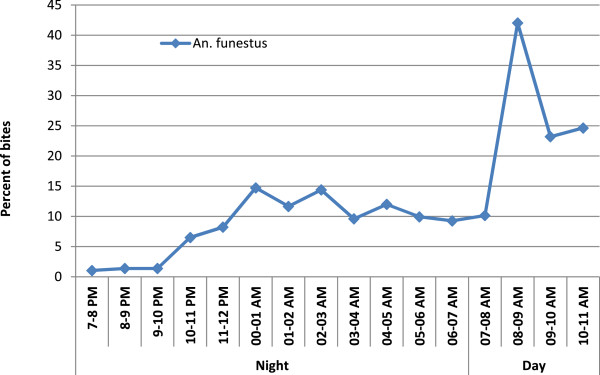
Results: Anopheles funestus showed a behavioural change in biting activity after introduction of LLINs, remaining anthropophilic and endophilic, while adopting diurnal feeding, essentially on humans. Six times more An. funestus were captured in broad daylight than at night. Only one infected mosquito was found during day capture. The mean of day CSP rate was 1.28% while no positive An. funestus was found in night captures.
Conclusion: Mosquito behaviour is an essential component for assessing vectorial capacity to transmit malaria. The emergence of new behavioural patterns of mosquitoes may significantly increase the risk for malaria transmission and represents a new challenge for malaria control. Additional vector control strategies are, therefore, necessary.
Figures
References
-
- Maxmen A. Malaria surge feared. Nature. 2012;485:293. - PubMed
-
- WHO. World Malaria Report. Geneva, Switzerland: World Health Organization; 2012.
-
- Gillies MT, De Meillon D. The Anophelinae of Africa South of the Sahara. Publ South Afri Inst Med Res. 1968;54:343.
-
- Bockarie MJ, Service MW, Barnish G, Momoh W, Salia F. The effect of woodsmoke on the feeding and resting behaviour of Anopheles gambiae s.s. Acta Trop. 1994;57:337–340. - PubMed
-
- Magbity EB, Marbiah NT, Maude G, Curtis CF, Bradley DJ, Greenwood BM, Petersen E, Lines JD. Effects of community-wide use of lambdacyhalothrin-impregnated bednets on malaria vectors in rural Sierra Leone. Med Vet Entomol. 1997;11:79–86. - PubMed
Publication types
MeSH terms
Substances
LinkOut - more resources
Full Text Sources
Other Literature Sources
Medical
Miscellaneous
