


ClearedLeavesDB: an online database of cleared plant leaf images
- PMID: 24678985
- PMCID: PMC3986656
- DOI: 10.1186/1746-4811-10-8
ClearedLeavesDB: an online database of cleared plant leaf images
Abstract
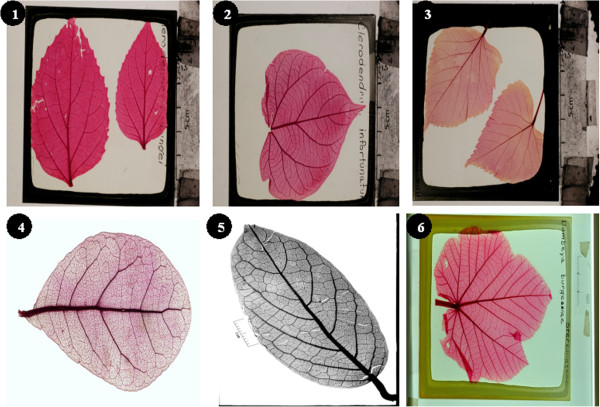
Background: Leaf vein networks are critical to both the structure and function of leaves. A growing body of recent work has linked leaf vein network structure to the physiology, ecology and evolution of land plants. In the process, multiple institutions and individual researchers have assembled collections of cleared leaf specimens in which vascular bundles (veins) are rendered visible. In an effort to facilitate analysis and digitally preserve these specimens, high-resolution images are usually created, either of entire leaves or of magnified leaf subsections. In a few cases, collections of digital images of cleared leaves are available for use online. However, these collections do not share a common platform nor is there a means to digitally archive cleared leaf images held by individual researchers (in addition to those held by institutions). Hence, there is a growing need for a digital archive that enables online viewing, sharing and disseminating of cleared leaf image collections held by both institutions and individual researchers.
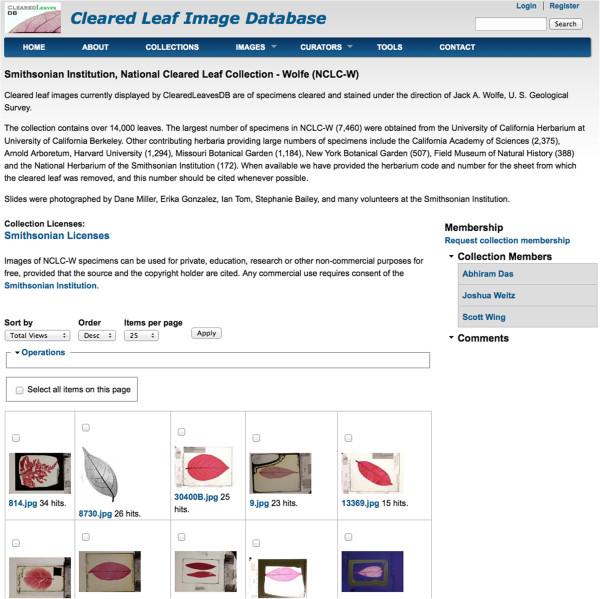
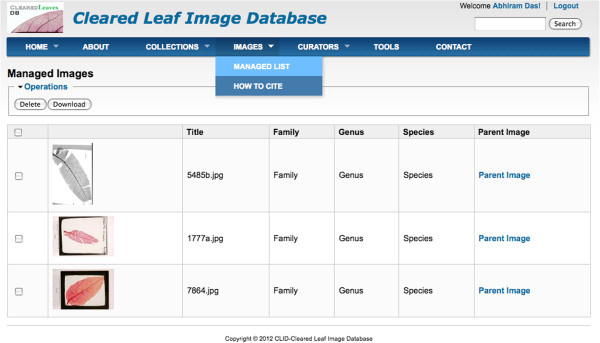
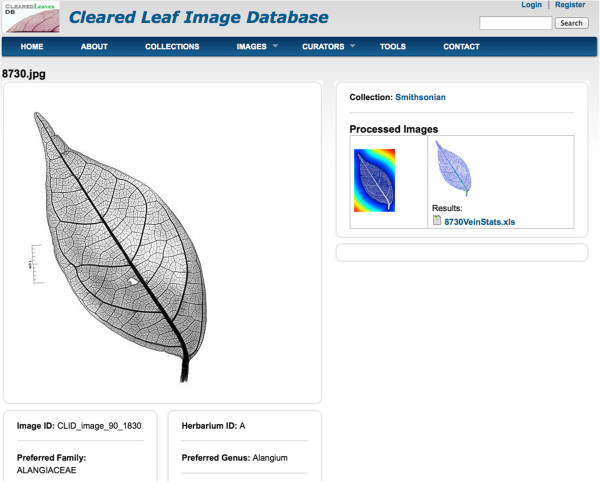
Description: The Cleared Leaf Image Database (ClearedLeavesDB), is an online web-based resource for a community of researchers to contribute, access and share cleared leaf images. ClearedLeavesDB leverages resources of large-scale, curated collections while enabling the aggregation of small-scale collections within the same online platform. ClearedLeavesDB is built on Drupal, an open source content management platform. It allows plant biologists to store leaf images online with corresponding meta-data, share image collections with a user community and discuss images and collections via a common forum. We provide tools to upload processed images and results to the database via a web services client application that can be downloaded from the database.
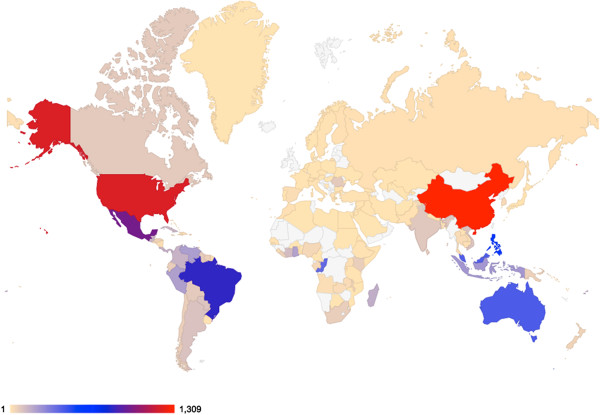
Conclusions: We developed ClearedLeavesDB, a database focusing on cleared leaf images that combines interactions between users and data via an intuitive web interface. The web interface allows storage of large collections and integrates with leaf image analysis applications via an open application programming interface (API). The open API allows uploading of processed images and other trait data to the database, further enabling distribution and documentation of analyzed data within the community. The initial database is seeded with nearly 19,000 cleared leaf images representing over 40 GB of image data. Extensible storage and growth of the database is ensured by using the data storage resources of the iPlant Discovery Environment. ClearedLeavesDB can be accessed at http://clearedleavesdb.org.
Figures
References
-
- Ellis B, DCD, Hickey LJ, Johnson KR, Mitchel JD, Wilf P, Wing SL. Manual of Leaf Architecture. Ithaca, NY: Cornell University Press; 2009.
-
- Niinemets U, Portsmuth A, Tobias M. Leaf shape and venation pattern alter the support investments within leaf lamina in temperate species: a neglected source of leaf physiological differentiation? Funct Ecol. 2007;21:28–40.
-
- Brodribb TJ, Feild TS. Stem hydraulic supply is linked to leaf photosynthetic capacity: evidence from New Caledonian and Tasmanian rainforests. Plant Cell and Environment. 2000;23:1381–1388. doi: 10.1046/j.1365-3040.2000.00647.x. - DOI
LinkOut - more resources
Full Text Sources
Other Literature Sources
