


Remote control of gene function by local translation
- PMID: 24679524
- PMCID: PMC3988848
- DOI: 10.1016/j.cell.2014.03.005
Remote control of gene function by local translation
Abstract
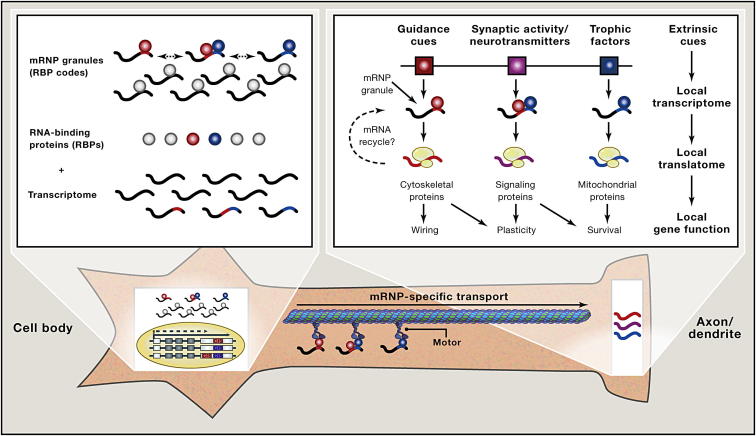
The subcellular position of a protein is a key determinant of its function. Mounting evidence indicates that RNA localization, where specific mRNAs are transported subcellularly and subsequently translated in response to localized signals, is an evolutionarily conserved mechanism to control protein localization. On-site synthesis confers novel signaling properties to a protein and helps to maintain local proteome homeostasis. Local translation plays particularly important roles in distal neuronal compartments, and dysregulated RNA localization and translation cause defects in neuronal wiring and survival. Here, we discuss key findings in this area and possible implications of this adaptable and swift mechanism for spatial control of gene function.
Copyright © 2014 The Authors. Published by Elsevier Inc. All rights reserved.
Figures
References
-
- Alvarez J. The autonomous axon: a model based on local synthesis of proteins. Biol. Res. 2001;34:103–109. - PubMed
-
- Alvarez J., Giuditta A., Koenig E. Protein synthesis in axons and terminals: significance for maintenance, plasticity and regulation of phenotype. With a critique of slow transport theory. Prog. Neurobiol. 2000;62:1–62. - PubMed
-
- Andreassi C., Zimmermann C., Mitter R., Fusco S., De Vita S., Saiardi A., Riccio A. An NGF-responsive element targets myo-inositol monophosphatase-1 mRNA to sympathetic neuron axons. Nat. Neurosci. 2010;13:291–301. - PubMed
Publication types
MeSH terms
Substances
Grants and funding
LinkOut - more resources
Full Text Sources
Other Literature Sources
