


Nuclear Receptors, RXR, and the Big Bang
- PMID: 24679540
- PMCID: PMC4029515
- DOI: 10.1016/j.cell.2014.03.012
Nuclear Receptors, RXR, and the Big Bang
Abstract
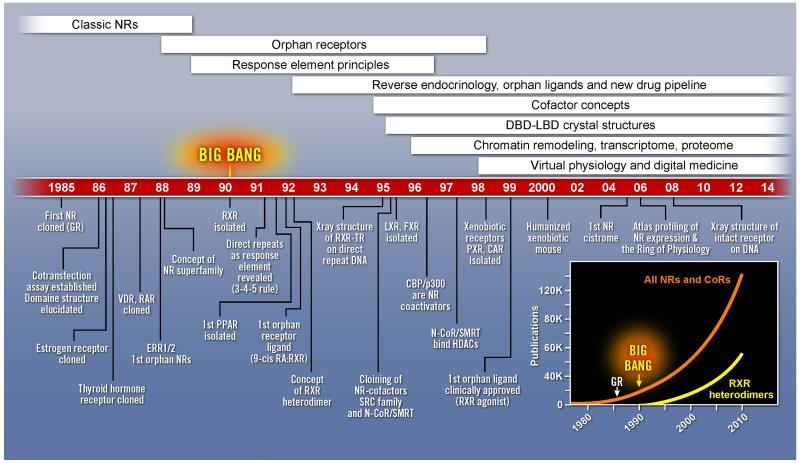
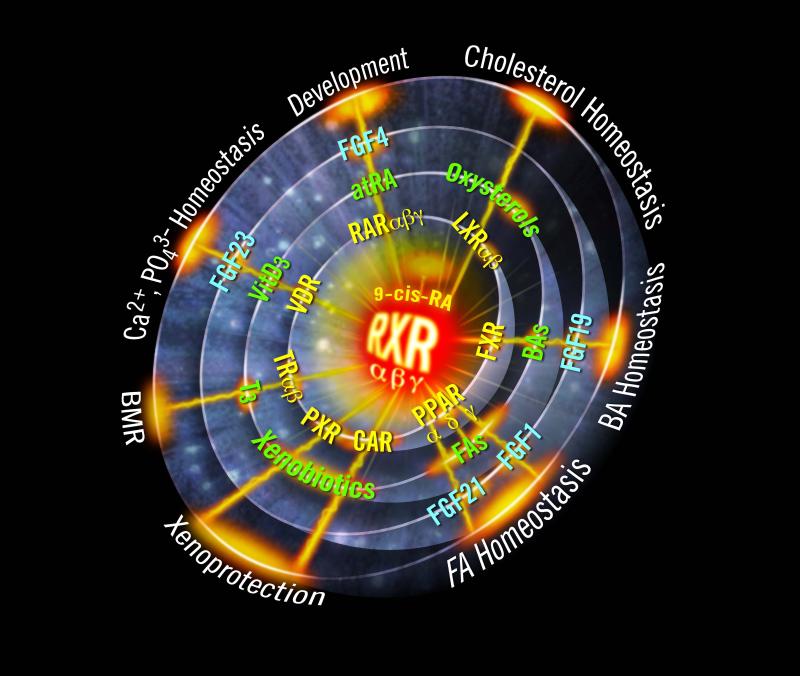
Isolation of genes encoding the receptors for steroids, retinoids, vitamin D, and thyroid hormone and their structural and functional analysis revealed an evolutionarily conserved template for nuclear hormone receptors. This discovery sparked identification of numerous genes encoding related proteins, termed orphan receptors. Characterization of these orphan receptors and, in particular, of the retinoid X receptor (RXR) positioned nuclear receptors at the epicenter of the "Big Bang" of molecular endocrinology. This Review provides a personal perspective on nuclear receptors and explores their integrated and coordinated signaling networks that are essential for multicellular life, highlighting the RXR heterodimer and its associated ligands and transcriptional mechanism.
Copyright © 2014 Elsevier Inc. All rights reserved.
Figures
References
-
- Baker ME. Origin and diversification of steroids: co-evolution of enzymes and nuclear receptors. Mol Cell Endocrinol. 2011;334:14–20. - PubMed
-
- Beato M. Transcriptional control by nuclear receptors. FASEB journal : official publication of the Federation of American Societies for Experimental Biology. 1991;5:2044–2051. - PubMed
-
- Blumberg B, Evans RM. Orphan nuclear receptors--new ligands and new possibilities. Genes & development. 1998;12:3149–3155. - PubMed
Publication types
MeSH terms
Substances
Grants and funding
- P01 HL088093/HL/NHLBI NIH HHS/United States
- R01 HL105278/HL/NHLBI NIH HHS/United States
- CA014195/CA/NCI NIH HHS/United States
- HL088093/HL/NHLBI NIH HHS/United States
- P42 ES010337/ES/NIEHS NIH HHS/United States
- DK090962/DK/NIDDK NIH HHS/United States
- R01 DK067158/DK/NIDDK NIH HHS/United States
- HHMI/Howard Hughes Medical Institute/United States
- ES010337/ES/NIEHS NIH HHS/United States
- R37 DK057978/DK/NIDDK NIH HHS/United States
- DK057978/DK/NIDDK NIH HHS/United States
- R24 DK090962/DK/NIDDK NIH HHS/United States
- HL105278/HL/NHLBI NIH HHS/United States
- R01DK067158/DK/NIDDK NIH HHS/United States
- R01 DK057978/DK/NIDDK NIH HHS/United States
- P30 CA014195/CA/NCI NIH HHS/United States
LinkOut - more resources
Full Text Sources
Other Literature Sources
Molecular Biology Databases
