


Socioeconomic status, child enrichment factors, and cognitive performance among preschool-age children: results from the Follow-Up of Growth and Development Experiences study
- PMID: 24679548
- PMCID: PMC4997613
- DOI: 10.1016/j.ridd.2014.02.003
Socioeconomic status, child enrichment factors, and cognitive performance among preschool-age children: results from the Follow-Up of Growth and Development Experiences study
Abstract
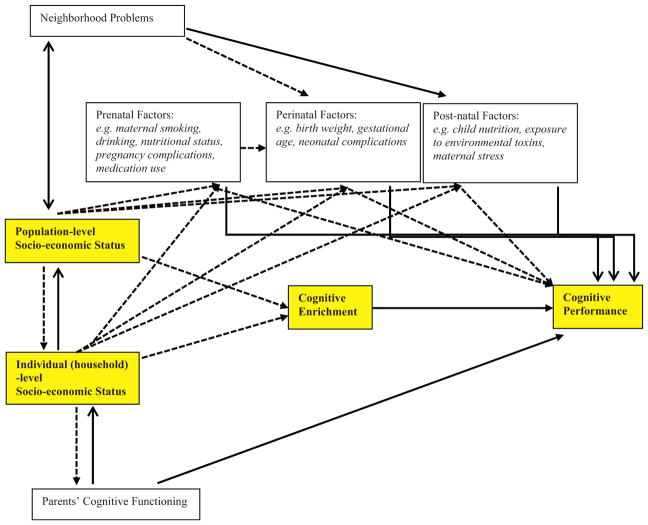
Lower cognitive performance is associated with poorer health and functioning throughout the lifespan and disproportionately affects children from lower socioeconomic status (SES) populations. Previous studies reporting positive associations between child home enrichment and cognitive performance generally had a limited distribution of SES. We evaluated the associations of SES and child enrichment with cognitive performance in a population with a wide range of SES, particularly whether enrichment attenuates associations with SES. Children were sampled from a case-control study of small-for-gestational-age (SGA) conducted in a public hospital serving a low SES population (final n=198) and a private hospital serving a middle-to-high SES population (final n=253). SES (maternal education and income) and perinatal factors (SGA, maternal smoking and drinking) were obtained from maternal birth interview. Five child home enrichment factors (e.g. books in home) and preschool attendance were obtained from follow-up interview at age 4.5 years. Cognitive performance was assessed with the Differential Ability Scales (DAS), a standardized psychometric test administered at follow-up. SES and enrichment scores were created by combining individual factors. Analyses were adjusted for perinatal factors. Children from the public birth hospital had a significantly lower mean DAS general cognitive ability (GCA) score than children born at the private birth hospital (adjusted mean difference -21.4, 95% CI: -24.0, -18.7); this was substantially attenuated by adjustment for individual SES, child enrichment factors, and preschool attendance (adjusted mean difference -5.1, 95% CI: -9.5, -0.7). Individual-level SES score was associated with DAS score, beyond the general SES effect associated with hospital of birth. Adjustment for preschool attendance and home enrichment score attenuated the association between individual SES score and adjusted mean DAS-GCA among children born at both of the hospitals. The effect of being in the lower compared to the middle tertile of SES score was reduced by approximately a quarter; the effect of being in the upper compared to the middle tertile of SES score was reduced by nearly half, but this comparison was possible only for children born at the private hospital. A child's individual SES was associated with cognitive performance within advantaged and disadvantaged populations. Child enrichment was associated with better cognitive performance and attenuated the SES influence. Health care providers should reinforce guidelines for home enrichment and refer children with delays to early intervention and education, particularly children from disadvantaged populations.
Keywords: Differential Ability Scales; Epidemiology; Neurodevelopmental; Sociodemographic determinants.
Copyright © 2014. Published by Elsevier Ltd.
Figures
References
-
- Allen MC. Neurodevelopmental outsomes of preterm infants. Current Opinion in Neurology. 2008;21(2):123–128. - PubMed
-
- Anthopoulous R, Edwards SE, Miranda ML. Effects of maternal prenatal smoking and birth outcomes extending into the normal range on academic performance in fourth grade in North Carolina, USA. Paediatric and Perinatal Epidemiology. 2013;27:564–574. - PubMed
-
- Baghurst PA, Tong S, Sawyer MG, Burns J, McMichael AJ. Sociodemographic and behavioural determinants of blood lead concentrations in children aged 11–13 years. The Port Pirie Cohort Study. Medical Journal of Australia. 1999;170(2):63–67. - PubMed
-
- Boyle CA, Boulet S, Schieve LA, Cohen RA, Blumberg SJ, Yeargin-Allsopp M, et al. Trends in the prevalence of developmental disabilities in US children, 1997–2008. Pediatrics. 2011;127(6):1034–1042. - PubMed
Publication types
MeSH terms
Grants and funding
LinkOut - more resources
Full Text Sources
Other Literature Sources
