


Context and explicit threat cue modulation of the startle reflex: preliminary evidence of distinctions between adolescents with principal fear disorders versus distress disorders
- PMID: 24679992
- PMCID: PMC4041703
- DOI: 10.1016/j.psychres.2014.01.047
Context and explicit threat cue modulation of the startle reflex: preliminary evidence of distinctions between adolescents with principal fear disorders versus distress disorders
Abstract
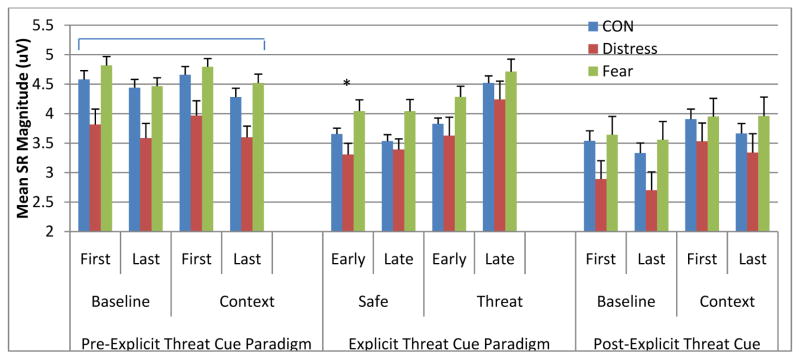
Anxiety and depression are prevalent, impairing disorders. High comorbidity has raised questions about how to define and classify them. Structural models emphasise distinctions between "fear" and "distress" disorders while other initiatives propose they be defined by neurobiological indicators that cut across disorders. This study examined startle reflex (SR) modulation in adolescents with principal fear disorders (specific phobia; social phobia) (n=20), distress disorders (unipolar depressive disorders, dysthymia, generalised anxiety disorder; post-traumatic stress disorder) (n=9), and controls (n=29) during (a) baseline conditions, (b) threat context conditions (presence of contraction pads over the biceps muscle), and (c) an explicit threat cue paradigm involving phases that signalled safety from aversive stimuli (early and late stages of safe phases; early stages of danger phases) and phases that signalled immediate danger of an aversive stimulus (late stages of danger phases). Adolescents with principal fear disorders showed larger SRs than other groups throughout safe phases and early stages of danger phases. SRs did not differ between groups during late danger phases. Adolescents with principal distress disorders showed attenuated SRs during baseline and context conditions compared to other groups. Preliminary findings support initiatives to redefine emotional disorders based on neurobiological functioning.
Keywords: Adolescents; Distress disorders; Fear disorders; Startle reflexes.
Copyright © 2014 Elsevier Ireland Ltd. All rights reserved.
Figures
References
-
- Allen NB, Trinder J, Brennan C. Affective startle modulation in clinical depression: preliminary findings. Biological Psychiatry. 1999;46:542–550. - PubMed
-
- Bittner A, Egger HL, Erkanli A, Costello E, Foley DL, Angold A. What do childhood anxiety disorders predict? Journal of Child Psychology and Psychiatry. 2007;48:1174–1183. - PubMed
-
- Clark LA, Watson D. Distress and fear disorders: an alternative empirically based taxonomy of the ‘mood’ and ‘anxiety’ disorders. British Journal of Psychiatry. 2006;189:481–483. - PubMed
-
- Craske MG. The R-DOC Initiative: science and practice. Depression & Anxiety. 2012;29:253–256. - PubMed
-
- Craske MG, Waters AM. Panic disorder, phobias, and generalized anxiety disorder. Annual Review of Clinical Psychology. 2005;1:197–225. - PubMed
Publication types
MeSH terms
Grants and funding
LinkOut - more resources
Full Text Sources
Other Literature Sources
Medical
Research Materials
