


Prevalence and correlates of binge eating in seasonal affective disorder
- PMID: 24680872
- PMCID: PMC4019042
- DOI: 10.1016/j.psychres.2014.03.012
Prevalence and correlates of binge eating in seasonal affective disorder
Abstract
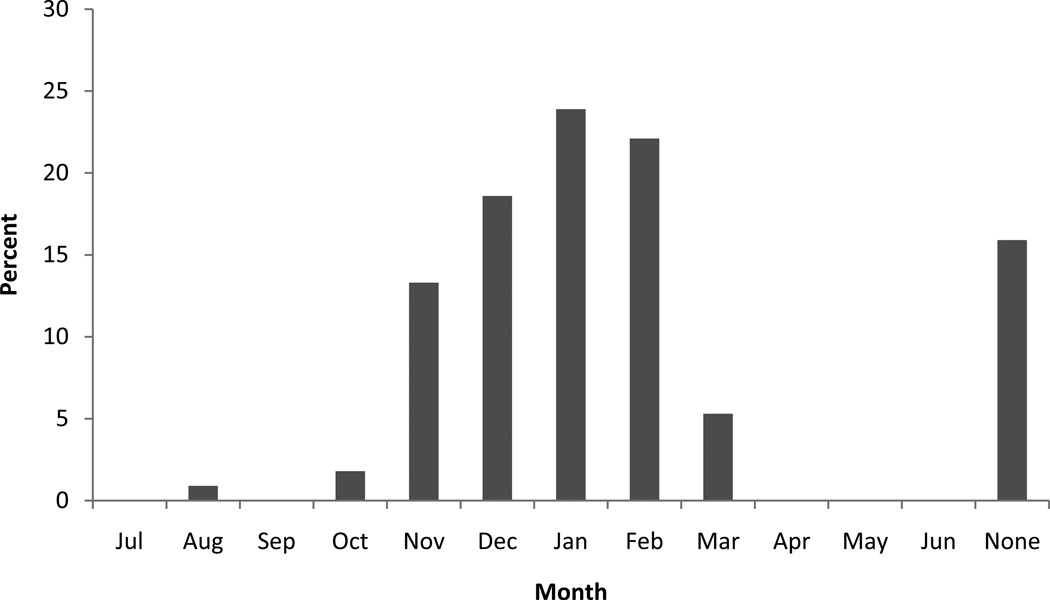
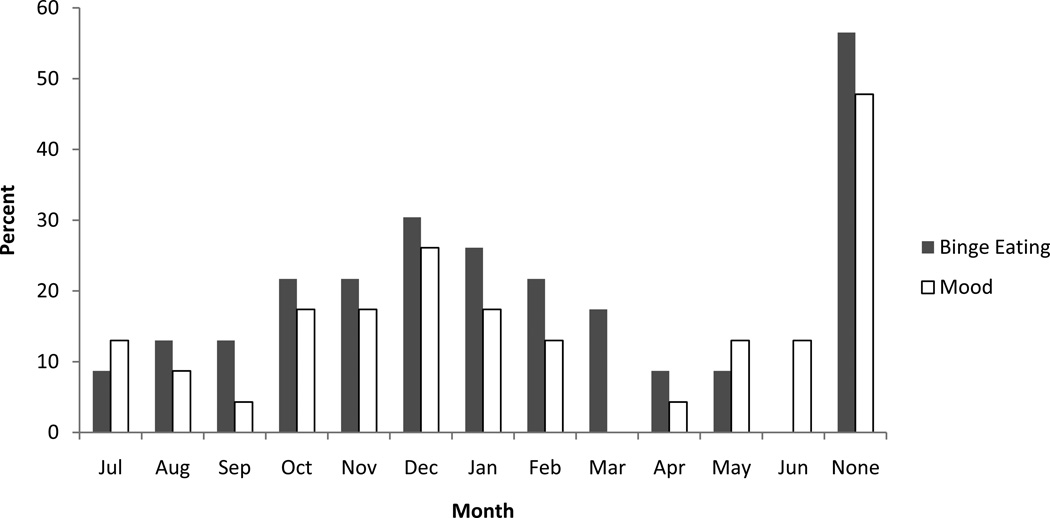
Eating pathology in Seasonal Affective Disorder (SAD) may be more severe than hyperphagia during winter. Although research has documented elevated rates of subclinical binge eating in women with SAD, the prevalence and correlates of binge eating disorder (BED) in SAD remain largely uncharacterized. We examined the prevalence and correlates of binge eating, weekly binge eating with distress, and BED as defined by the DSM-IV-TR in SAD. We also tested whether binge eating exhibits a seasonal pattern among individuals with BED. Two samples were combined to form a sample of individuals with SAD (N=112). A third sample included non-depressed adults with clinical (n=12) and subclinical (n=11) BED. All participants completed the Questionnaire of Eating and Weight Patterns-Revised (QEWP-R) and modified Seasonal Pattern Assessment Questionnaire (M-SPAQ). In the SAD sample, 26.5% reported binge eating, 11.6% met criteria for weekly binge eating with distress, and 8.9% met criteria for BED. Atypical symptom severity predicted binge eating and BED. In the BED sample, 30% endorsed seasonal worsening of mood, and 26% reported a winter pattern of binge eating. The spectrum of eating pathology in SAD includes symptoms of BED, which are associated with atypical depression symptoms, but typical depression symptoms.
Keywords: Affective disorders; Atypical depression; Binge eating disorder; Seasonality.
Copyright © 2014 Elsevier Ireland Ltd. All rights reserved.
Figures
References
-
- American Psychiatric Association. Diagnostic and statistical manual of mental disorders: Text revision. 4th ed. Washington, DC: APA; 2000.
-
- American Psychiatric Association. Diagnostic and statistical manual of mental disorders. 5th ed. Washington, DC: APA; 2013.
-
- Angst J, Gamma A, Sellaro R, Zhang H, Merikangas K. Toward a validation of atypical depression in the community: Results of the Zurich cohort study. Journal of Affective Disorders. 2002;72:125–138. - PubMed
-
- Benazzi F. Prevalence and clinical features of atypical depression in depressed outpatients: a 467-case study. Psychiatry Research. 1999;86:259–265. - PubMed
Publication types
MeSH terms
Grants and funding
LinkOut - more resources
Full Text Sources
Other Literature Sources
Medical
Miscellaneous
