


Scalpel versus no-scalpel incision for vasectomy
- PMID: 24683021
- PMCID: PMC6464377
- DOI: 10.1002/14651858.CD004112.pub4
Scalpel versus no-scalpel incision for vasectomy
Abstract
Background: Currently, the two most common surgical techniques for approaching the vas during vasectomy are the incisional method and the no-scalpel technique. Whereas the conventional incisional technique involves the use of a scalpel to make one or two incisions, the no-scalpel technique uses a sharp-pointed, forceps-like instrument to puncture the skin. The no-scalpel technique aims to reduce adverse events, especially bleeding, bruising, hematoma, infection and pain and to shorten the operating time.
Objectives: The objective of this review was to compare the effectiveness, safety, and acceptability of the incisional versus no-scalpel approach to the vas.
Search methods: In February 2014, we searched the computerized databases of CENTRAL, MEDLINE, POPLINE and LILACS. We looked for recent clinical trials in ClinicalTrials.gov and the International Clinical Trials Registry Platform. Previous searches also included in EMBASE. For the initial review, we searched the reference lists of relevant articles and book chapters.
Selection criteria: Randomized controlled trials and controlled clinical trials were included in this review. No language restrictions were placed on the reporting of the trials.
Data collection and analysis: We assessed all titles and abstracts located in the literature searches and two authors independently extracted data from the articles identified for inclusion. Outcome measures included safety, acceptability, operating time, contraceptive efficacy, and discontinuation. We calculated Peto odds ratios (OR) with 95% confidence intervals (CI) for the dichotomous variables.
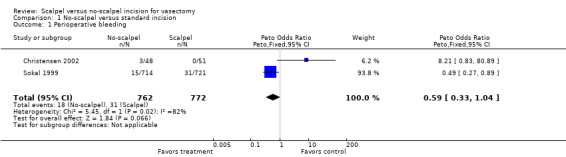
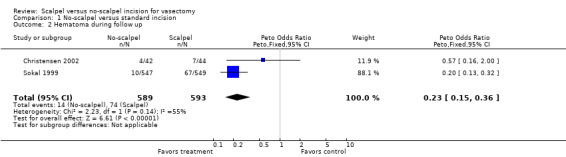
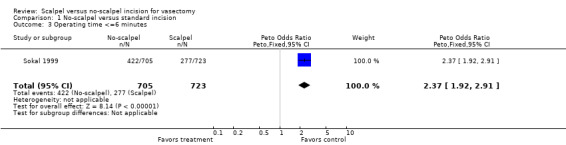
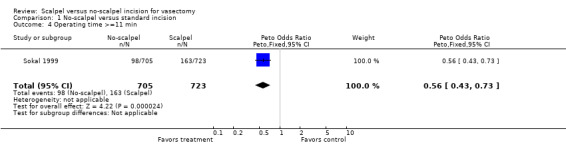
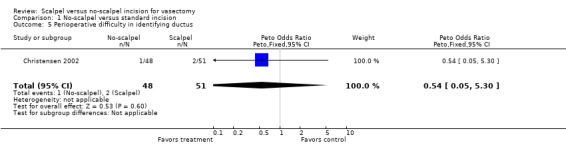
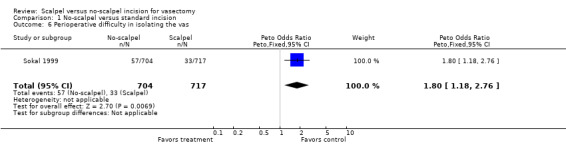
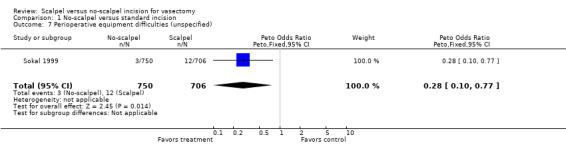
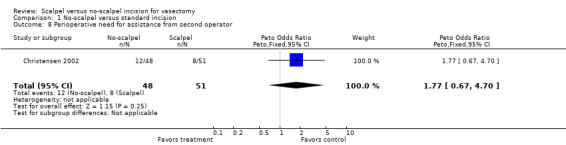
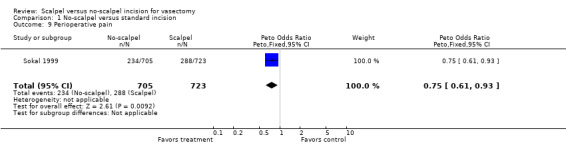
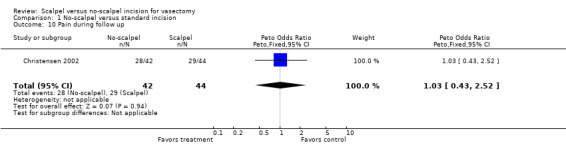
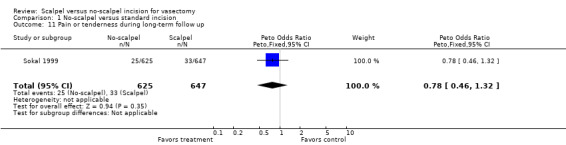
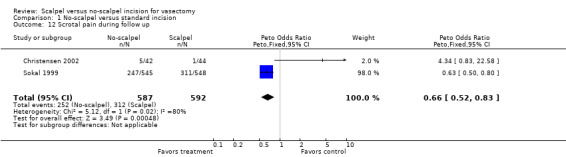
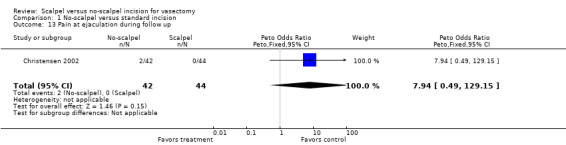
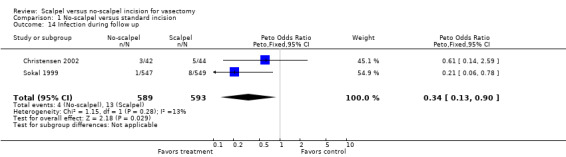
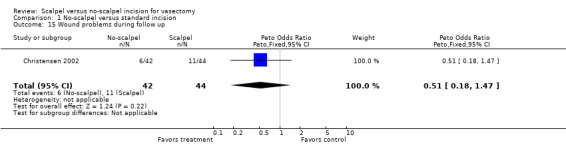
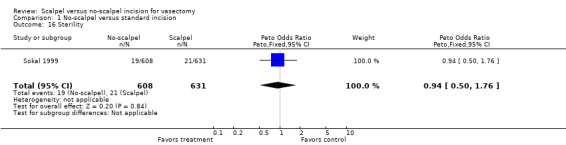
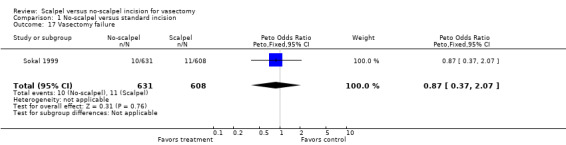
Main results: Two randomized controlled trials evaluated the no-scalpel technique and differed in their findings. The larger trial demonstrated less perioperative bleeding (OR 0.49; 95% CI 0.27 to 0.89) and pain during surgery (OR 0.75; 95% CI 0.61 to 0.93), scrotal pain (OR 0.63; 95% 0.50 to 0.80), and incisional infection (OR 0.21; 95% CI 0.06 to 0.78) during follow up than the standard incisional group. Both studies found less hematoma with the no-scalpel technique (OR 0.23; 95% CI 0.15 to 0.36). Operations using the no-scalpel approach were faster and had a quicker resumption of sexual activity. The smaller study did not find these differences; however, the study could have failed to detect differences due to a small sample size as well as a high loss to follow up. Neither trial found differences in vasectomy effectiveness between the two approaches to the vas.
Authors' conclusions: The no-scalpel approach to the vas resulted in less bleeding, hematoma, infection, and pain as well as a shorter operation time than the traditional incision technique. No difference in effectiveness was found between the two approaches.
Conflict of interest statement
L Lopez is employed at FHI 360 (formerly known as Family Health International) where one of the included trials was conducted (Sokal 1999). She was not involved in that trial.
Figures
Update of
-
Scalpel versus no-scalpel incision for vasectomy.Cochrane Database Syst Rev. 2007 Apr 18;(2):CD004112. doi: 10.1002/14651858.CD004112.pub3. Cochrane Database Syst Rev. 2007. Update in: Cochrane Database Syst Rev. 2014 Mar 30;(3):CD004112. doi: 10.1002/14651858.CD004112.pub4. PMID: 17443540 Updated.
References
References to studies included in this review
Christensen 2002 {published data only}
-
- Christensen P, Al‐Aqidi OA, Jensen FS, Dorflinger T. Vasectomy. A prospective, randomized trial of vasectomy with bilateral incision versus the Li vasectomy [Vasektomi. Et prospektivt, randomiseret studie af vasektomi med dobbeltsidig incision vs. vasektomi a.m. Li]. Ugeskr Laeger 2002;164:2390‐4. - PubMed
Sokal 1999 {published data only}
-
- Sokal D, McMullen S, Gates D, Dominik R. A comparative study of the no scalpel and standard incision approaches to vasectomy in 5 countries. The Male Sterilization Investigator Team. Journal of Urology 1999;162:1621‐5. - PubMed
References to studies excluded from this review
Black 1989 {published data only}
-
- Black TR, Gates DS, Lavely K, Lamptey P. The percutaneous electrocoagulation vasectomy technique‐‐a comparative trial with the standard incision technique at Marie Stopes House, London. Contraception 1989;39:359‐68. - PubMed
Black 2003 {published data only}
-
- Erratum to Black 2003 article. Journal of Family Planning and Reproductive Health Care 2003; Vol. 29:159.
-
- Black T, Francome C. Comparison of Marie Stopes scalpel and electrocautery no‐scalpel vasectomy techniques. Journal of Family Planning and Reproductive Health Care 2003;29:32‐4. - PubMed
Chen 2004 {published data only}
-
- Chen KC. A novel instrument‐independent no‐scalpel vasectomy ‐ a comparative study against the standard instrument‐dependent no‐scalpel vasectomy. International Journal of Andrology 2004;27:222‐7. - PubMed
Chen 2005 {published data only}
-
- Chen KC, Peng CC, Hsieh HM Chiang HS. Simply modified no‐scalpel vasectomy (percutaneous vasectomy) ‐ a comparative study against the standard no‐scalpel vasectomy. Contraception 2005;71:153‐6. - PubMed
Nirapathpongporn 1990 {published data only}
-
- Nirapathpongporn A, Huber DH, Krieger JN. No‐scalpel vasectomy at the King's birthday vasectomy festival. Lancet 1990;335:894‐5. - PubMed
Song 2006 {published data only}
-
- Song L, Gu Y, Lu W, Liang X, Chen Z. A phase II randomized controlled trial of a novel male contraception, an intra‐vas device. International Journal of Andrology 2006;29(4):489‐95. - PubMed
Additional references
Berlin 1997
-
- Berlin JA. Does blinding of readers affect the results of meta‐analyses? University of Pennsylvania Meta‐analysis Blinding Study Group. Lancet 1997;350:185‐6. - PubMed
Cook 2007
Goldstein 2002
-
- Goldstein M. Surgical management of male infertility and other scrotal disorders. In: Walsh PC, Retik AB, Vaughan ED, Wein AJ editor(s). Campbell's Urology. Eighth. Philadelphia: W.B. Saunders Co., 2002:1532‐1587.
Higgins 2005
-
- Higgins JPT, Green S, editors. Cochrane Handbook for Systematic Reviews of Interventions 4.2.5 [updated May 2005]. www.cochrane.dk/cochrane/handbook/hbook.htm. John Wiley & Sons, Ltd, (accessed 1 June 2005).
Labrecque 2004
-
- Labrecque M, Dufresne C, Barone MA, St‐Hilaire K. Vasectomy surgical techniques: a systematic review. BioMed Central Medicine 2004:2. Available through the World Wide Web at http://www.biomedcentral.com/1741‐7015/2/21. - PMC - PubMed
Li 1991
-
- Li SQ, Goldstein M, Zhu J, Huber D. The no‐scalpel vasectomy. Journal of Urology 1991;145:341‐4. - PubMed
PIP 1992
-
- Population Information Programme. Vasectomy: new opportunities. Population Reports 1992;Series D(No. 5):2‐6.
RCOG 2004
-
- Royal College of Obstetricians and Gynaecologists. Male and Female Sterilisation. Evidence‐Based Guideline No. 4. London: RCOG Press, 2004.
Schwingl 2000
-
- Schwingl PJ, Guess HA. Safety and effectiveness of vasectomy. Fertility and Sterility 2000;73:923‐36. - PubMed
Publication types
MeSH terms
LinkOut - more resources
Full Text Sources
Other Literature Sources
Medical
