


Are Minority Children Disproportionately Represented in Early Intervention and Early Childhood Special Education?
- PMID: 24683265
- PMCID: PMC3966630
- DOI: 10.3102/0013189x12459678
Are Minority Children Disproportionately Represented in Early Intervention and Early Childhood Special Education?
Abstract
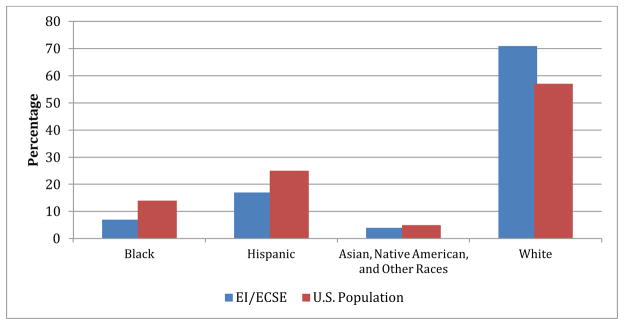
We investigated whether and to what extent children who are racial/ethnic minorities are disproportionately represented in early intervention and/or early childhood special education (EC/ECSE). We did so by analyzing a large sample of 48-month-olds (N=7,950) participating in the Early Childhood Longitudinal Study-Birth Cohort (ECLS-B), a nationally representative dataset of children born in the U.S. in 2001. Multivariate logistic regression analyses indicate that boys (OR=1.66), children born at very low birthweight (OR=3.98) or with congenital anomalies (OR=2.17), and children engaging in externalizing problem behaviors (OR=1.10) are more likely to be represented in EI/ECSE. Children from low SES households (OR=.48), those displaying greater numeracy or receptive language knowledge (ORs=.96 and .76, respectively), and children being raised in households where a language other than English is primarily spoken (OR=.39) are less likely to be represented in EI/ECSE. Statistical control for these and an extensive set of additional factors related to cognitive and behavioral functioning indicated that 48-month-old children who are Black (OR=.24) or Asian (OR=.32) are disproportionately under-represented in EI/ECSE in the U.S.
Keywords: Minority disproportionate representation; early intervention; preschool; racial/ethnic disparities; special education.
Figures
References
-
- American Academy of Pediatrics. [Accessed 5/30/12];Recommendations for preventive pediatric health care. 2008 at: http://brightfutures.aap.org/pdfs/AAP%20Bright%20Futures%20Periodicity%2....
-
- Artiles AJ, Rueda R, Salazar JJ, Higareda I. Within-group diversity in minority disproportionate representation: English language learners in urban school districts. Exceptional Children. 2005;71(3):283–300.
-
- Bahr MW, Fuchs D, Stecker PM, Fuchs LS. Are teachers’ perceptions of difficult-to teach students racially biased? School Psychology Review. 1991;20(4):599–608.
-
- Blanchett WJ, Klingner JK, Harry B. The intersection of race, culture, language, and disability: Implications for urban education. Urban Education. 2009;44:389–409. doi: 10.1177/0042085909338686. - DOI
-
- Bodovski K, Farkas G. Mathematics growth in early elementary school: The roles of beginning knowledge, student engagement, and instruction. The Elementary School Journal. 2007;108:115–130. doi: 10.1086/525550. - DOI
Grants and funding
LinkOut - more resources
Full Text Sources