. 2014 Apr 10;7(1):113-26.
doi: 10.1016/j.celrep.2014.02.044. Epub 2014 Mar 27.

A histone methylation network regulates transgenerational epigenetic memory in C. elegans

Affiliations

A histone methylation network regulates transgenerational epigenetic memory in C. elegans

Eric L Greer et al. Cell Rep. .

Abstract

How epigenetic information is transmitted from generation to generation remains largely unknown. Deletion of the C. elegans histone H3 lysine 4 dimethyl (H3K4me2) demethylase spr-5 leads to inherited accumulation of the euchromatic H3K4me2 mark and progressive decline in fertility. Here, we identified multiple chromatin-modifying factors, including H3K4me1/me2 and H3K9me3 methyltransferases, an H3K9me3 demethylase, and an H3K9me reader, which either suppress or accelerate the progressive transgenerational phenotypes of spr-5 mutant worms. Our findings uncover a network of chromatin regulators that control the transgenerational flow of epigenetic information and suggest that the balance between euchromatic H3K4 and heterochromatic H3K9 methylation regulates transgenerational effects on fertility.


Figures

Figure 1
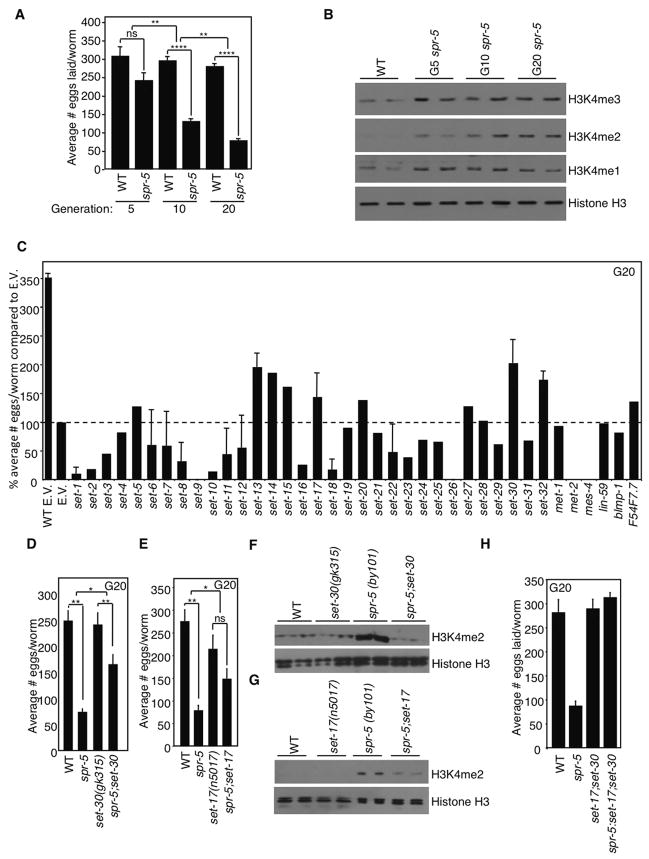
Figure 1. set-17 and set-30 deletions suppress the progressive sterility of spr-5 mutant worms
A) spr-5(by101) mutant worms display progressive fertility defects (bars represent mean +/− SEM for 4 experiments for generation 5, 15 experiments for generation 10, and 34 experiments for generation 20: each experiment consists of average eggs laid for 10 worms of each genotype performed in triplicate) B) H3K4me2 increases across generations of spr-5(by101) mutant worms as assessed by whole worm western blots of L4 stage worms. H3K4me1 and H3K4me3 are higher in spr-5(by101) mutant worms but do not change across generations. Blots are representative of 4 independent experiments performed in duplicate. C) Number of eggs laid by spr-5(by101) mutant worms fed dsRNA of C. elegans potential methyltransferases or empty vector (E.V.) for 20 generations. D) spr-5;set-30 double mutants for 20 generations causes a partial suppression of decreased fertility capacity of spr-5(by101) mutant worms. This graph displays the mean +/− SEM of 4 independent experiments: each experiment consists of average eggs laid for 10 worms of each genotype performed in triplicate. E) spr-5;set-17 double mutant worms have a partial suppression of the fertility defect of spr-5(by101) mutant worms at generation 20. This graph displays the mean +/− SEM of 4 independent experiments. F) spr-5(by101) mutant worms have increased H3K4me2 at generation 20 but spr-5;set-30 double mutants have normal H3K4me2 levels as assessed by whole worm western blots of L3 worms. G) spr-5;set-17 double mutants have lower H3K4me2 at generation 20 than spr-5(by101) mutants as assessed by whole worm western blots of L4 worms. h) spr-5;set-17;set-30 triple mutant worms have a complete suppression of the fertility defect of spr-5(by101) mutant worms at generation 20. This graph displays the mean +/− SEM of 3 independent experiments: each experiment consists of average eggs laid for 10 worms of each genotype performed in triplicate. *: p<0.05, **: p<0.01, ****: p<0.0001
Figure 2
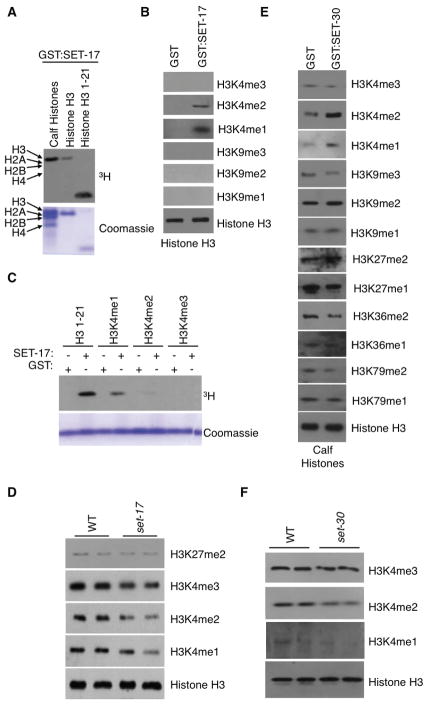
Figure 2. SET-17 and SET-30 are H3K4me1/me2 methyltransferases
A) GST:SET-17 full length protein methylates histone H3 amino acids 1–21, histone H3, and only histone H3 of calf histones in vitro. B) GST:SET-17 full length protein methylates H3K4me1/me2 of Histone H3 as assessed by western blots of in vitro methylation assays performed on recombinant Histone H3. C) GST:SET:17 methylates H3K4me1 and H3K4me2 as assessed by radioactive methyltransferase assays of histone H3 amino acids 1–21 which are unmodified or premethylated on H3K4. D) set-17(n5017) mutant worms have lower H3K4 methylation as assessed by whole worm western blots of L4 worms. E) GST:SET-30 full length protein methylates H3K4me1/me2 as assessed by western blots of in vitro methylation assay performed on histones. F) set-30(gk315) mutant worms have lower H3K4 methylation as assessed by whole worm western blots of L1 worms.
Figure 3
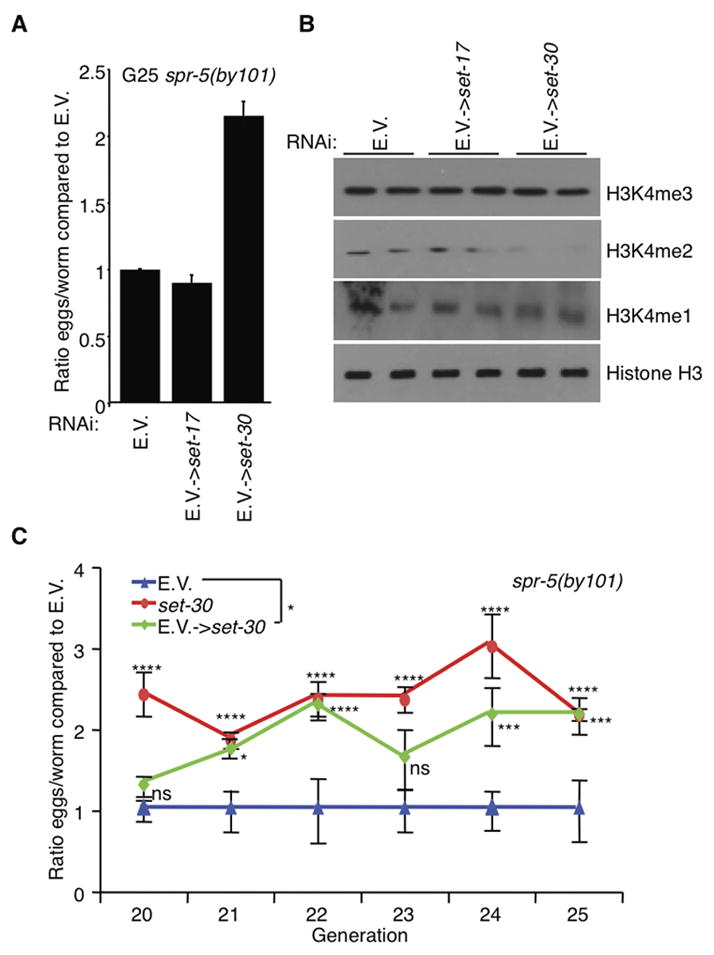
Figure 3. set-30 knockdown reverts the progressive phenotypes of spr-5 mutant worms
A) RNAi against set-30 but not set-17 for 5 generations partially reverted the fertility defect of spr-5(by101) mutant worms fed empty vector control RNAi (E.V.) for 20 generations prior. This graph represents the mean +/− SEM of 3 independent experiments: each experiment consists of average eggs laid for 10 worms of each genotype performed in triplicate. B) spr-5(by101) mutant worms increased H3K4me2 at generation 25 is reverted by 5 generations of treatment with set-30 RNAi as assessed by whole worm western blots of L3 worms. C) The fertility defect of spr-5(by101) mutant worms fed empty vector RNAi bacteria (E.V.) for 20 generations and switched to set-30 RNAi suggests that set-30 knockdown for 2–3 generations causes the same degree of partial reversion of the fertility defect as spr-5(by101) mutant worms which had been fed dsRNA against set-30 for 22–23 generations. *: p<0.05, ***: p<0.001, ****: p<0.0001
Figure 4
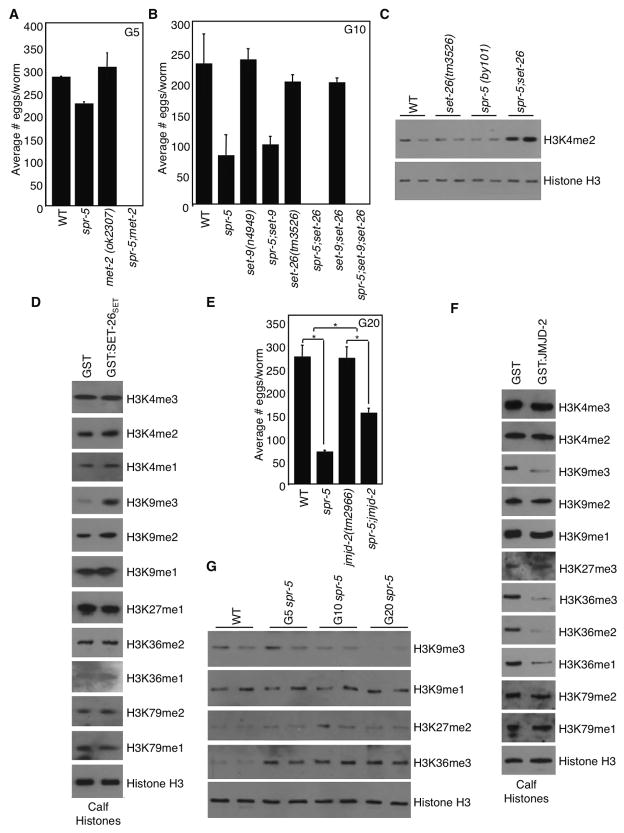
Figure 4. H3K9me regulation controls the spr-5(by101) progressive sterility
A) spr-5;met-2 double mutants accelerates the progressive sterility of spr-5(by101) mutant worms after 5 generations. This graph represents the mean +/− SEM of 2 independent experiments: each experiment consists of average eggs laid for 10 worms of each genotype performed in triplicate. B) spr-5;set-26 double mutants accelerates the progressive sterility of spr-5(by101) mutant worms after 10 generations. Graph is a representative experiment where each bar represents the mean +/− SEM for 3 replicates of 10 worms each. set-9(n4949) deletions’ effect on fertility has been tested 1 additional time. set-26(tm3526) deletions’ effect on fertility has been tested 5 additional times. C) spr-5;set-26 double mutants have significantly higher H3K4me2 at generation 4 as assessed by whole worm western blots of L3 worms. Representative blot of 4 independent experiments. D) GST:SET-26SET causes an increase in H3K9me2/me3 as assessed by western blots of in vitro methyltransferase assays of histones. E) spr-5;jmjd-2 double mutant worms have a suppression of the fertility defect of spr-5(by101) mutant worms at generation 20 (graph is the mean +/− SEM of 3 independent experiments: each experiment consists of average eggs laid for 10 worms of each genotype performed in triplicate). *: p<0.05. F) GST:JMJD-2 causes a decrease in H3K9me3 and H3K36me as assessed by western blots of in vitro demethylase assays of histones. G) H3K9me3 decreases across generations of spr-5(by101) mutant worms as assessed by whole worm western blots of L4 stage worms. These blots are representative of 3 independent experiments performed in duplicate.
Figure 5
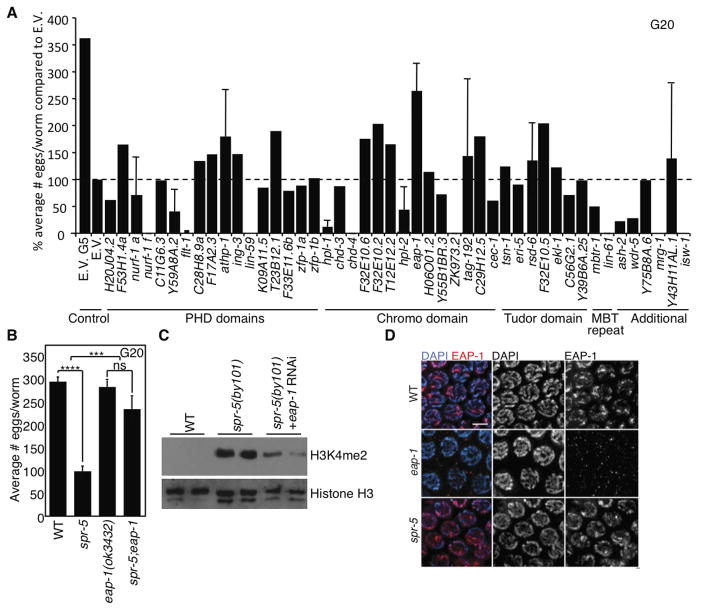
Figure 5. eap-1 deletion suppresses the progressive phenotypes of spr-5 mutant worms
A) spr-5(by101) mutant worms fed dsRNA of C. elegans potential methyl binding genes for 20 generations’ effect on fertility as compared to E.V. treated spr-5(by101) mutant worms. B)spr-5;eap-1 double mutant worms have an almost complete suppression of the fertility defect of spr-5(by101) mutant worms at generation 20 (graph is the mean +/− SEM of 7 independent experiments: each experiment consists of average eggs laid for 10 worms of each genotype performed in triplicate). ***: p<0.001, ****: p<0.0001. C) spr-5(by101) mutant worms display increased H3K4me2 at generation 20 which is suppressed by knockdown of eap-1 for 20 generations as assessed by western blots of whole worm lysates at the L3 stage. D) EAP-1 is expressed in every nucleus throughout the germline and localizes to chromatin as seen in immunofluorescence of mid-pachytene nuclei of dissected gonads from wild type, eap-1(ok3432), and spr-5(by101) mutants at generation 5.
Figure 6
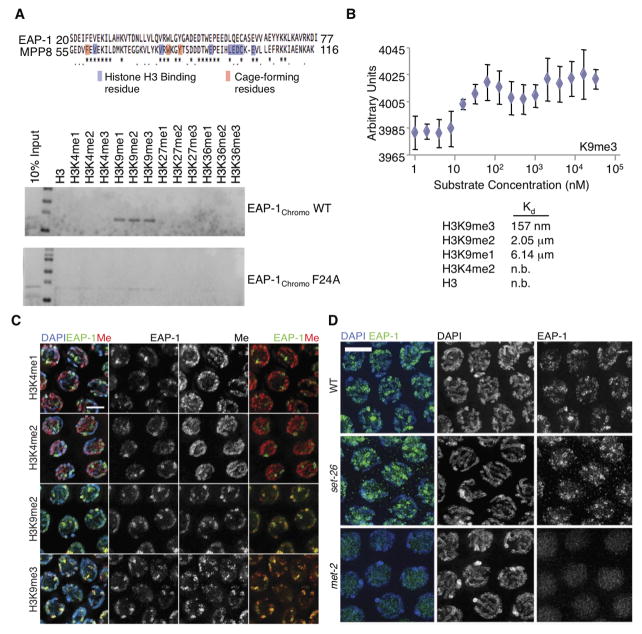
Figure 6. EAP-1 binds methylated H3K9
A) EAP-1chromo binds to H3K9 methylated peptides in in vitro binding assays. Shown above is EAP-1 homology to MPP8 with conserved residues marked *. Mutation of any of the three cage-forming amino acids to alanine eliminate EAP-1chromo’s ability to bind to H3K9 methylated peptides (F24A is displayed). B) Microscale thermophoresis of EAP-1chromo and MLA histones shows that EAP-1 has highest binding affinity for H3K9me3 than H3K9me2 than H3K9me1 and no binding affinity for H3K4me2 or unmodified Histone H3. Binding affinity for H3K9me3 is displayed in the figure while other histone H3 affinities are displayed in Figure S6E. C) EAP-1 colocalizes with H3K9me2/me3 but not with H3K4me1/me2 as assessed by immunofluorescence of dissected gonads from wild type adult hermaphrodites. Pachytene nuclei are shown. Scale bar, 4 μm. D) EAP-1 no longer localizes to the chromatin when H3K9 methylation is reduced by mutation of the H3K9me1/me2 methyltransferase met-2. Pachytene nuclei are shown. Scale bar, 4 μm.
Figure 7
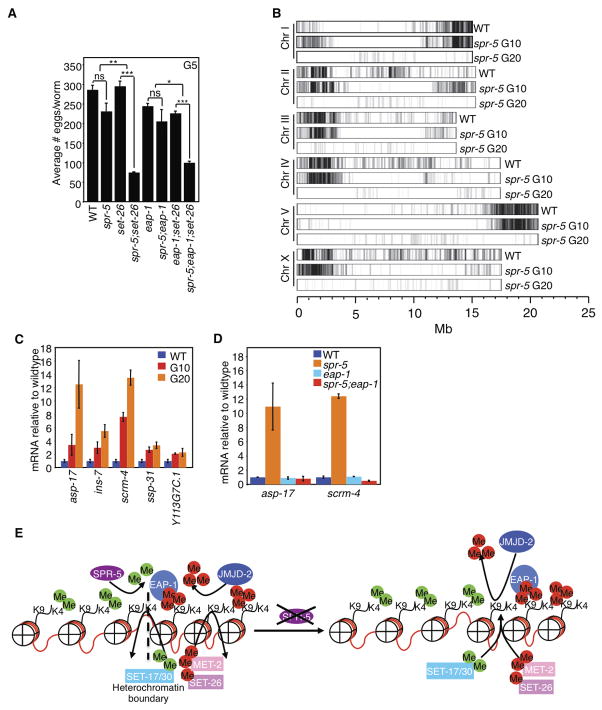
Figure 7. EAP-1 regulates transgenerational gene expression of spr-5 mutant worms
A) spr-5;eap-1;set-26 triple mutant worms lay as many eggs as spr-5;set-26 double mutants at generation 5 suggesting that set-26 is epistatic to eap-1 (graph is the mean +/− SEM of 2 independent experiments: each experiment consists of average eggs laid for 10 worms of each genotype performed in triplicate). *: p<0.05, **: p<0.01, ***: p<0.001. B) EAP-1 binds to regions which are marked with H3K9me3 and decline across generations of spr-5(by101) mutant worms. Band intensity reflects EAP-1 binding. Darker regions reflect stronger binding affinity while whiter regions reflect weaker ones. Note that EAP-1 binding does occur in G20 worms but is weaker than in WT and spr-5 G10 mutant worms. C) EAP-1 bound target genes display increases in gene expression across spr-5(by101) generations. The results represent the mean +/− SD of 4 biological replicates of ~1000 young adult worms as compared to pan-actin expression. D) EAP-1 bound target genes do not increase in gene expression in generation 20 spr-5;eap-1 double mutant worms. The results presented correspond to the mean +/− SEM of 2 (scrm-4) or 4 (asp-17) independent biological experiments of replicates of ~1000 young adult worms as compared to pan-actin expression. E) Model for epigenetic inheritance of elevated H3K4me2.

References

    1. Alvares SM, Mayberry GA, Joyner EY, Lakowski B, Ahmed S. H3K4 demethylase activities repress proliferative and postmitotic aging. Aging cell 2013 - PMC - PubMed
    1. Andersen EC, Horvitz HR. Two C. elegans histone methyltransferases repress lin-3 EGF transcription to inhibit vulval development. Development (Cambridge, England) 2007;134:2991–2999. - PubMed
    1. Ashe A, Sapetschnig A, Weick EM, Mitchell J, Bagijn MP, Cording AC, Doebley AL, Goldstein LD, Lehrbach NJ, Le Pen J, et al. piRNAs can trigger a multigenerational epigenetic memory in the germline of C. elegans. Cell. 2012;150:88–99. - PMC - PubMed
    1. Avery OT, Macleod CM, McCarty M. Studies on the Chemical Nature of the Substance Inducing Transformation of Pneumococcal Types: Induction of Transformation by a Desoxyribonucleic Acid Fraction Isolated from Pneumococcus Type Iii. J Exp Med. 1944;79:137–158. - PMC - PubMed
    1. Bannister AJ, Zegerman P, Partridge JF, Miska EA, Thomas JO, Allshire RC, Kouzarides T. Selective recognition of methylated lysine 9 on histone H3 by the HP1 chromo domain. Nature. 2001;410:120–124. - PubMed

Publication types

Associated data