Review
. 2014 May-Jun;5(3):369-80.
doi: 10.4161/gmic.28681. Epub 2014 Mar 31.

Metabolic tinkering by the gut microbiome: Implications for brain development and function

Affiliations
Review

Metabolic tinkering by the gut microbiome: Implications for brain development and function

Joel Selkrig et al. Gut Microbes. 2014 May-Jun.

Abstract

Brain development is an energy demanding process that relies heavily upon diet derived nutrients. Gut microbiota enhance the host's ability to extract otherwise inaccessible energy from the diet via fermentation of complex oligosaccharides in the colon. This nutrient yield is estimated to contribute up to 10% of the host's daily caloric requirement in humans and fluctuates in response to environmental variations. Research over the past decade has demonstrated a surprising role for the gut microbiome in normal brain development and function. In this review we postulate that perturbations in the gut microbial-derived nutrient supply, driven by environmental variation, profoundly impacts upon normal brain development and function.

Keywords: glucose; gut microbiota; hypothalamic-pituitary-adrenal axis; metabolism; microbiota-gut-brain axis; neurodevelopment; short chain fatty acids; β-hydroxybutyrate.


Figures
None
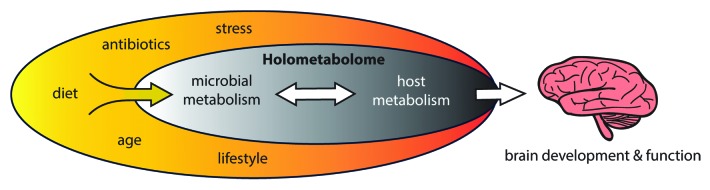
Figure 1. The host-microbe holometabolome. Environmental variations (yellow oval) leading to changes in the gut microbial metabolic capacity can induce alterations and compensations within the metabolic network. The consequence of a perturbed holometabolome will likely affect many different body systems, including brain development. The diet is likely to be a major environmental modulator of this system.
None
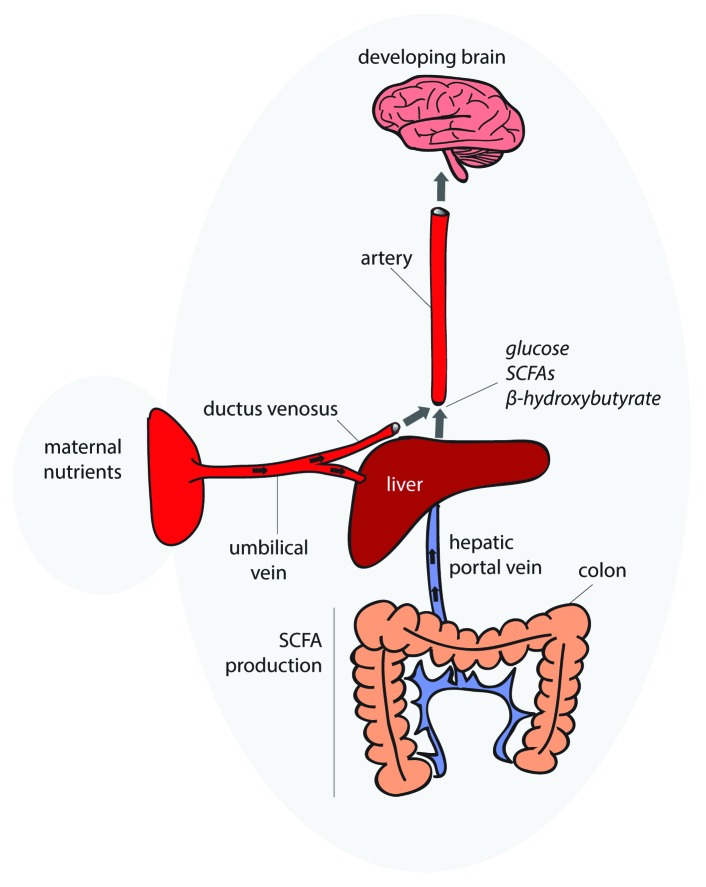
Figure 2. Gut microbiota supply nutrients to the developing brain. This hypothetical model illustrates the route by which gut microbiota supply nutrients to the developing brain. Upon draining to the liver via the hepatic portal vein, SCFAs are incorporated into either lipogenic or gluconeogenic pathways for energy storage, depending on the metabolic state of the host, or disseminated directly into the bloodstream. Gut microbial regulation of blood metabolites which are required to build a healthy brain may modify developmental trajectories. In utero, nutrients for normal brain development are transported to the infant across the placental barrier via the umbilical vein. Two thirds of the nutrient and oxygen loaded blood passes through the liver while the remaining bypasses the liver via the ductus venosus and is diverted directly into the blood stream of developing fetus.
None
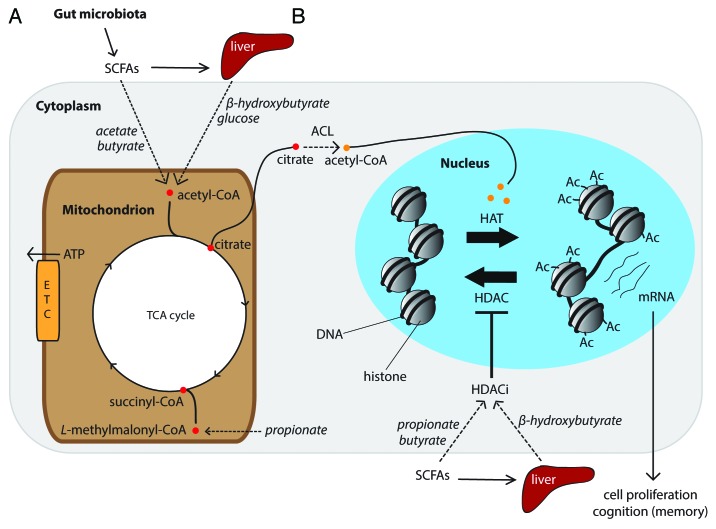
Figure 3. External metabolic cues regulate histone acetylation via the tricarboxylic acid (TCA) cycle. This hypothetical model illustrates how gut microbial regulated serum metabolites, which are readily used by mitochondria to generate ATP, may influence host cell gene transcription. (A) SCFAs are produced in the colon and disseminated directly into the blood stream or trafficked to the liver and released as glucose or β-hydroxybutyrate, depending on the host’s metabolic status. These metabolites are then used by cells within the CNS to generate ATP via the TCA cycle. (B) ATP-citrate lyase (ACL) uses mitochondrial derived citrate to generate acetyl-CoA in the cytoplasm and nucleus. In the nucleus, histone acetyl-transferases (HATs) transfer the acetyl group from acetyl-CoA onto histone lysine residues to facilitate cell proliferation and the expression of genes important for learning and memory. Histone deacetylases (HDACs) remove acetyl groups from histones to suppress gene transcription. HDACs can be inhibited bya histone deacetylase inhibitors (HDACi), including gut microbial regulated serum metabolites, e.g., β-hydroxybutyrate, butyrate, and propionate. This is illustration is not to scale.
None
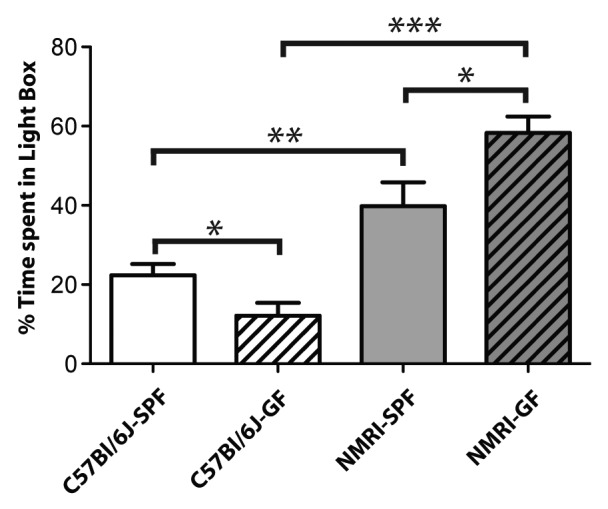
Figure 4. Strain differences in anxiety-like behavior between germ-free C57Bl/6J and NMRI mice. In the light-dark box test, a behavioral test for anxiety, mice were individually placed into a dark box and allowed 10 min of free exploration and the amount of time spent exploring the light box was recorded. An ANOVA showed significant main effects of strain of mice used and of being germ-free. Bonferroni-corrected t tests showed that within each strain, the C57Bl/6J and NMRI, the germ-free mice had significantly different anxiety-like behaviors from their SPF counterparts. Germ-free C57Bl/6J mice (n = 11) spent significantly less time exploring the light box compared with SPF counterparts (n = 14). NMRI germ-free mice (n = 5) spent significantly more time exploring the light box, and were significantly less anxious than their SPF counterparts (n = 7). P ≤ 0.05 (*), P ≤ 0.01 (**), P ≤ 0.001 (***).

References

    1. Cummings JH. Short chain fatty acids in the human colon. Gut. 1981;22:763–79. doi: 10.1136/gut.22.9.763. - DOI - PMC - PubMed
    1. Rosenberg E, Zilber-Rosenberg I. Symbiosis and development: the hologenome concept. Birth Defects Res C Embryo Today. 2011;93:56–66. doi: 10.1002/bdrc.20196. - DOI - PubMed
    1. Russell SL, Gold MJ, Hartmann M, Willing BP, Thorson L, Wlodarska M, Gill N, Blanchet MR, Mohn WW, McNagny KM, et al. Early life antibiotic-driven changes in microbiota enhance susceptibility to allergic asthma. EMBO Rep. 2012;13:440–7. doi: 10.1038/embor.2012.32. - DOI - PMC - PubMed
    1. Tremaroli V, Bäckhed F. Functional interactions between the gut microbiota and host metabolism. Nature. 2012;489:242–9. doi: 10.1038/nature11552. - DOI - PubMed
    1. Erecinska M, Cherian S, Silver IA. Energy metabolism in mammalian brain during development. Prog Neurobiol. 2004;73:397–445. doi: 10.1016/j.pneurobio.2004.06.003. - DOI - PubMed

Publication types

LinkOut - more resources