


Dopamine D(3) receptors contribute to methamphetamine-induced alterations in dopaminergic neuronal function: role of hyperthermia
- PMID: 24685638
- PMCID: PMC4060957
- DOI: 10.1016/j.ejphar.2014.03.023
Dopamine D(3) receptors contribute to methamphetamine-induced alterations in dopaminergic neuronal function: role of hyperthermia
Abstract
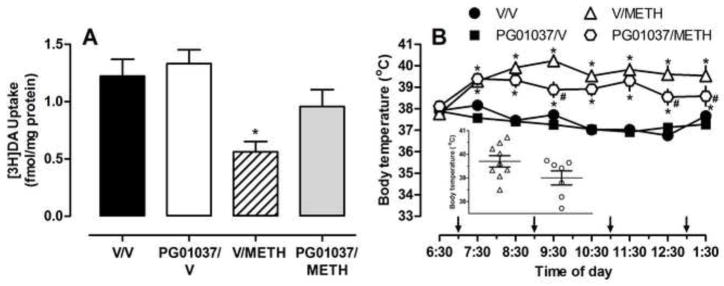
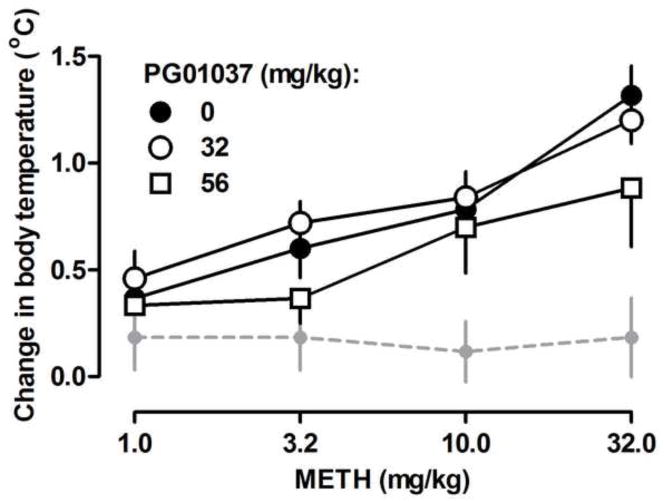
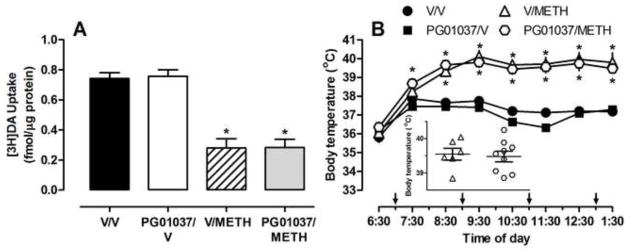
Methamphetamine administration causes long-term deficits to dopaminergic systems that, in humans, are thought to be associated with motor slowing and memory impairment. Methamphetamine interacts with the dopamine transporter (DAT) and increases extracellular concentrations of dopamine that, in turn, binds to a number of dopamine receptor subtypes. Although the relative contribution of each receptor subtype to the effects of methamphetamine is not fully known, non-selective dopamine D2/D3 receptor antagonists can attenuate methamphetamine-induced changes to dopamine systems. The present study extended these findings by testing the role of the dopamine D3 receptor subtype in mediating the long-term dopaminergic, and for comparison serotonergic, deficits caused by methamphetamine. Results indicate that the dopamine D3 receptor selective antagonist, PG01037, attenuated methamphetamine-induced decreases in striatal DAT, but not hippocampal serotonin (5HT) transporter (SERT), function, as assessed 7 days after treatment. However, PG01037 also attenuated methamphetamine-induced hyperthermia. When methamphetamine-induced hyperthermia was maintained by treating rats in a warm ambient environment, PG01037 failed to attenuate the effects of methamphetamine on DAT uptake. Furthermore, PG01037 did not attenuate methamphetamine-induced decreases in dopamine and 5HT content. Taken together, the present study demonstrates that dopamine D3 receptors mediate, in part, the long-term deficits in DAT function caused by methamphetamine, and that this effect likely involves an attenuation of methamphetamine-induced hyperthermia.
Keywords: D(3) antagonist; Dopamine D(3) receptors; Dopamine transporter; Methamphetamine; PG01037; Serotonin transporter.
Copyright © 2014 Elsevier B.V. All rights reserved.
Figures
References
-
- Albers DS, Sonsalla PK. Methamphetamine-induced hyperthermia and dopaminergic neurotoxicity in mice: pharmacological profile of protective and nonprotective agents. The Journal of pharmacology and experimental therapeutics. 1995;275:1104–1114. - PubMed
-
- Bowyer JF, Tank AW, Newport GD, Slikker W, Jr, Ali SF, Holson RR. The influence of environmental temperature on the transient effects of methamphetamine on dopamine levels and dopamine release in rat striatum. The Journal of pharmacology and experimental therapeutics. 1992;260:817–824. - PubMed
-
- Bowyer JF, Davies DL, Schmued L, Broening HW, Newport GD, Slikker W, Jr, Holson RR. Further studies of the role of hyperthermia in methamphetamine neurotoxicity. The Journal of pharmacology and experimental therapeutics. 1993;268:1571–1580. - PubMed
Publication types
MeSH terms
Substances
Grants and funding
LinkOut - more resources
Full Text Sources
Other Literature Sources
Medical
