. 2014 Jun;82(6):2472-84.
doi: 10.1128/IAI.01521-14. Epub 2014 Mar 31.

Phase variation mediates reductions in expression of surface proteins during persistent meningococcal carriage

Affiliations

Phase variation mediates reductions in expression of surface proteins during persistent meningococcal carriage

Mohamed Alamro et al. Infect Immun. 2014 Jun.

Abstract

Asymptomatic and persistent colonization of the upper respiratory tract by Neisseria meningitidis occurs despite elicitation of adaptive immune responses against surface antigens. A putative mechanism for facilitating host persistence of this bacterial commensal and pathogen is alterations in expression of surface antigens by simple sequence repeat (SSR)-mediated phase variation. We investigated how often phase variation occurs during persistent carriage by analyzing the SSRs of eight loci in multiple isolates from 21 carriers representative of 1 to 6 months carriage. Alterations in repeat number were detected by a GeneScan analysis and occurred at 0.06 mutations/gene/month of carriage. The expression states were determined by Western blotting and two genes, fetA and nadA, exhibited trends toward low expression states. A critical finding from our unique examination of combinatorial expression states, "phasotypes," was for significant reductions in expression of multiple phase-variable surface proteins during persistent carriage of some strains. The immune responses in these carriers were examined by measuring variant-specific PorA IgG antibodies, capsular group Y IgG antibodies and serum bactericidal activity in concomitant serum samples. Persistent carriage was associated with high levels of specific IgG antibodies and serum bactericidal activity while recent strain acquisition correlated with a significant induction of antibodies. We conclude that phase-variable genes are driven into lower expression states during long-term persistent meningococcal carriage, in part due to continuous exposure to antibody-mediated selection, suggesting localized hypermutation has evolved to facilitate host persistence.


Figures
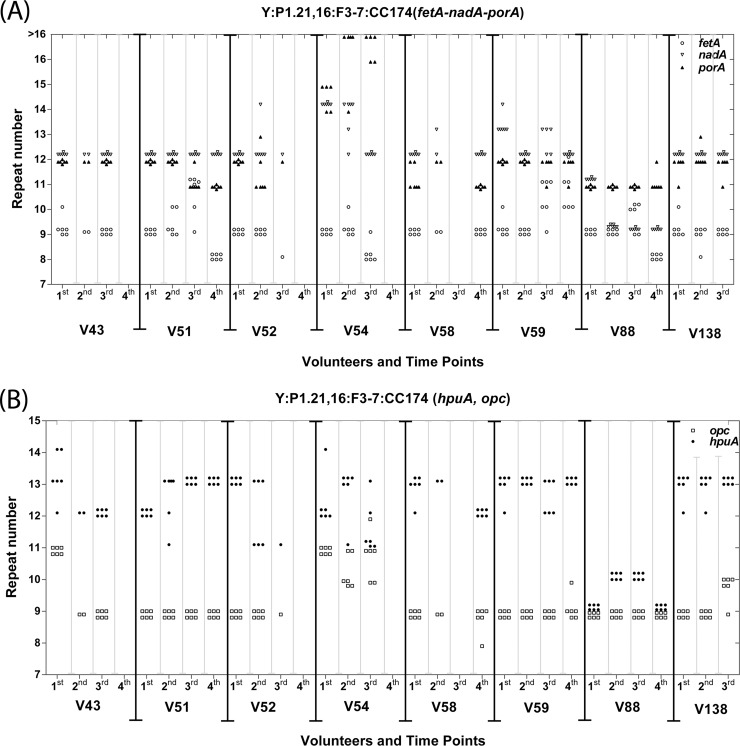
FIG 1
FIG 1
Changes in repeat tract length of five genes during persistent carriage of cc174 strains. Multiple meningococcal isolates of the same strain were collected from eight volunteers (labeled as “V” in the figure) persistently colonized with a cc174 serogroup Y strain either ST1466 (V51, V52, V58, V59, V88, and V138) or ST8510 (V54; V43 exhibited replacement of ST8510 with ST1466 between the first and second time points). Up to six isolates per time point were analyzed for up to four time points (1st to 4th which were separated by 1, 2, or 3 months, respectively) for the number of simple sequence repeats in five phase-variable genes as follows: panel A, fetA [poly(C) tract, open circles], nadA (tetranucleotide 5′TAAA tract, open triangles), porA [poly(G) tract, filled triangles]; and panel B, hpuA [poly(G) tract, filled diamonds] and opc [poly(C) tract, open squares].
FIG 2
FIG 2
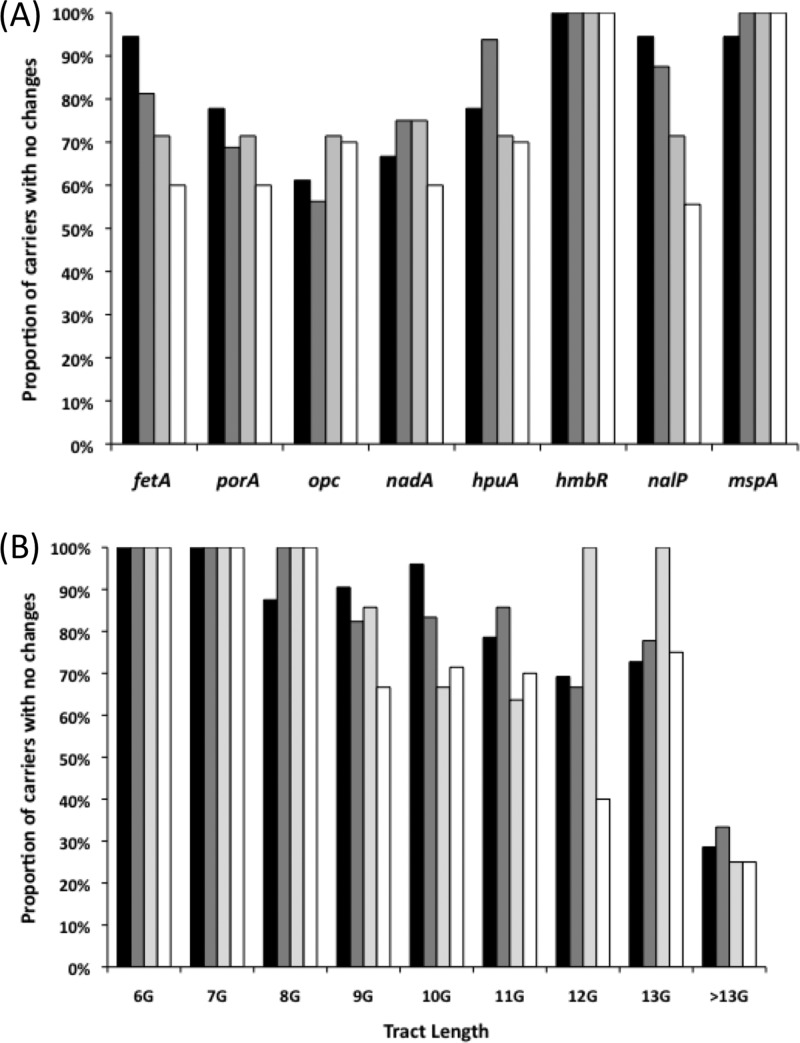
Effect of persistent carriage on changes in the repeat tracts of phase-variable meningococcal genes. Each gene was examined for significant changes in repeat tract length between a pair of time points for carriers persistently colonized with the same meningococcal strain and plotted as the percentage of carriers with no significant changes. The total number of carrier samples examined for each of the four pairs of time points were as follows: fetA (18, 16, 7, and 10), porA (18, 16, 7, and 10), opc (18, 16, 7, and 10), nadA (9, 8, 4, and 5), hpuA (18, 16, 7, and 10), hmbR (5, 3, 1, and 2), nalP (18, 16, 7, and 10), and mspA (18, 16, 7, and 10). Time points were as follows: 1st to 2nd (1 month), black bars; 2nd to 3rd (2 months), dark gray bars; 3rd to 4th (3 months), light gray bars; and 1st-4th or 2nd-4th (5 or 6 months, respectively), white bars. (A) Changes per gene; (B) changes as a function of the repeat tract length relative to the tract length in the initial time point of each pair.
FIG 3
FIG 3
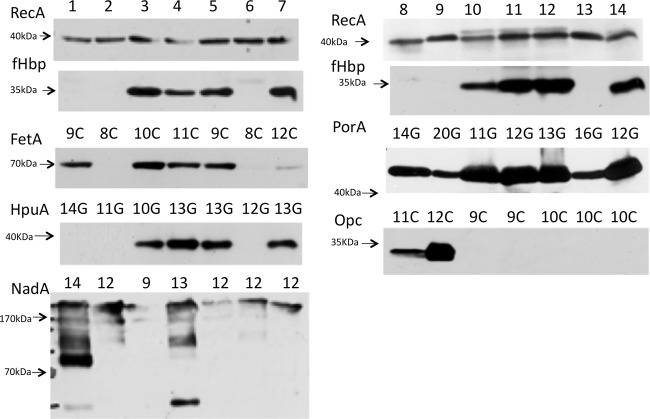
Comparison of protein expression levels for cc174 phase variants with different tract lengths. Whole-cell lysates were prepared from meningococcal cells grown to mid-log phase with (lanes 1 to 7) or without (lanes 8 to 14) induction of iron-repressed genes. Western blots were probed with 1:1,000 or 1:2,000 dilutions of primary antibodies/antisera (see Table S1A in the supplemental material), followed by an appropriate secondary antibody. Note that the an anti-F1-3 FetA variant mouse polyclonal and an antimeningococcal serotype P1.16 mouse MAb were used to detect FetA and PorA, respectively, whereas the other antisera recognize a wide range of antigenic types of the relevant protein. Repeat numbers are indicated as either the number of G's in a poly(G) tract or, for nadA, the number of 5′TAAA repeats. Lanes 1 and 8, N54.1; lanes 2 and 9, N343.5; lanes 3 and 10, N369.1; lanes 4 and 11, N352.3; lanes 5 and 12, N288.5; lanes 6 and 13, N343.2; lanes 7 and 14, N438.3. These isolates were from two different cc174 ST types: ST8510 (N54 and N343) and ST1466 (N288, N352, N369, and N438).
FIG 4
FIG 4
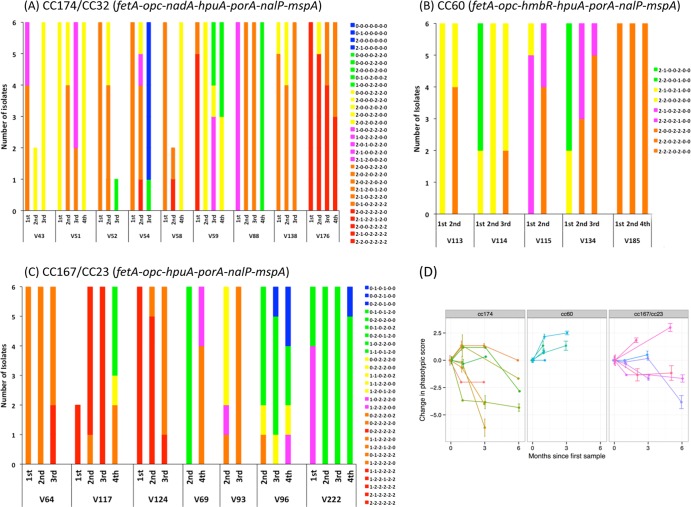
Longitudinal alterations in the multiplex phase-variation expression states during persistent carriage of meningococcal strains. The expression states of phase-variable genes were determined from a combination of repeat number and direct assessments of expression state by Western blotting. The expression states of phase-variable loci were coded as 0 (OFF/low), 1 (intermediate), and 2 (ON/high) as described in the text. The combined pattern of expression states (i.e., phasotypes) for six or seven genes (as indicated in each panel) were determined for up to six isolates per time point. A total score was assigned to each phasotype by combining the expression scores of individual genes (i.e., seven genes in their maximum expression state scores 14), and then phasotypes with similar scores were color coded and plotted in panels A to C as follows: red (10 to 14), orange (8 and 9), magenta (7), yellow (6), green (4 and 5), and blue (0 to 3). A mean score for each time point of each volunteer was calculated from these total phasotype scores. (A) Eight cc174 carriers and one cc32 carrier (V176); (B) five cc60 carriers; (C) three cc167 and four cc23 carriers. (D) Graphs for three groups of strains (cc174, cc60, and cc167/cc23) showing the change in mean score relative to the initial time point when carriage was first detected.
FIG 5
FIG 5
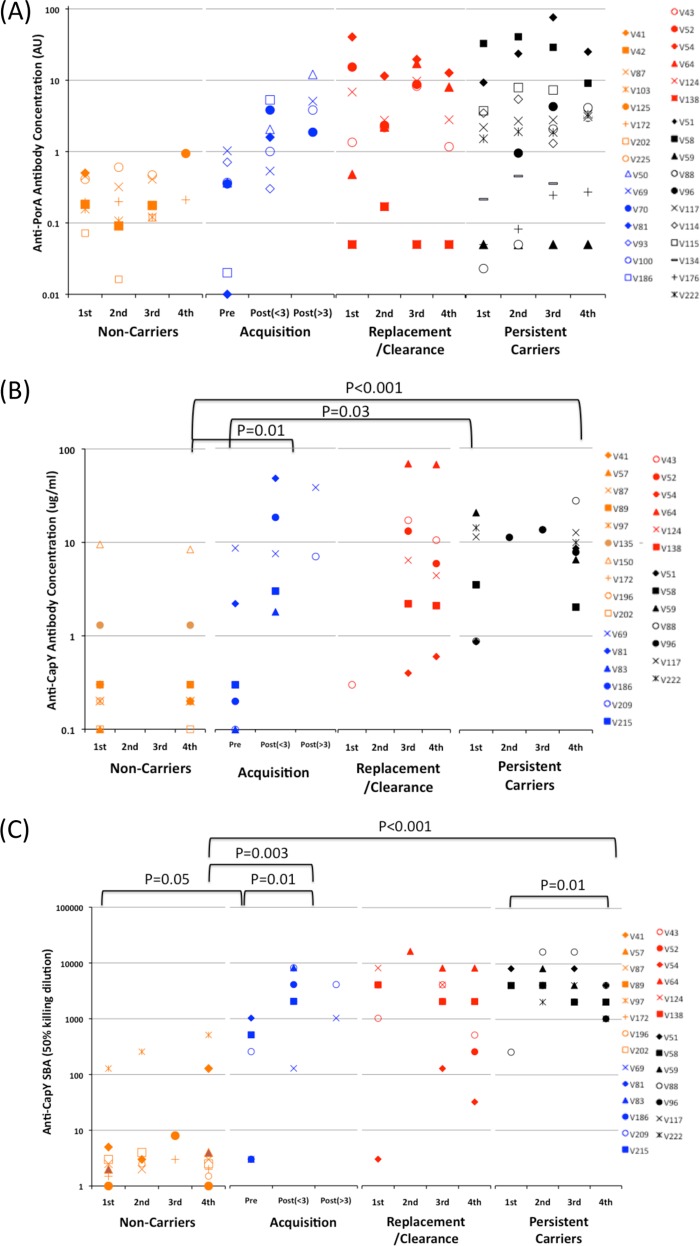
Antigen-specific immune responses in serum samples from meningococcal carriers. Volunteers were grouped into four categories according to the type of meningococcal carriage detected by nasopharyngeal swabbing as follows: persistent carriers, same strains detected at all time points; acquisition, progression from absence to presence of carriage with time points separated into precolonization (Pre) and less than or more than 3 months after colonization [i.e., Post(<3) and Post(>3), respectively]; replacement/clearance, initial strain either replaced by antigenically different strain or not detected in the 4th time point; and noncarriers, no meningococcal carriage detected at any time point. One to four sera were analyzed for each volunteer. (A) Anti-PorA IgG antibodies detected by a multiplex fluorescence-bead assay (expressed in arbitrary units [AU]). (B) Anti-CapY IgG antibodies detected by ELISA against purified capsular antigen. (C) Serum bactericidal activity against an ST-11 meningococcal strain expressing a serogroup Y capsular antigen. Values represent the dilution providing 50% killing.

References

    1. Moxon ER, Bayliss CD, Hood DW. 2007. Bacterial contingency loci: the role of simple sequence DNA repeats in bacterial adaptation. Annu. Rev. Genet. 40:307–333. 10.1146/annurev.genet.40.110405.090442 - DOI - PubMed
    1. van der Woude MW, Baumler AJ. 2004. Phase and antigenic variation in bacteria. Clin. Microbiol. Rev. 17:581–611. 10.1128/CMR.17.3.581-611.2004 - DOI - PMC - PubMed
    1. Bayliss CD. 2009. Determinants of phase variation rate and the fitness implications of differing rates for bacterial pathogens and commensals. FEMS Microbiol. Rev. 33:504–520. 10.1111/j.1574-6976.2009.00162.x - DOI - PubMed
    1. Deitsch KW, Lukehart SA, Stringer JR. 2009. Common strategies for antigenic variation by bacterial, fungal and protozoan pathogens. Nat. Rev. Microbiol. 7:493–503. 10.1038/nrmicro2145 - DOI - PMC - PubMed
    1. Moxon ER, Rainey PB, Nowak MA, Lenski R. 1994. Adaptive evolution of highly mutable loci in pathogenic bacteria. Curr. Biol. 4:24–33. 10.1016/S0960-9822(00)00005-1 - DOI - PubMed

Publication types

MeSH terms

LinkOut - more resources